travel-guide
Hallstatt from Salzburg: the perfect day trip (2026 guide)
How to actually enjoy Hallstatt from Salzburg — the drive, the best arrival time, the village parking ban and an honest hour-by-hour plan from chauffeurs who drive the route every day.
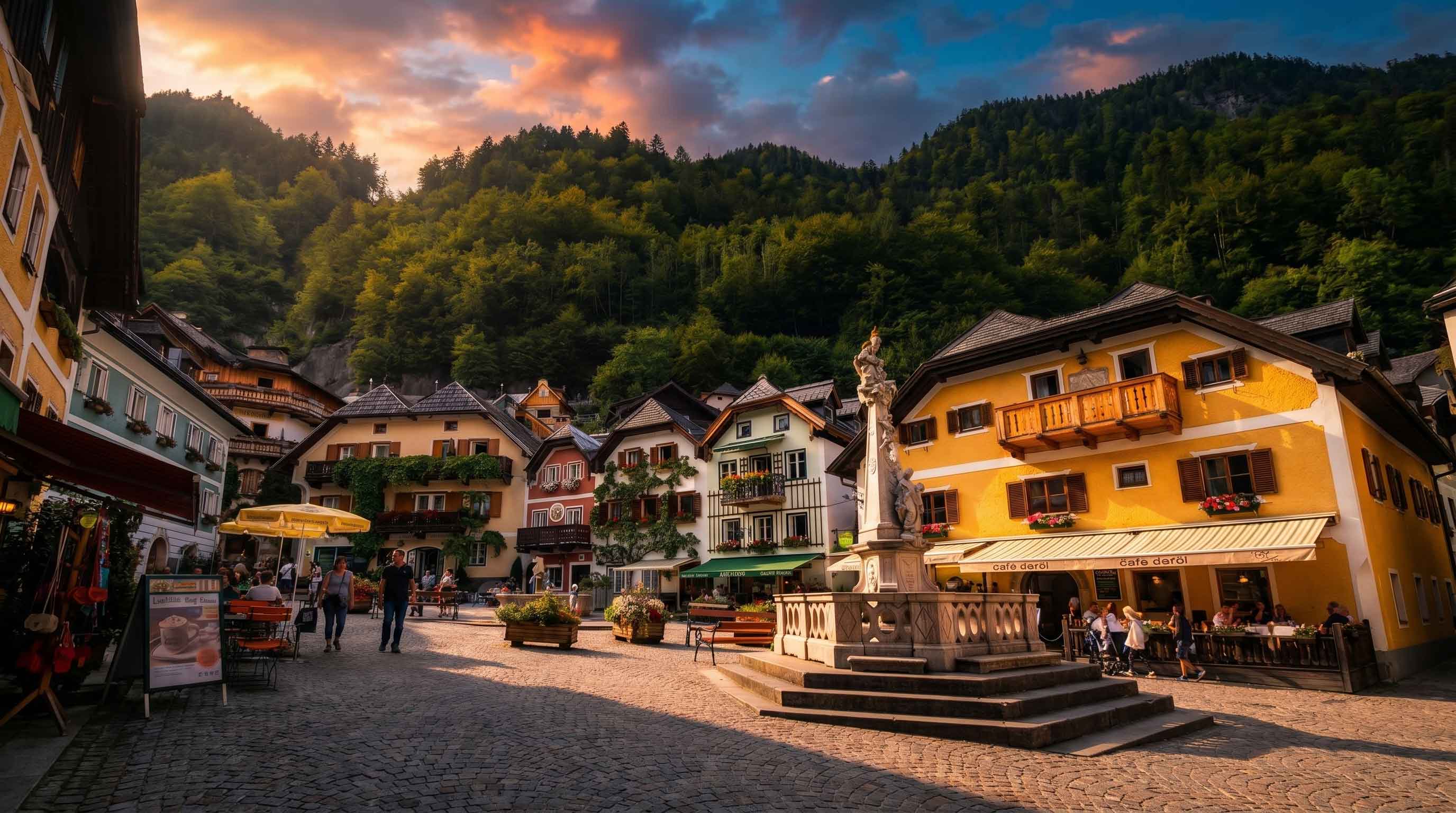
Hallstatt is one of the most photographed places on earth and it sits just 75 kilometres from Salzburg. Yet most visitors make the same mistake: they arrive at the wrong time, land in the middle of the tour-bus crush, and see the "quietest village in the Salzkammergut" mostly as crowded lanes. This guide shows you how to do it better, written from the experience of chauffeurs who drive this route all year round, sometimes three times a week in summer.
At a glance
- Distance: approx. 75 km from Salzburg, pure drive time 1 h 15 to 1 h 25
- Best arrival: before 9:30 am or after 4:00 pm, the hours between are busiest
- Important: the centre is car-free, with a strict parking ban
- Time budget: 3 to 4 hours for village and Skywalk, 5 to 6 hours with the salt mine
- Season: beautiful year-round, quiet and snowy in winter, start early in summer
How do you get from Salzburg to Hallstatt?
There are three realistic ways, and they differ mostly in time and stress.
By train and ferry: scenic but fiddly. You take the train via Attnang-Puchheim or Bad Ischl to Hallstatt station, which lies on the opposite shore, and a small ferry then carries you across the lake into the village. With connections this takes two to two and a half hours each way, and the last evening ferry is tight. Depending on the connection and how far ahead you book, expect roughly 20 to 30 euros per person each way plus around 4 to 6 euros for the ferry. Honestly: if you travel alone, have time to spare and see the journey as part of the experience, this is a fine choice. For families, for guests on a tight schedule, or for anyone with a concert in Salzburg that evening, it gets uncomfortable fast.
By rental car: flexible, but here lies the trap. You cannot park in the centre, and the official car parks (P1 and P2 at the edge of the village, plus P4 and P5 towards Lahn) are full by late morning in summer. Arrive at 11 am and you may spend 40 minutes hunting for a space. Parking usually costs around 8 to 12 euros for the day. On top of that, a car brought in from Germany needs a valid motorway vignette (a day vignette currently around 9 euros, the 10-day version roughly 12 to 13 euros). The prettiest road, the B158 via Fuschl and St. Gilgen, is vignette-free but sluggish from late morning in summer.
By private chauffeur: you're collected at your Salzburg accommodation, driven straight to the village entrance with no changes, step out, and the parking problem isn't yours. That's exactly what our private Hallstatt tour from Salzburg is built for: you set the pace and duration, the car waits. Unlike a metered street taxi, which keeps counting while you explore, the day is agreed in advance and the same driver stays with you throughout.
The three options side by side
| Criterion | Train and ferry | Rental car | Private chauffeur |
|---|---|---|---|
| Travel time each way | 2 to 2.5 hours | 1 h 20 plus parking hunt | 1 h 20, door to door |
| Departure from your hotel | no, station first | yes, if the car is ready | yes |
| Parking | not an issue | the critical point, approx. 8 to 12 euros per day | not an issue |
| Stops along the way | barely possible | yes | yes, spontaneously |
| With children and luggage | tiring | workable | easy, child seats pre-ordered |
| In snow and ice | reliable | winter tyres required, practice needed | driver does it weekly |
| Best for | solo travellers, budget, rail fans | long stays, low season | families, couples, tight schedules |
The route in detail: which road, and when
There are two main variants, and we choose between them by weekday and hour.
The scenic B158: Salzburg Süd, then Hof bei Salzburg, Fuschl am See, St. Gilgen, Bad Ischl and onwards along the Hallstätter See. This is clearly the more beautiful road, with several natural photo stops, and takes around 1 hour 20 with a clear run. Its weakness: in high season it backs up between St. Gilgen and Strobl, and driving through Bad Ischl between 11 am and 3 pm can cost ten to twenty minutes.
The motorway variant: A1 to Regau or Steyrermühl, then via Gmunden and the Traunsee down to Bad Goisern. This is often faster during the morning coach rush but far less idyllic. We usually save it for the return leg, when guests are tired and the day has already delivered.
In practice: out along the lakes, back on the motorway, or the other way round. That way you see two faces of the Salzkammergut in one day instead of the same road twice.
The best time of day and why it decides everything
Hallstatt has around 800 residents and welcomes over 10,000 visitors on peak days. The difference between 8:30 am and 12:30 pm is not gradual, it's dramatic. Coach groups from Salzburg, Vienna and the bus tours arrive in a tight band between 10:30 am and 3:00 pm.
Our practical advice: leave early. Start in Salzburg at 8:00 am and you're standing in a nearly empty village by 9:15 am, with the classic postcard view from the northern viewpoint to yourself, and by midday you're up at the Skywalk or in the mine, exactly when the crowds below begin.
The weekday matters too. Saturday is usually the calmest summer day in Hallstatt, because many coach holidays begin or end that day. Monday and Tuesday tend to be the fullest. Sundays bring extra day-trippers from Upper Austria and Bavaria in their own cars, which strains the car parks more than the lanes. If you can pick freely, take a Saturday in May, June or September and leave at 7:45 am.
What to see in Hallstatt
The market square and the lanes
The historic core can be walked in a good hour. From the market square with its pastel townhouses, narrow stairways climb to the Protestant and Catholic parish churches. The bone house (Karner) beside the Catholic church, with its painted skulls, is one of the most unusual sights in the Alps, small but unforgettable. Entry is only a few euros, typically around 2 to 3, and cash only.
Salzwelten Hallstatt and the Skywalk
A funicular takes you up to the "World Heritage View" Skywalk, floating freely above the village, the finest panorama over lake and rooftops. Right there sits the oldest salt mine in the world, worked for over 7,000 years. The tour with mine train and miners' slides lasts around 90 minutes and is ideal even in rain, because it's underground. Combined funicular and mine tickets usually fall in the range of about 40 to 46 euros for adults, with family tickets much cheaper per head. The funicular alone is around 20 euros. Book online in high season, or you'll queue at the bottom while your window shrinks.
A boat trip on Lake Hallstatt
With time to spare, hire a classic electric boat or take the scheduled vessel. From the water you see why this place became so famous: the houses clinging to the steep slope between mountain and lake. An electric boat for an hour runs roughly 25 to 35 euros depending on the operator, and no licence is needed.
The Obertraun extension
Ten driving minutes further along the southern shore lies Obertraun with the Dachstein Krippenstein cable car, giving access to the Giant Ice Cave, the Mammoth Cave and the 5fingers viewing platform. This is the best add-on for anyone who has seen Hallstatt before or prefers mountains to villages. Allow three extra hours and expect distinctly cooler weather up top, often ten degrees below lake level.
Hour-by-hour: a perfect day
| Time | Programme |
|---|---|
| 08:00 | Pickup in Salzburg, drive through the Salzkammergut |
| 08:40 | Short photo stop at Wolfgangsee / Fuschl |
| 09:20 | Arrive Hallstatt, market square and lanes in the empty village |
| 10:30 | Funicular up, Skywalk and salt-mine tour |
| 12:30 | Lunch with lake views (local whitefish or char) |
| 14:00 | Boat trip or lakeside stroll |
| 15:00 | Optional: on to Obertraun (Dachstein Ice Cave, 5fingers) |
| 16:30 | Return to Salzburg |
Hallstatt through the year
Spring (April to June): our favourite window. The lake is still cold and deep green, the slopes are fresh, and the coaches have not arrived in full force. In early May there can still be snow on the Krippenstein while it is 20 degrees at lake level. Pack in layers.
Summer (July and August): the most demanding time. Without an early start the day turns heavy. The compensation is long evenings: from about 5 pm the village noticeably empties. If you are flexible, invert the plan, leave at 2 pm, have dinner in Hallstatt and drive home in golden light.
Autumn (September and October): in our experience the best overall package. Calmer lanes, clear air, morning mist over the lake that lifts around ten. For photographers October is hard to beat.
Winter (November to March): silent, snowy, at times almost empty. Note that some businesses and parts of the salt mine close for stretches of winter, and the funicular has maintenance periods. The eastern shore road is cleared but narrow. Winter visitors often combine the day with time in the mountains; our ski transfers serve the same region.
What typically goes wrong
- Leaving too late. The most common error. A 10 am departure means arriving in the densest window.
- Not pre-booking mine tickets. In high season the morning slots sell out and the whole day slides.
- Misjudging the size. Hallstatt is tiny. Eight hours here without an Obertraun or St. Wolfgang extension will feel long.
- Satnav routing into the centre. Self-drivers regularly end up at the tunnel barrier and have to turn around. Set the destination to the car park, never the market square.
- A commitment the same evening. With a 7 pm Festspiele performance you should leave Hallstatt by 4:15 pm at the latest. In those cases we deliberately plan the return via the motorway.
- A flight the same day. Do not pair Hallstatt with an afternoon departure. For the airport leg our airport transfer service is the cleaner solution.
Eating, photographing, and being a good guest
For lunch we recommend fish from the lake, whitefish or char, grilled or smoked. Reserve ahead at the restaurants with lakeside terraces, especially between noon and 2 pm. If you prefer something simpler, buy a fish roll at the shore and sit on a bench, which is often the nicer version anyway.
The famous view looks south from the northern end of the village towards the church tower. Between 8:30 and 9:30 am you will have it almost to yourself. Remember that people live behind nearly every facade. Hallstatt has asked for consideration for good reason, and drone flights over the village are heavily restricted. A quiet visitor is the better guest here.
Practical notes
- Footwear: sturdy shoes, the lanes are steep and slippery when wet.
- Mine: a constant 8 degrees underground, so bring a jacket even in high summer.
- Children: the mine admits children from roughly age four and is often the highlight of their trip. For the drive we supply appropriate seats through our child seat service, please state ages when booking.
- Accessibility: the lakeside path is manageable with a wheelchair, the upper lanes and the mine are not.
- Cash: small stalls and the bone house often take cash only.
- Drones and "selfie etiquette": Hallstatt explicitly asks for respect, it's a lived-in village, not an open-air museum.
Hallstatt rewards everyone who arrives early and takes their time. With the right planning and no parking stress, Austria's most famous village becomes not a mass destination but exactly the quiet, almost unreal place the pictures were once made for. If you want the day entirely worry-free, we handle the drive, the timing and the waiting; you simply enjoy. Take a look at our private Hallstatt tour and our private chauffeur service, or calculate your fixed price directly. Any further questions are welcome via our contact form.
Stefan Reiter — VPC Premium Transfer & Tours, Salzburg. Written first-hand: we drive these routes every day.
Frequently asked questions
How long does the drive from Salzburg to Hallstatt take?+
Pure driving time is around 1 hour 15 to 1 hour 25 for roughly 75 kilometres. On the scenic B158 through Fuschl, St. Gilgen and Bad Ischl, high-season traffic between 11 am and 3 pm can add ten to twenty minutes. If you want photo stops at the Wolfgangsee, allow about 1 hour 45 in total for the outbound leg.
Can you park in Hallstatt?+
Not in the centre. Hallstatt is car-free with a strict parking ban, and satnavs regularly route self-drivers straight to the barrier. Use the official car parks P1 to P5 at the edge of the village, typically around 8 to 12 euros for the day. In summer they fill by late morning, and the hunt can then cost 40 minutes.
When is Hallstatt least crowded?+
Before 9:30 am and after 4:00 pm. Coaches arrive in a tight band between 10:30 am and 3:00 pm. Saturday is usually the calmest summer day, Monday and Tuesday the fullest. Across the year, May, June, September and October are ideal, and in winter the village can be almost empty.
Is the Hallstatt salt mine worth it?+
Yes, especially with children and in rain, since the tour is underground. It lasts around 90 minutes, includes the mine train and miners' slides, and sits at the oldest salt mine in the world. Combined tickets with the funicular usually run about 40 to 46 euros for adults. It stays a constant 8 degrees below ground, so bring a jacket.
Is a day trip to Hallstatt enough?+
For most visitors, yes. The village, bone house and Skywalk fill three to four hours, five to six with the salt mine. If you want a full day, add the Obertraun extension with the Dachstein Ice Cave and 5fingers, or a boat trip, otherwise the time on site starts to drag.
Can you reach Hallstatt from Salzburg without a car?+
Yes, by train and ferry via Attnang-Puchheim or Bad Ischl. The station sits on the opposite shore and a small boat carries you into the village. Allow two to two and a half hours each way, roughly 20 to 30 euros for the ticket plus 4 to 6 euros for the ferry. Check the last evening ferry carefully before you plan the day.
Is Hallstatt worth visiting in winter?+
Very much so. Between November and March the village is at its most atmospheric and quietest, ideal for photographers. Note that some businesses and parts of the salt mine may be closed and the funicular has maintenance periods. The shore road is cleared but narrow, so self-drivers need winter tyres and real confidence in those conditions.
Your fixed price in 60 seconds — we handle the rest.
Private Mercedes chauffeur, flight tracking included, pay by cash or card.