travel-guide
Munich to Salzburg: transfer, drive time & day trip 2026
Munich airport or city centre to Salzburg — drive time, the low-emission zone, what separates a fixed-price transfer from the meter, and how the drive itself becomes a perfect day.
Munich and Salzburg are closer than many think — a good 140 kilometres, separated only by the Bavarian-Austrian border and one of the most scenic motorways in the Alps. Whether you land at Munich Airport (MUC) and want to continue straight to Salzburg, or you're planning a day trip from central Munich, this guide explains the options, the typical pitfalls, and how the transfer itself becomes part of the holiday.
At a glance
- Distance: MUC airport → Salzburg approx. 140 km, central Munich → Salzburg approx. 145 km
- Drive time: around 1 h 30 without traffic (A8 / A99 bypass)
- Border: internal EU border, usually no stop — still carry ID
- Vignette: required for Austria — included in our fixed price
- Low-emission zone: Munich has one; our vehicles meet the requirements
The route: the A8 across the Bavarian foothills
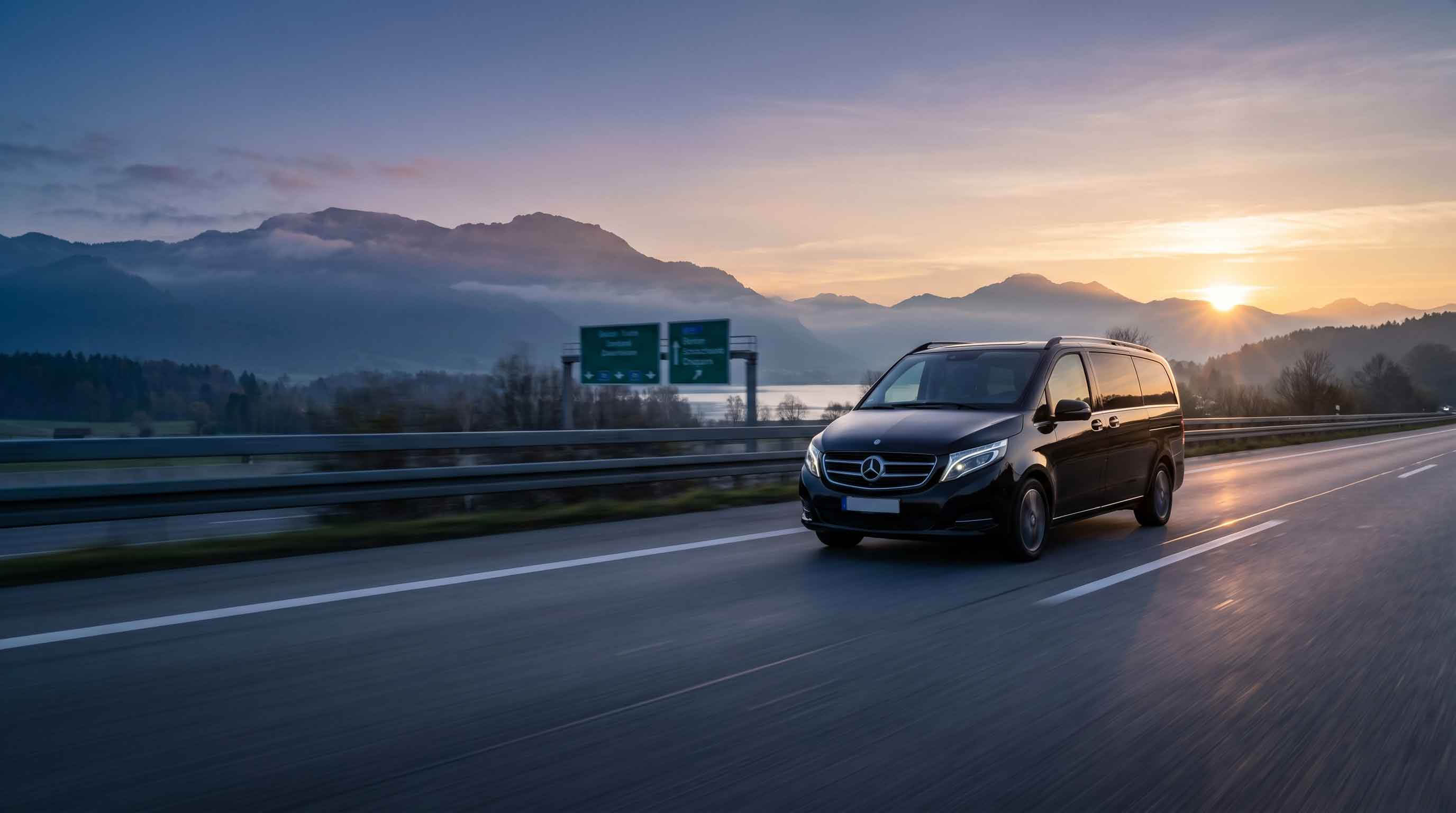
The classic route follows the A8 towards Salzburg, past the Chiemsee — the "Bavarian Sea". On a clear day the Alpine panorama opens up to your right, and by Bernau at the latest you understand why this corner is so loved. From the airport in northern Munich you first take the A99 bypass to avoid the city centre and its low-emission zone, then join the A8.
Pure drive time is around 90 minutes. Realistically, allow a buffer on Friday afternoons and at the start of school holidays — the A8 is one of Germany's most congestion-prone motorways. An experienced chauffeur knows the country back-routes when the motorway is at a standstill.
From the driver's seat the run splits into three sections. First the ring: out of the terminal area onto the A92, then the A99 curving east around Munich to the München-Süd interchange. Depending on the hour this costs 25 to 40 minutes and is the most variable leg, because commuter and freight traffic overlap. Second, the A8 from München-Ramersdorf to Bernau: four lanes, well built out, this is where you make time back. Third, Bernau to the Walserberg border crossing, narrower in places and home to the notorious Irschenberg concertina effect on the opposite carriageway — gradients, lorries overtaking lorries, stop-start traffic.
After Walserberg it is only a few minutes more. For old-town hotels we normally come off at Salzburg-Mitte; for addresses in Aigen, Parsch or towards Hallein, Salzburg-Süd is the better exit. If you arrive after 9 pm, know this: much of Salzburg's old town is pedestrianised. We drop at defined points and walk your luggage to the door when the last stretch cannot be driven.
Drive time by weekday and season
The "90 minutes" is an average, not a promise. What we actually see in operation:
| Window | Realistic drive time | Why |
|---|---|---|
| Tuesday to Thursday, 10 am to 3 pm | 1 h 25 to 1 h 40 | best window, few disruptions |
| Weekdays 6:30 to 9 am | 1 h 45 to 2 h 15 | commuter traffic around Munich |
| Friday 2 to 7 pm | 2 h to 2 h 45 | weekend exodus plus commuters |
| Saturday in winter (ski changeover) | 2 h to 3 h | arrival wave into Salzburgerland and Tyrol |
| Sunday evening in summer | 1 h 50 to 2 h 30 | return traffic towards Munich |
| Overnight 10 pm to 5 am | 1 h 20 to 1 h 30 | clear, occasional night roadworks |
Two seasonal patterns sit on top of that. Between late July and early September the Bavarian summer holidays overlap with the Salzburg Festival: inside the city the last mile slows down, because closures apply around the Festspielhaus and the old town. And in deep winter, specifically Saturdays between Christmas and the end of February, the stretch from Bernau to the border is the classic bottleneck. On those days we schedule pickups deliberately earlier rather than chasing time at the end.
Fixed price instead of the meter — why it matters here
On a cross-border route of 140 kilometres, an open meter is a financial risk. Traffic, diversions, airport waiting time — it all keeps ticking. A pre-agreed fixed price removes that uncertainty entirely: you know the final amount before you get in, including vignette, tolls and meet-and-greet at the terminal.
| Meter | VPC fixed price | |
|---|---|---|
| Price known in advance | no | yes |
| Traffic / waiting risk | passenger bears it | built into the price |
| Vignette & tolls | extra | included |
| Flight tracking | rarely | standard |
| Meet & greet at terminal | no | yes |
More detail on this connection is on our Munich Airport → Salzburg page, and for the reverse direction Salzburg → Munich Airport. For every route we cover, see the airport transfers overview.
The honest comparison of alternatives
We do not recommend a private chauffeur in every situation. If you travel alone with light luggage and a flexible schedule, the train is often calmer and cheaper. The Railjet from Munich Hauptbahnhof to Salzburg Hauptbahnhof takes roughly 1 h 30 to 1 h 50, runs about hourly, and a saver fare booked ahead sits in the low tens of euros. The catch: from MUC you first need around 45 minutes on the S-Bahn into the city, and changing trains with suitcases and children at rush hour is no fun.
A rental car makes sense if you want to stay mobile in Austria for several days. Then add the vignette (a 10-day vignette currently sits in the region of 12 to 14 euros, the annual one far more), old-town garage parking in Salzburg at roughly 3 to 5 euros an hour, and the return logistics. For a pure day trip, a rental car is rarely the most relaxing choice.
| Option | Strength | Weakness | Best for |
|---|---|---|---|
| Train (Railjet) | cheap, traffic-proof | transfer from the airport, fixed times | solo travellers, light bags |
| Coach | lowest cost | slow, few departures | flexible budget travel |
| Rental car | full freedom on the ground | vignette, parking, driving after a long flight | road trips |
| Private chauffeur | door to door, luggage, child seats, fixed calculation | not the cheapest option | families, groups, business, late arrivals |
And one more honest note: inside Salzburg you do not need a vehicle. You can walk the old town corner to corner in about 25 minutes. If your plan after arrival is museums, cathedral and fortress, your own feet beat any car.
Day trip from Munich to Salzburg
Salzburg is the perfect day trip from Munich: 90 minutes from the big city into a complete Baroque old town and UNESCO World Heritage site. A realistic plan:
- Morning: depart Munich around 8:30 am, arrive Salzburg 10:00 am.
- Old town: Getreidegasse with Mozart's birthplace, Residenzplatz, the cathedral.
- Fortress: take the funicular up to Hohensalzburg Fortress — the best view over the city and Alps.
- Lunch: dine at Stiftskeller St. Peter, one of the oldest restaurants in Europe.
- Afternoon: Mirabell Palace and the gardens from "The Sound of Music", then an easy drive back.
To make more of it, combine Salzburg with a detour into the Salzkammergut — for example to Hallstatt. For a full city guide, see our article 24 hours in Salzburg.
Budgeting for the day on the ground
So you can plan, here are typical third-party costs in Salzburg (2026, indicative): the funicular plus fortress admission runs about 14 to 18 euros per adult, Mozart's birthplace roughly 12 to 15 euros, with a combined birthplace-and-residence ticket slightly cheaper as a package. A 24-hour Salzburg Card sits around 30 to 34 euros depending on season and pays off from three attractions upward. Lunch in an old-town restaurant runs 20 to 35 euros per person.
Winter: ski transfer rather than city stroll
A large share of eastbound runs from Munich do not end in Salzburg but in the ski resorts beyond it. From MUC, Zell am See, Saalbach or Kitzbühel are another 60 to 90 minutes depending on destination. Three practical rules we have learned across seasons apply in winter. First: ski Saturdays are outlier days, and we always plan them with a generous buffer. Second: winter luggage is bulkier than guests state at booking — four people with ski bags and boots will defeat any saloon. Third: snow chain requirements can apply on resort access roads; our vehicles are equipped for that year-round.
If your destination lies beyond Salzburg, we plan the journey as one continuous run. Details on the ski transfers page.
Travelling with children
On a 140-kilometre run the child seat question is not a detail but a legal requirement — in Germany as in Austria, children under 150 centimetres and 14 years need an appropriate restraint. Rental desks and street taxis often improvise here. We ask for age and weight at booking and fit the right seats before pickup; more under child seat service. One thing that works well in practice: a short stop at the Chiemsee services, with a view over the water, roughly halfway.
Business travel: what actually makes the difference
For meetings in Salzburg the decisive number is not drive time but the reliability of arrival. On business runs we work backwards: target arrival minus drive time in the unfavourable scenario minus 15 minutes of reserve. If you must be seated in a meeting on Alpenstrasse at 10 am, you do not leave Schwabing at 8:15 on a weekday morning. For multi-day schedules, plant visits or roadshows, a private chauffeur on an hourly basis usually beats separate point-to-point rides. Tour operators and hotels work with us through our partnership programme.
Common pitfalls
- Munich low-emission zone: a green sticker is required in the centre. Rental and older vehicles can be affected — our fleet complies.
- Forgotten vignette: driving your own car into Austria requires a valid vignette from the border. Without one, fines are steep.
- Border checks: spot checks are possible at the border — keep your passport or ID handy.
- Luggage after a ski trip: for groups with ski or golf gear, a Mercedes V-Class van beats a saloon.
- Terminal confusion: MUC has Terminal 1 and Terminal 2 plus the satellite. Give us the airline, not just the time, and the driver waits at the right exit.
- Too little return buffer: for departures from MUC we recommend leaving Salzburg three hours before take-off, three and a half in winter.
What actually goes wrong
Three patterns explain almost every problem we see on this route. First, delayed baggage: if a case does not arrive at MUC, filing the report easily takes 40 minutes. Message the driver rather than rushing — the run gets replanned, not cancelled. Second, missed connections that move the whole pickup: this is why our dispatch hangs on the flight number, not the time you typed at booking. Third, full closures of the A8, usually after accidents between Rosenheim and Bernau. Then it is the B15 and the country roads along the Chiemsee; that costs 20 to 40 minutes but still beats standing still.
Whether a connecting transfer after landing or a relaxed day trip, the Munich–Salzburg route is short enough for spontaneous plans and beautiful enough to enjoy. With a fixed-price chauffeur, the drive becomes the easiest part of your journey — calculate your price here in 60 seconds or reach us via contact.
Stefan Reiter — VPC Premium Transfer & Tours, Salzburg. Written first-hand: we drive these routes every day.
Frequently asked questions
How long does the drive from Munich to Salzburg take?+
Around 90 minutes with clear roads, measured from Munich Airport via the A99 and A8. Weekday mornings are closer to 1 h 45 to 2 h 15, Friday afternoons up to 2 h 45, and winter ski Saturdays as much as three hours. Overnight between 10 pm and 5 am the road is fastest. We always plan on the realistic figure, not the optimistic one.
Do I need a vignette to drive to Salzburg?+
Yes, as soon as you use Austrian motorways in your own or a rental car. A 10-day vignette currently costs roughly 12 to 14 euros and comes digitally or as a sticker. Enforcement is automated and fines are steep. On our transfers the vignette is already included in the fixed price, so it is not something you need to arrange.
Is the train from Munich to Salzburg better than a transfer?+
For solo travellers with light bags, often yes: the Railjet from Munich Hauptbahnhof takes about 1 h 30 to 1 h 50 and costs far less. From the airport, though, add a 45-minute S-Bahn ride plus a change. With family, ski luggage, after a long-haul flight or on a late arrival, a door-to-door transfer is clearly the calmer option.
Are there border checks between Germany and Austria?+
At the Walserberg crossing there are spot checks, usually without stopping through traffic. At certain times short queues can still build up. Carry your ID card or passport within easy reach, even inside the Schengen area. The same applies to children: each needs their own travel document, not an entry in a parent's passport.
Is a day trip from Munich to Salzburg worth it?+
Yes. Leaving around 8:30 am puts you in the old town by 10 and gives you six to seven hours on the ground. That covers Getreidegasse, the cathedral, Hohensalzburg Fortress, lunch and the Mirabell gardens. Budget roughly 30 to 60 euros per person in third-party costs for admissions and food. If you want to add Hallstatt, stretch the trip over two days.
How early should I leave Salzburg for a flight from Munich?+
We recommend leaving Salzburg three hours before departure, three and a half in winter or on Fridays. That allows roughly 90 to 120 minutes of driving plus comfortable time for check-in and security at MUC. For intercontinental flights with early gate closure we add another 30 minutes on top.
Are child seats mandatory on this route?+
Yes. In both Germany and Austria, children under 150 centimetres and 14 years require a suitable restraint. Since the journey crosses both countries, plan for the stricter reading. Give us age and weight at booking and the infant carrier, child seat or booster is fitted before pickup.
Your fixed price in 60 seconds — we handle the rest.
Private Mercedes chauffeur, flight tracking included, pay by cash or card.