Salzburg to Vienna: three hours of motorway, or a day on the Danube
We can take you straight along the A1 to the Ringstrasse. Or we leave the motorway at Melk, follow the Danube through the Wachau, stop at the abbey, in Dürnstein and at a wine tavern, and hand you over at your Vienna hotel in the evening. One flat rate, one chauffeur, your pace.
- Direct approx. 3 h or Wachau route 4.5 to 5 h
- UNESCO World Heritage Wachau
- Flat rate, no meter running
- Mercedes E-Class or V-Class
Six stops between the Salzach and the Ring
 01
01Salzburg: pick-up at your hotel or front door
Usual departure 8:30 to 9:30
We collect you wherever you are staying: a hotel in the Old Town, a villa in Aigen or a chalet on the edge of the city. Vehicle access around Getreidegasse and Residenzplatz is restricted, so for Old Town hotels we agree a meeting point just outside the pedestrian zone, such as Hanuschplatz or the Staatsbrücke, and carry the luggage the last few metres.
For the Wachau version we recommend leaving between half past eight and half past nine. By then Salzburg's morning rush on the Innsbrucker Bundesstraße has cleared, we reach Melk ahead of the midday coaches and arrive in Vienna in the early evening, before the Ring turns into rush hour. If you only want the direct run, any time works: we drive at six in the morning, or at midnight after a concert.
 02
02Mondsee: the first lake view on the A1
approx. 25 minutes from Salzburg
Shortly after joining at Salzburg-Nord the A1 climbs through the Flachgau, and beyond Thalgau the Mondsee suddenly opens up with the Drachenwand cliffs and the Schafberg behind it. It is one of the finest motorway views in Austria, and most travellers see it for about two seconds.
If you like, we leave at the Mondsee exit for a short break. Ten minutes on the lakeshore, or a look inside the basilica of St. Michael, known from a famous wedding scene on film, costs almost nothing in time and turns leaving Salzburg into a proper moment. In winter this is often where the first snow of the route lies; from November we run on winter tyres and keep an eye on the stretches around Mondsee and Straßwalchen, which are prone to morning ice.
 03
03Linz: optional stop on the Danube
approx. 1 h 15 from Salzburg, stop 30 to 60 minutes
Linz sits almost exactly halfway and is often underrated. Via the A7 we are fifteen minutes from the West Autobahn to the Danube riverfront, between the Lentos art museum and the Ars Electronica Center on the far bank. A coffee on the Hauptplatz and a slice of Linzer torte is the classic break.
To be honest: if you are doing the Wachau, you should usually skip Linz. Both together make for a long day, and city traffic on the A7 backs up on weekdays between seven and nine and again from half past three. Linz earns its place mainly on the direct run, when you want to stretch your legs or fit in a business meeting. For Linz on its own we have a separate page for that short business hop.
 04
04Melk Abbey: the gateway to the Wachau
approx. 2 h from Salzburg, visit 1.5 to 2 h
We leave the A1 at the Melk exit, and from the slip road you can already see the Benedictine abbey standing yellow on its rock above the Danube. We drive you up to the visitor entrance at the abbey car park, so there is no uphill walk from the lower town, and wait there with the car.
The Marble Hall, the library and the abbey church are baroque Austria at its purest, and the view from the terrace across the Danube valley is the first real Wachau moment. Allow about an hour and a half, closer to two with a guided tour and the gardens. In summer, coach groups and river-cruise passengers arrive around midday; before eleven it is noticeably quieter. Tour times and winter opening change, so we check them before your trip and time the Salzburg departure accordingly.
 05
05Dürnstein and the Wachau: apricots, wine and the Danube
approx. 1.5 to 2.5 h with stops
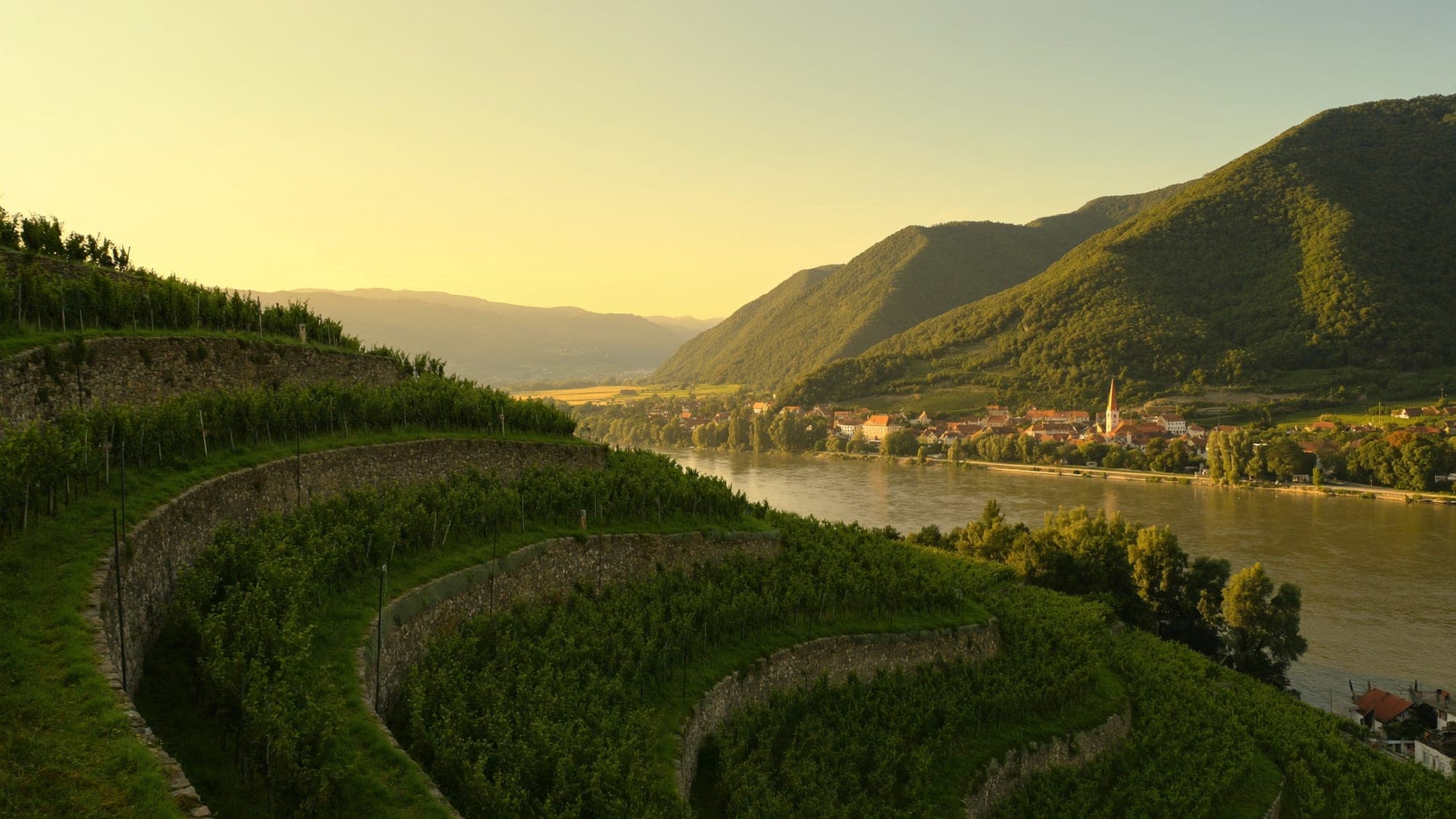
Beyond Melk we cross the Danube bridge and follow the B3 downstream along the north bank: Aggsbach, Spitz, Wösendorf, Weißenkirchen. On one side, vineyard terraces held up by dry-stone walls; on the other, the river; in between, villages of church spires and apricot orchards. These 36 kilometres are why the Wachau has been UNESCO World Heritage since 2000, and with a chauffeur you can simply look out of the window instead of watching bends and cyclists.
In Dürnstein we stop at the edge of the village, because the centre is car-free. On foot you are a few minutes from the blue and white tower of the abbey church, probably the most photographed sight on the Danube. If you feel energetic, climb to the castle ruin where, as the story goes, Richard the Lionheart was held captive; allow a good hour up and back, and sturdy shoes.
Along the way we stop wherever it suits you: at a Heuriger wine tavern in Weißenkirchen, at an apricot stand in July, at the cable ferry between Spitz and Arnsdorf for a look at the far bank. At Krems we leave the valley on the S5 towards Vienna. If you take a glass of Grüner Veltliner at the tavern, that is exactly what a chauffeur is for.
 06
06Vienna: arrival on the Ringstrasse
approx. 1 h from Krems
From Krems the S5 takes us to Stockerau and on along the A22 beside the Danube into the city. This northern approach is usually calmer than the western entry through the Wien valley, where commuters from the west queue. On the direct route we come in on the A1 via the Auhof junction instead, and choose live between the western approach and the Gürtel depending on traffic.
Most of our guests stay on or close to the Ringstrasse, around the State Opera, the Stadtpark and Schwarzenbergplatz. The Ring runs one way, clockwise, and some hotels have their entrance in a side street; we know the approaches and bring you right to the door, where the porter takes over the luggage. If you are staying further out, in a private apartment or the embassy district, of course we drive you there too.
The Wachau between Melk and Krems
The detour leaves the A1 at Melk and follows the Danube via Spitz and Dürnstein to Krems. From there it is roughly 80 kilometres to Vienna's Ringstrasse.
Towards Vienna we drive the north bank on the B3, or the quieter south bank on request.
Direct, Danube or train?
| Direct via the A1 | Wachau route with chauffeur | Railjet Salzburg–Vienna | |
|---|---|---|---|
| Travel time | approx. 3 h door to door | 4.5 to 5 h driving, 7 to 8 h with visits | approx. 2.5 h station to station, plus getting to and from the train |
| What you see | Mondsee, Alpine foothills, Mostviertel | Melk Abbey, Dürnstein, vineyard terraces, riverbanks | Plenty of countryside, but no stops |
| Luggage | Up to 7 suitcases in the V-Class, door to door | Stays safely in the car while you sightsee | You carry it, then change to tram or car in Vienna |
| Flexibility | Departure at any time | Stop where you like, a glass at the tavern included | Fixed timetable, usually twice an hour |
| Best for | Appointments, families, lots of luggage, late arrivals | Couples and groups who want the travel day to count | Solo travellers with light bags staying near a station |
| Price | Flat rate in the booking calculator | Flat rate including waiting time, on request | ÖBB or Westbahn ticket |
When the train is the better choice
We say this openly because we drive this route every week: if you travel alone, carry a backpack or small case, and stay in Vienna close to the Hauptbahnhof or Westbahnhof, the Railjet is fast and inexpensive. It runs on a regular timetable, has Wi-Fi and a dining car, and its pure journey time is shorter than our direct route.
A chauffeur pays off as soon as one of three things applies. First, luggage and people. A family with a pushchair, four suitcases and two child seats loses the train's time advantage on the platform. Second, door to door. From a chalet on the Gaisberg to a hotel on the Ring there is no train, only two car journeys with a platform in between. Third, and this is the heart of this page: the train passes the Wachau by. You glimpse Melk for a moment from the window, and Dürnstein not at all.
If you are torn between the options, write to us through the enquiry form. We will tell you honestly which one suits your trip, even if the answer is the railway.
The Wachau from June to September
In summer the Danube route is a celebration: long evenings, open wine taverns, apricots by the roadside. It is also the busy season, and we plan for it.
Apricot season in July
The Wachau apricot usually ripens from early to mid-July, depending on the year. Farmers then set up stands along the B3 between Spitz and Dürnstein selling fresh fruit, jam and schnapps. We stop wherever you like, and there is room in the boot for a crate.
Heurige and wineries
Wachau wine taverns are not open all year but in rotating serving periods. We know who is open in your week and build in a stop for Riesling, Grüner Veltliner and a platter of cold cuts. The driver does not drink; you can.
Riverside and ferries
In season, the cable ferries between Spitz and Arnsdorf or Weißenkirchen and St. Lorenz cross without an engine, carried by the current. If you like, you cross on foot and we collect you on the other bank. The riverside meadows near Weißenkirchen make a good short break by the water.
What goes wrong in summer
Saturdays in July and August bring holiday traffic on the A1 and cyclists on the B3. River-cruise ships moor at Melk and Dürnstein, and midday gets crowded. Our answer: an early start, Melk before eleven, Dürnstein in the late afternoon once the cruise passengers are back on board.
A quiet Wachau, a festive Vienna
From November to March the Danube is a different river. The vineyards are bare, the villages empty, and morning fog often hangs over the water before lifting around midday and laying pale light across the terraces. Many wine taverns and apricot stands are closed, and Melk Abbey is usually open by guided tour only in winter. In return you have Dürnstein almost to yourself, and the view from the abbey tower without coach groups is a gift. In winter we usually shorten the Wachau route to Melk, a drive along the bank and a coffee in Dürnstein, so that you reach Vienna before darkness falls at around half past four.
Vienna itself is at its peak in winter. From mid-November the Christmas markets open on Rathausplatz, at Spittelberg, in front of Schönbrunn Palace and on Karlsplatz, and many guests arrive with us in the afternoon and walk straight from the hotel to the mulled punch. Around New Year's Eve and the Vienna Philharmonic's New Year's Concert on 1 January the Ring hotels are full and parts of the centre are closed off; we know the diversions and bring you as close to the entrance as possible.
January and February belong to the ball season, dozens of balls from the Hofburg to the Opera Ball on the Thursday before Ash Wednesday. Guests travelling from Salzburg to a ball bring gown and tailcoat in a garment bag; in the V-Class both hang uncreased. On request we collect you from the ball after midnight and drive you back to Salzburg.
On the road: the A1 is well cleared in winter, but between Mondsee and the Hausruck and around Amstetten fresh snow brings slushy lanes and lorry queues. We run on winter tyres, build in a buffer and call you the evening before if the forecast suggests leaving earlier.
Direct or via the Danube? Your price in a minute
Book the direct transfer online at a flat rate. For the Wachau route with waiting time, send us your preferred stops and we reply with a binding quote.
What this route has taught us
VPC Chauffeur-Team
Chauffeurs who drive Salzburg–Vienna every week
The A1 between Salzburg and Vienna is one of Austria's busiest motorways, and it has its quirks. Roadworks with narrowed lanes appear almost every year somewhere between Sattledt and St. Pölten; we check the reports the day before and adjust the departure. On Friday afternoons the Vienna-bound side is usually clear because commuters are heading out of the city; on Sunday evenings, by contrast, traffic queues into town, often from the Steinhäusl junction to Auhof.
In the Wachau itself the B3 is narrow, and in spring and summer we share it with many cyclists on the Danube cycle path. That is no problem, but it takes time; we would rather allow an hour of pure driving for the 36 kilometres than forty minutes. When the Danube floods, which can happen after heavy rain or the snowmelt, riverside roads are occasionally closed, and we switch to the south bank or the hills above.
Our most important tip: do not try to do too much. Melk, Dürnstein and a wine tavern make a wonderful day. Add Linz, Göttweig Abbey and a stroll through Krems and you end up sitting in the car and arriving in Vienna tired. We would rather plan three good stops than six rushed ones.
Four steps from enquiry to the Ring
- 01
Choose route and stops
Tell us whether you want the direct run or the Wachau, and what matters to you: the abbey, wine, a walk, photographs. We suggest a realistic order with timings.
- 02
Pick the vehicle
The E-Class for up to three guests with normal luggage; the V-Class for families, groups of up to seven and plenty of luggage. Child seats are provided on request.
- 03
Confirm the flat rate
You receive a binding flat rate covering waiting time at the stops, motorway vignette and driver expenses. No surprises when you step out, even if you stay longer in Melk than planned.
- 04
On the day
Your chauffeur calls the evening before, collects you on time and adapts the day to weather, traffic and your mood as you go. In Vienna the journey ends at your door.
Salzburg to Vienna with a chauffeur
Can't find your answer? Message us on WhatsApp – we typically reply within minutes.
WhatsAppHow long is the drive from Salzburg to Vienna?+
Direct via the A1 about three hours for roughly 300 kilometres, up to three and a half with Sunday-evening queues or roadworks. Via the Wachau it is 4.5 to 5 hours of driving; with visits to Melk, Dürnstein and a wine-tavern stop, allow seven to eight hours.
Can I stop at Melk and Dürnstein on the way to Vienna?+
Yes, that is exactly what the Wachau route is for. We wait with the car while you visit the abbey or stroll through Dürnstein, and your luggage stays safely inside. Waiting time is included in the flat rate we agree with you in advance.
Is the train from Salzburg to Vienna faster?+
Station to station, yes: the Railjet takes about two and a half hours. Door to door the gap often closes once you add getting to the station, handling luggage and onward travel in Vienna. You will not see the Wachau from the train. Alone and travelling light, the train is a good choice.
When is the best time to visit the Wachau?+
Spring for the apricot blossom, usually late March to April, July for the apricot harvest, and September to October for the grape harvest are the loveliest times. In winter the valley is quiet and misty and many taverns close, but there are no crowds. We adapt the route to the season.
Which vehicle suits a family with lots of luggage?+
The Mercedes V-Class seats up to seven with plenty of room for suitcases, pushchairs and ski bags. We bring child seats in the right size on request. For up to three guests the E-Class is the quieter saloon.
How much is a private transfer from Salzburg to Vienna?+
Our booking calculator gives the direct transfer as a flat rate per vehicle, not per person. For the Wachau route we send a binding quote covering the detour and waiting time. Tolls and vignette are included either way.
Do you also drive to Vienna Airport?+
Yes, we have a dedicated page for the Salzburg to Vienna Airport transfer with flight monitoring. This page covers the journey into central Vienna and to the Ringstrasse hotels.
Can the chauffeur take us to the Opera Ball or the New Year's Concert?+
Yes. We drive you to the event, wait if you wish, or collect you at an agreed time, including after midnight and back to Salzburg. Closures apply in the centre on such evenings, so we recommend booking early.
Related journeys to and from Salzburg
Vienna → Salzburg
The return west along the A1, arriving past the Salzkammergut lakes.
→Salzburg → Budapest
The long Danube run, continuing east to the Hungarian capital.
→Salzburg → Linz
The short business hop to the Danube for meetings in Upper Austria.
→Vienna Airport from Salzburg
Straight to the Schwechat terminal with flight monitoring and buffer time.
→Our fleet
E-Class and V-Class in detail: space, luggage, equipment.
→Your Danube day starts in Salzburg
Tell us your date, party size and preferred stops. We plan the route and give you a flat rate.