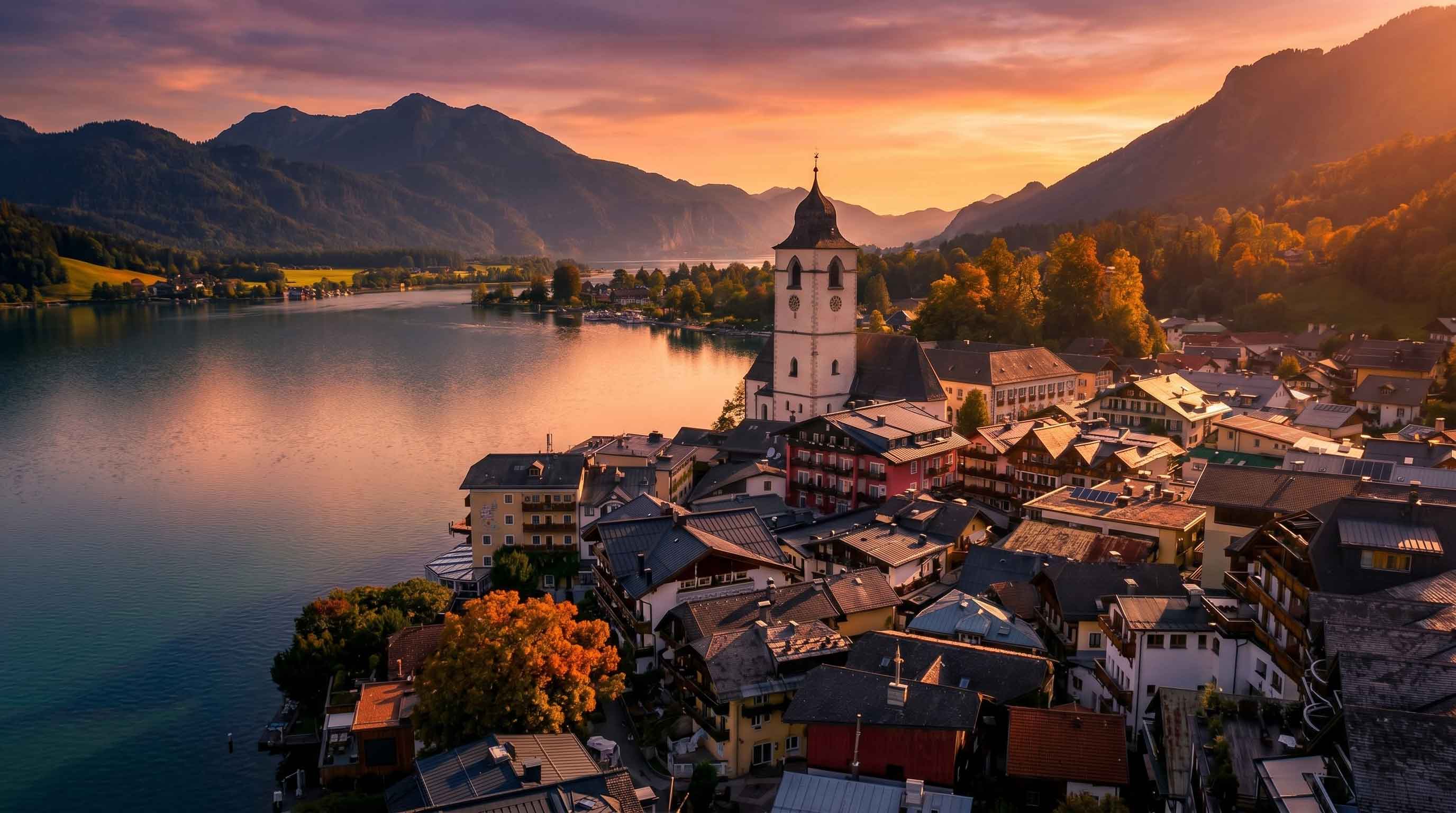
travel-guide
Hallstatt and Wolfgangsee: The Perfect Day Trip from Salzburg
Both lakes in one day: the loop via St. Gilgen, Strobl and St. Wolfgang to Hallstatt, with the Schafbergbahn, an honest hour-by-hour time budget, and which direction to drive depending on the season. Written by someone who drives these roads every week, including the bad days.
The question we hear most often on the phone in summer is this: can we do Hallstatt and Wolfgangsee in one day? The honest answer is yes, but only if you drive the loop in the right direction and decide in advance what you are willing to skip. Anyone who tries to combine both lakes with the Schafbergbahn, the salt mine, a boat crossing and a long lunch ends up with a fourteen-hour day and a bad mood. Anyone who picks one as the main event and treats the other as a beautiful side trip gets one of the best days in the Salzkammergut.
Why the loop works geographically
Salzburg sits at the north-western edge of the Salzkammergut. Wolfgangsee is roughly halfway along the route, Hallstatt is at the far end. So you are not driving the same road twice, you are driving a loop: out on the B158 via Fuschl to St. Gilgen, on to Strobl, then through Bad Ischl on the B145 to Bad Goisern, and from there along the B166 hugging the Hallstättersee. Coming back you normally retrace to Bad Ischl and then choose between Strobl again or the B154 via Mondsee and the A1 motorway.
Pure driving time for the whole day is around three to three and a half hours. That sounds harmless, and this is exactly where people go wrong: they treat those three hours as the plan. In reality it is driving time plus parking, plus the walk from the car park, plus queueing at the railway, plus the twenty minutes you spend stuck at the roundabout in Bad Ischl when school lets out.
The roads, described honestly
The B158 out of Salzburg towards Hof bei Salzburg is the prettiest exit from the city, but it is also a commuter road. Between 07:00 and 08:30 you crawl outbound past Hof, and inbound between 16:00 and 18:00. From Fuschl onwards it relaxes, the Fuschlsee opens up on your left, and the through-road in St. Gilgen is narrow.
One detail most guests never see on the map: there is no direct lakeside road for cars from St. Gilgen to St. Wolfgang. The Falkensteinwand drops vertically into the water and only the hiking path and the boats get through. To reach St. Wolfgang by car you go the long way around via Strobl, which is twenty to thirty minutes depending on traffic. This is precisely where combining car and boat pays off, more on that below.
The B145 through Bad Ischl is the main artery of the Salzkammergut. It is well built but Ischl itself is the pinch point where everything converges on busy days. From Bad Goisern the B166 narrows, runs along a steep slope through several tunnels, and cannot be bypassed if there is a rockfall or an accident. When the B166 closes, the only alternative is the long detour over the Pötschenhöhe and Bad Aussee, which costs an hour. It is rare, but it happens, which is why we never schedule Hallstatt as the last item before an evening flight.
A realistic time budget
Here is a day that actually works, leaving Salzburg at 08:00:
- 08:00 to 08:45 Salzburg to St. Gilgen on the B158, with a short photo stop at Fuschlsee.
- 08:45 to 09:15 St. Gilgen: lakefront promenade, Mozart monument, coffee. The village does not need more than that in the morning.
- 09:15 to 09:45 On via Strobl to St. Wolfgang.
- 09:45 to 12:15 Schafbergbahn up, 45 to 60 minutes on the summit, back down. The ride itself is about 35 minutes each way.
- 12:15 to 13:15 Lunch in St. Wolfgang, or on the way in Bad Ischl.
- 13:15 to 14:15 Drive to Hallstatt via Bad Ischl and Bad Goisern.
- 14:15 to 17:00 Hallstatt: village core, market square, the classic lake view, optionally the salt mine with its funicular and Skywalk.
- 17:00 to 18:15 Return to Salzburg.
That is a full but manageable day. If you also want the salt mine at an unhurried pace, drop the Schafberg. Two mountain railways in one day is athletic, and what you mostly end up seeing is queues.
Which order? It depends on the season
The standard internet answer is Hallstatt first, because that is where the crowds go. True for July and August, not true all year.
| Season | Recommended order | Why |
|---|---|---|
| July and August | Hallstatt first, Wolfgangsee in the afternoon | Coach groups reach Hallstatt from about 10:00. Arrive at 08:30 and you nearly have it to yourself. Wolfgangsee absorbs afternoon crowds far better. |
| May, June, September | Wolfgangsee first, Hallstatt in the afternoon | The Schafbergbahn has clearer visibility and shorter queues in the morning. Hallstatt noticeably empties after 16:00 when the day coaches leave. |
| October and November | Wolfgangsee first | Low cloud often sits on the Hallstättersee until around 11:00. Arrive too early and you photograph grey. On the Schafberg you are frequently above the inversion layer. |
| December to March | Hallstatt first, shorter loop | The Schafbergbahn does not run and it is dark by 16:00. Hallstatt in the winter light in the morning, then Advent markets or coffee in St. Wolfgang and Bad Ischl. |
The Schafbergbahn: when it is worth it and when it is not
The Schafbergbahn is a cogwheel railway from St. Wolfgang, normally running from early May into late October depending on snow and maintenance. A return ticket costs roughly 45 to 55 euro per adult depending on season, considerably less for children. Book online for a fixed departure slot, otherwise on good days you can lose up to two hours at the ticket window.
Now the honest part: if the summit is in cloud, the railway is money thrown away. We check the summit webcam in the morning before we set off and tell guests plainly when it is not worth it that day. The fallback is the Zwölferhorn cable car in St. Gilgen, which is lower and more often stays under the cloud base, or simply more time in Hallstatt.
Hallstatt: parking, access and what goes wrong
Hallstatt's centre is closed to through traffic during the day. You park in the designated areas, usually P1 in the Lahn district or P2 at the village entrance, and walk the last five to fifteen minutes along the lake. A day ticket runs roughly eight to fifteen euro depending on the car park and season. On peak days P1 and P2 are full by around 11:00, at which point you get pushed out towards Obertraun and the walk becomes long.
What goes wrong in practice: guests underestimate the gradient in the village and turn up in unsuitable shoes or towing wheeled suitcases. The path from the car park to the classic photo spot on the northern shore is not flat. Second, the village is small. Two hours covers the market square, the lake view and a coffee; you only need three to four hours if you add the salt mine or the bone house. Third, if you want the Dachstein ice caves or Krippenstein as well, that is a separate day. It cannot honestly be combined with Wolfgangsee in one.
When train, boat or walking is the better answer
We make our living driving people, and we still talk guests out of it regularly. Three examples:
- Hallstatt only, no time pressure, tight budget. The train from Salzburg Hauptbahnhof via Attnang-Puchheim to Hallstatt station, followed by the little ferry across the lake, is one of the loveliest approaches in Austria. It takes about two and a half hours each way and, booked as advance fares, costs roughly 20 to 35 euro per person for the day.
- Wolfgangsee only. Postbus 150 from Salzburg Mirabellplatz to St. Gilgen and Strobl is reliable, runs frequently and costs a few euro. If you only want an afternoon by the lake, you do not need a car.
- The St. Gilgen to St. Wolfgang leg. Here the boat clearly beats the car. We drop guests in St. Gilgen, they take the Wolfgangsee ferry across for roughly 10 to 16 euro, and we pick them up in St. Wolfgang. They see the Falkensteinwand from the water, we skip the village through-roads, and nobody loses time.
Where a private driver genuinely earns their place is the combination. Two lakes, a mountain railway, a boat and luggage in the back cannot be chained together cleanly by public transport in a single day. That is also the difference from a metered street taxi that drops you once and disappears: a driver who stays with you all day can move the meeting point when the railway stops running or the fog refuses to lift.
Practical notes from the driver's seat
If you drive yourself, you need the vignette for motorway sections, roughly 12 to 13 euro for the ten-day digital version. Strictly speaking the B158 and B145 loop does not require it, but the return via the A1 through Mondsee does. In winter, Austria's situational winter equipment rule applies from 1 November to 15 April, and the Pötschenhöhe is no place to be on summer tyres.
For families: this loop means around three hours seated in the car in total. A properly fitted child seat is the difference between a lovely day and a very long one, and we supply them through our child seat service. If you would rather have the loop as a guided outing with fixed timings, the details are on our Hallstatt tour from Salzburg page. And when the trip sits next to an arrival or departure day, we happily plan it together with your airport transfers so the luggage can simply stay in the vehicle all day.
One honest note about food: in Hallstatt, everywhere is full between 12:00 and 14:00. Eat in St. Wolfgang or Bad Ischl and have only a coffee in Hallstatt, and you save an hour of waiting and usually eat better.
If you are planning this loop, just tell us how many of you there are, the date you have in mind and whether the Schafberg should be part of it. We will tell you which order works best on your particular day and send you a no-obligation quote for the full day's chauffeur service. You can also read more on our private chauffeur page.
Stefan Reiter — VPC Premium Transfer & Tours, Salzburg. Written first-hand: we drive these routes every day.
Frequently asked questions
Can you really do Hallstatt and Wolfgangsee in one day?+
Yes, if you commit to one main attraction. Budget three to three and a half hours of pure driving, two to three hours in Hallstatt and two to two and a half hours at Wolfgangsee including the Schafbergbahn. If you also want the salt mine at an unhurried pace, drop the Schafberg. Both mountain railways in one day simply does not fit comfortably.
How long is the drive from Salzburg to Hallstatt?+
Direct via Bad Ischl on the B158 and B145 it is around 75 to 90 minutes in normal traffic. In July and August and at weekends, Bad Ischl plus the hunt for parking in Hallstatt can stretch that to two hours. If the B166 is closed, the detour over the Pötschenhöhe adds roughly another hour.
Is there a direct road from St. Gilgen to St. Wolfgang?+
No. The Falkensteinwand drops vertically into the Wolfgangsee, so cars must take the detour via Strobl, about twenty to thirty minutes. Only the hiking path and the passenger boats connect the two villages directly. That is exactly why the combination makes sense: take the boat across while the vehicle drives around and meets you in St. Wolfgang.
When does the Schafbergbahn run and is it worth it?+
The cogwheel railway from St. Wolfgang normally runs from early May into late October, depending on snow. A return ticket is roughly 45 to 55 euro per adult and you should book a time slot online. It is only worth it in clear conditions. If the summit is in cloud you will see nothing, and the Zwölferhorn or extra time in Hallstatt is the better call.
Can you drive into Hallstatt village and park there?+
During the day the village core is closed to through traffic. You park in the designated areas, usually P1 in the Lahn district or P2 at the village entrance, and walk five to fifteen minutes along the lake. A day ticket runs about eight to fifteen euro depending on the car park and season. On peak days they fill by around 11:00 and you get sent towards Obertraun.
Is a private driver worth it, or will train and bus do?+
For a single destination public transport is fine: train plus ferry to Hallstatt, or Postbus 150 to Wolfgangsee, are cheap and reliable. The moment you want to chain both lakes, a mountain railway and a boat into one day, or you are travelling with children and luggage, the timetable becomes the bottleneck. That is where a driver who stays with you all day earns their place.
Which order should you drive in autumn?+
In October and November, do Wolfgangsee first. Low cloud often sits on the Hallstättersee until around 11:00 and your photos come out grey. On the Schafberg you are frequently above the inversion in full sun on exactly those days. It usually breaks up around midday, and you reach Hallstatt just as the first day groups are heading home.
Your fixed price in 60 seconds — we handle the rest.
Private Mercedes chauffeur, flight tracking included, pay by cash or card.