travel-guide
Hallstatt in Summer: How to Plan Your Visit
Car parks full by 09:30, access restrictions in the old centre, queues at the Dachstein cable car: a Salzburg chauffeur explains the best arrival windows, realistic timings for the ice cave and swimming, and when the train is genuinely the better call.
Hallstatt in summer has not been a hidden gem for a very long time. We drive the route from Salzburg several times a week, and in July and August almost daily. What we have learned in that time comes down to one sentence: the quality of a Hallstatt day is decided less by what you see and more by the hour you arrive and how you get out again. This article is an attempt to take both of those problems off your plate.
Why summer in Hallstatt behaves differently from the rest of the year
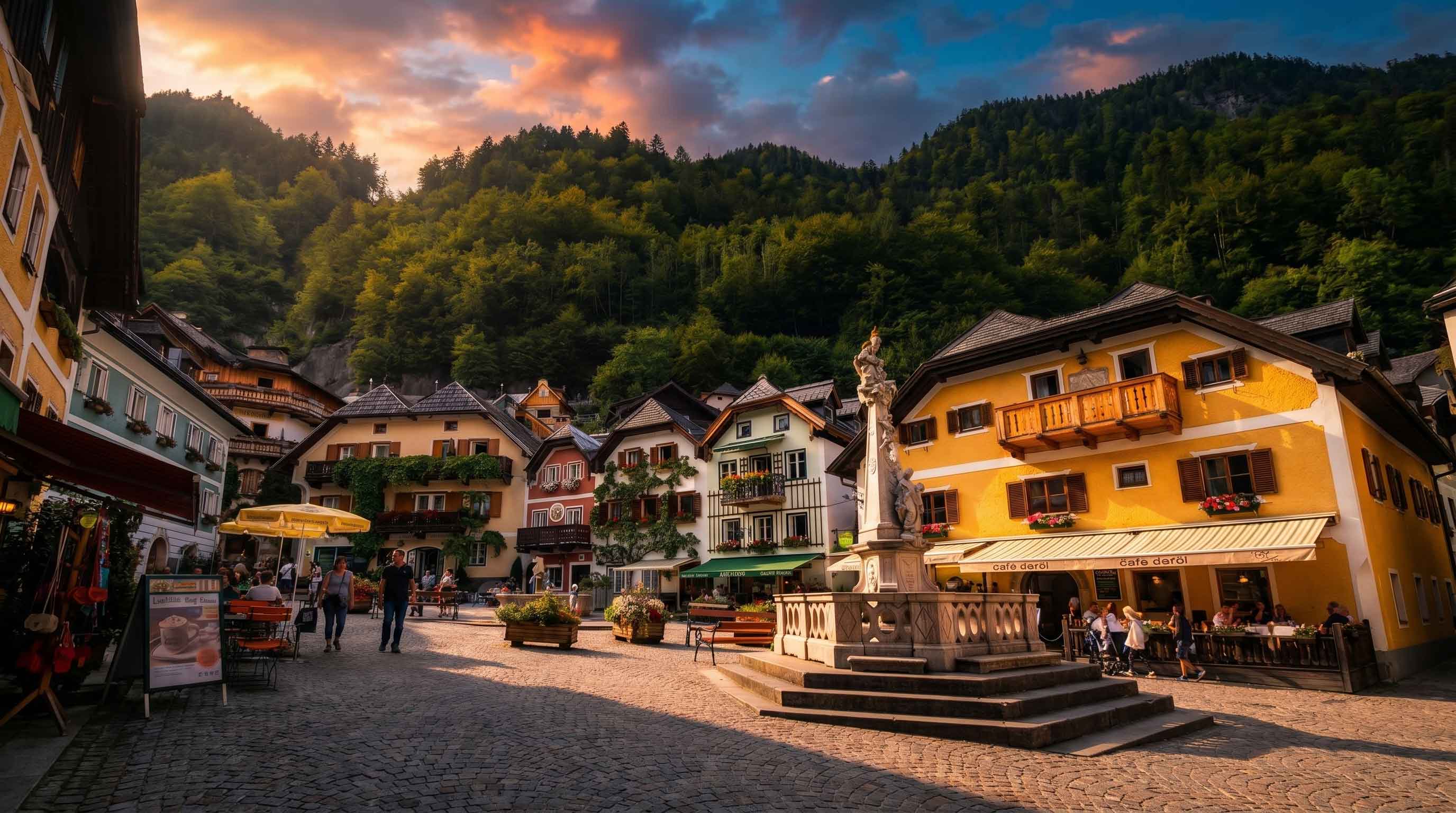
The village has roughly 700 residents and receives several thousand visitors a day at peak. The historic core sits on a narrow shelf between a cliff face and the lake. There is exactly one through road, the B166, and much of it disappears into tunnels. When something backs up there, no alternative route exists. You simply wait.
On top of that, the village has for several years operated an access system that surprises many visitors: coaches can no longer simply roll in, they need a pre-booked time slot with a limited stay. Private cars are not subject to that quota, but you feel the effect anyway, because arrivals compress into blocks. Between roughly 10:00 and 15:00 the market square is a dense crowd. At 8:30 the village and the classic view from the northern shore are effectively yours.
A second point almost nobody knows in advance: the old centre is largely closed to through traffic and parking. If you drive yourself, you will end up on one of the P1 to P3 lots and walk in, anywhere from five to twenty minutes depending on which one you get. Sensible in principle, a lottery in high summer.
The parking lottery, told honestly
P1 is closest to the centre and is usually full by around 09:30. P2 fills shortly after. P3 in the Lahn area holds out longest but means the longest walk. Day rates run roughly ten to twenty euro depending on the lot and season. The money is not the issue. Time is. On August Saturdays we have watched self-drivers queue forty to sixty minutes for P2 while our guests were already standing on the lakeside promenade and we were long gone.
If you do drive yourself, budget for the Austrian motorway vignette. The ten-day sticker currently sits at around twelve euro, the two-month version above that. On the pure country-road route via Lake Wolfgang you technically do not need it, but you will be slower.
Arrival windows: when you should actually leave
From Salzburg it is roughly 70 to 80 kilometres depending on the route. We use two. The prettier one runs on the B158 through St. Gilgen, along Lake Wolfgang, on through Bad Ischl to the B145 and then the B166. The faster one takes the A1 westbound, exits at Regau, then the B145 through Gmunden along the Traunsee shore. In quiet hours both come in at about 75 to 90 minutes of pure driving.
That number does not always hold. Friday and Sunday afternoons, the B145 between Bad Ischl and Gmunden is reliably sticky. Saturday mornings in July and August, St. Gilgen and the Wolfgangsee shore jam up because lake swimmers and day trippers move at the same time. And rain does not speed the Salzkammergut route up. It slows it down, because the tunnel sections fill.
| Departure from Salzburg | What you find in Hallstatt | Our verdict |
|---|---|---|
| 06:45 to 07:30 | Empty market square, mist on the lake, no oncoming traffic | Best for photographs and quiet |
| 08:00 to 09:00 | Village fills from about 10:00, parking still workable | Good compromise with children |
| 09:30 to 11:00 | Full car parks, packed lanes, long queues | The worst option available |
| 14:30 to 15:30 | Coaches leaving, softer light, tables free | Underrated and very pleasant |
The afternoon block is our personal favourite for guests who do not want an early alarm. From around 15:00 the village noticeably empties, because group tours have used up their slots. The evening light on the western shore is kinder than harsh midday sun anyway.
The Dachstein ice cave, Krippenstein and the time factor
Many guests do not realise the Dachstein caves are not in Hallstatt at all. They are in Obertraun, about ten minutes further along the south-eastern shore. From there a cable car takes you up to the Schoenbergalm mid-station, and then there is still a 15 to 20 minute walk, partly steep, to the cave entrance. Budget three and a half to four hours from the Obertraun car park for the Giant Ice Cave, more if you add the Mammoth Cave or the viewing platform at Krippenstein.
Two honest notes. First, the cave sits around freezing all year. A summer dress and sandals are a bad idea there; a jacket and proper shoes are not. Second, on clear days the cable car base station builds queues of thirty to sixty minutes. If you want the cave and the village on the same day, one of them has to be shortened. Our recommendation: cave in the morning, Hallstatt in the late afternoon.
Swimming, the ferry and the quieter corners
Lake Hallstatt is comfortably warm in high summer, usually around twenty to twenty-two degrees, warmer in the shallows. The public lido in the Lahn district is straightforward and good for families. Considerably quieter is the eastern shore towards Obertraun, where several small access points reach the water and the view back at the village is the finest in the whole valley.
An underrated move: take the ferry. It shuttles between the village and the railway station on the opposite shore, takes a few minutes and costs only a few euro. Even if you arrive by car, the round trip is worth it purely for the perspective. With time to spare, rent one of the small electric boats at Lahn, for which no licence is required in Austria.
And yes, there are days when a chauffeur is not the right answer. If you are travelling as a couple, you are flexible, you need no fixed return and you rather enjoy a train day, the rail route from Salzburg Hauptbahnhof via Attnang-Puchheim with the ferry crossing at the end is a genuinely lovely option. It runs about two and a half to three hours each way and ties you to a timetable, but it is honestly less stressful than any self-drive attempt on an August Saturday.
What a fixed pickup time actually changes
The worst part of a Hallstatt day is rarely the village. It is the way home: finding the car again, wondering whether you will make dinner in Salzburg, or waiting for a vehicle that is simply not available. Metered street taxis do not sit on every corner in Hallstatt, and on peak days spontaneous rides often do not materialise at all.
So we work with an agreed pickup point and an agreed time. In practice that means we set you down as close to the centre as the access rules permit, you walk in with no luggage, and we are back at the same spot at the arranged hour. No parking ticket, no queue, no trek back to a lot three kilometres away. If your day shifts because the cable car took longer, we shift the pickup, as far as the day's dispatch plan allows.
For families a second point matters just as much: child seats are legally required in Austria, and the right seat is not a detail to sort out on the morning of departure. We prepare that in advance, see child seat service. If you would rather experience Hallstatt as a guided day with stops at Lake Wolfgang or Bad Ischl, the structured version lives at Hallstatt tour from Salzburg. And if you have a flight to catch the same or the following day, we plan that together through our airport transfers.
Our template for a relaxed summer day
Leave Salzburg around 07:15, take the B158 along Lake Wolfgang, short stop in St. Gilgen for the view across the water. Arrive in Hallstatt around 08:45 and take two calm hours in the village, the bone house and the market square without the crush. Then over to Obertraun for the cable car and the ice cave into the early afternoon. Back at the lake for an hour of swimming or coffee at Lahn. Pickup around 16:30, back in Salzburg around 18:00. A full day, but not a rushed one, and it works even in mid-August.
If you like, we will plan your day around your accommodation, your group size and your onward travel time, and send you a no-obligation quote. Write to us through contact, ideally with your preferred date and the number of travellers, and we will come back with a concrete proposal including pickup and return times.
Stefan Reiter — VPC Premium Transfer & Tours, Salzburg. Written first-hand: we drive these routes every day.
Frequently asked questions
How long does it take to get from Salzburg to Hallstatt?+
It is roughly 70 to 80 kilometres and about 75 to 90 minutes of pure driving. The B158 via Lake Wolfgang and Bad Ischl is the prettier route; the A1 with the Regau exit and the B145 through Gmunden is usually more predictable. On summer Saturdays and Friday or Sunday afternoons, add twenty to forty minutes of buffer.
Can you park in the centre of Hallstatt?+
No. The historic centre is largely closed to through traffic and parking. You use the P1 to P3 car parks and walk five to twenty minutes. Day rates run roughly ten to twenty euro. P1 is usually full by about 09:30 in summer; P3 at Lahn holds out longest but means the longest walk in.
What is the best time of day to visit Hallstatt?+
Early or late, but not in between. Before 09:00 the village is quiet and the light on the lake is at its best. Between 10:00 and 15:00 it is at its fullest. From around 15:00 Hallstatt empties noticeably as group tours use up their slots. Late afternoon is our underrated favourite.
How much time do you need for the Dachstein ice cave?+
Budget three and a half to four hours from the Obertraun car park. That covers the cable car to Schoenbergalm, a 15 to 20 minute walk and the guided tour. On clear days add thirty to sixty minutes of queueing at the base station. The cave stays around freezing all year, so a jacket and proper shoes are essential.
Can you swim in Lake Hallstatt?+
Yes. In high summer the water usually sits around twenty to twenty-two degrees, warmer in the shallows. The public lido in the Lahn district is family friendly and straightforward. Much quieter are the small shore access points towards Obertraun, which also give you the finest view back at the village.
Is the train to Hallstatt a good alternative to driving?+
For couples without a fixed schedule, absolutely. From Salzburg Hauptbahnhof you travel via Attnang-Puchheim and cross by ferry from Hallstatt station. That is about two and a half to three hours each way. You are tied to a timetable but you skip the parking problem entirely. With children, luggage or a connecting flight it quickly becomes impractical.
Why does a fixed pickup time matter in Hallstatt?+
Because the journey home is the worst part of the day. Metered street taxis do not sit on every corner in Hallstatt, and on peak days a spontaneous ride often does not materialise. With an agreed pickup point and time you skip the parking ticket, the queue and the long walk back to the car park. If your day shifts, we adjust the pickup where possible.
Your fixed price in 60 seconds — we handle the rest.
Private Mercedes chauffeur, flight tracking included, pay by cash or card.