travel-guide
Private Chauffeur in Salzburg: What to Expect
How a chauffeured day in Salzburg actually runs: hourly charter versus point-to-point, the meeting protocol at the airport and at hotels, waiting rules, what a chauffeur will and will not do, and honest advice on when the bus, the train or your own two feet beat a car.
Most guests book a private chauffeur for the first time and are not entirely sure what they are buying. A better rental car with a driver? A guide? Someone who stands outside the hotel all day? We have been driving these roads for years, in 33 degree heat near the Getreidegasse in August and through snowfall on the Pass Lueg in January. This is an honest description of how a chauffeured day actually runs, what we do, what we do not do, and when you are better off with no car at all.
Hourly charter versus point-to-point: the decision that matters
Almost every mis-booking starts here. Point-to-point means one pickup address, one destination, one journey. Salzburg Airport to the Hotel Sacher, the old town to Zell am See, the Hauptbahnhof to Bad Reichenhall. The vehicle is not held for you while you are out; it moves on afterwards.
Hourly charter means the car and the chauffeur belong to you for a defined block of time. You get out, spend two hours walking Hallstatt, come back, and the same vehicle with your luggage still inside is waiting where you left it. You may change the route as the day unfolds.
Rule of thumb from the road: from three stops onward, or the moment you want the freedom to decide en route, an hourly charter is both cheaper and far calmer than four separately booked transfers. For a pure arrival with suitcases, point-to-point is the right tool; anything else is paid standing time.
| Situation | Point-to-point | Hourly charter |
|---|---|---|
| Airport arrival to hotel | Right choice | Unnecessary |
| Salzkammergut with photo and coffee stops | Works badly | Right choice |
| Ski day, luggage stays in the car | Only with a fixed return time | Right choice |
| Business meetings, times shift | Risky | Right choice |
| Dinner in St. Gilgen, fixed 22:30 return | Right choice | More than you need |
The meeting protocol: where the chauffeur actually stands
At Salzburg Airport the process is simple. Your chauffeur stands in the arrivals hall immediately past the baggage belt, name board visible within the first few metres. Salzburg is a small airport with a single exit, so there is no second door at which you can miss each other. You do not need to call anyone or tap through an app while keeping two children and three suitcases in view.
Munich is different, and that is where it usually goes wrong. Terminal 1 has several separate arrival modules with their own exits; Terminal 2 has one central hall. That is why we work from flight numbers, not clock times. If your booking says only arriving 14:00, and the aircraft actually lands at 13:20, the chauffeur may still be on the motorway. With a flight number we see the change before you do. More on this on our airport transfers page.
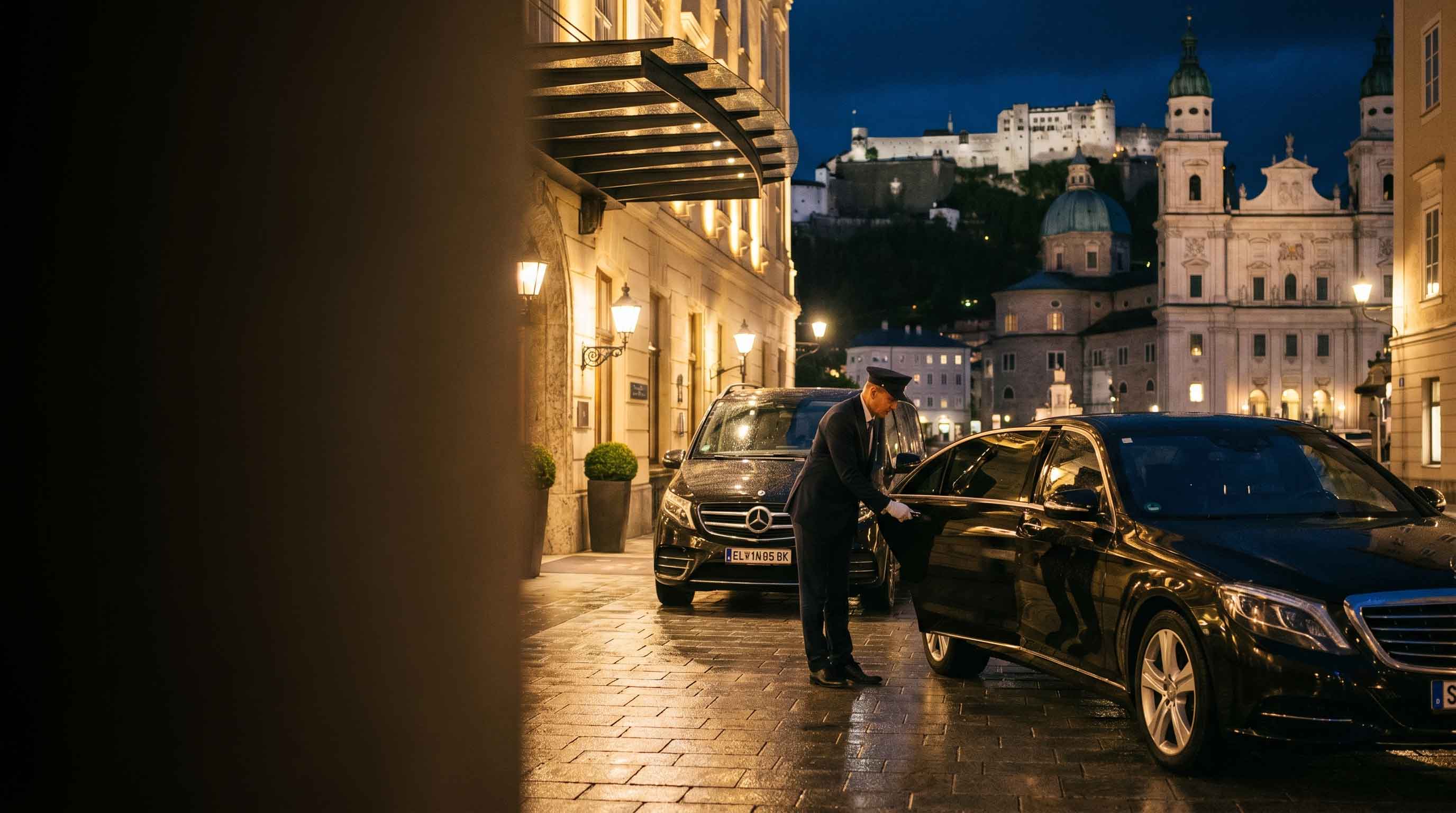
At hotels the rule is five to ten minutes early, at the address itself, not around the corner. In Salzburg's old town that often is not the hotel door, because the pedestrian zone is real and enforced. For the Goldener Hirsch we wait at Herbert-von-Karajan-Platz; for the Bristol, at the Makartsteg side. Whatever applies to your hotel is written into the confirmation, so nobody walks in circles with luggage.
Waiting time: the rule worth knowing
Waiting time causes more arguments in this industry than anything else, so we state it up front. For airport pickups the clock starts at the actual landing, not the scheduled one. A generous grace period follows, and in Salzburg it is almost always enough, because bags from short-haul flights rarely take more than twenty minutes. For long-haul arrivals via Munich with passport control, we build in more from the start.
At hotels and private addresses the grace period is shorter, simply because the car is sitting in traffic and cannot park for free. If you know you will be late, send a message. A chauffeur who has been told will wait calmly; one who has heard nothing has to make decisions.
Short interruptions inside a point-to-point transfer, five minutes at a supermarket or a photo stop at the Fuschlsee, we handle without fuss. If it turns into an hour-long lunch, that is a charter, not a stop. This is not pedantry: it is the difference between a vehicle that has two more jobs today and one that has kept the day clear for you.
What a chauffeur will and will not do
He carries your bags from the car to reception or to the check-in desk. He asks about cabin temperature rather than guessing. He fits child seats before you arrive, so nothing is being bolted in while a toddler waits in the rain, and he knows Austria requires a suitable restraint for children under 14 and under 135 cm. He pulls over when someone feels unwell on the climbs toward the Gerlos Pass. He stays quiet while you work and talks about the region when you ask.
What he will not do: act as a licensed guide. In Austria, guiding is a regulated trade, and he may not lead you through the Hohensalzburg Fortress or Hallstatt delivering a commentary. He waits while a licensed guide takes over, or we arrange that guide for you in advance. He does not supervise children without an adult, does not sign anything on your behalf, and does not take valuables into safekeeping. And he does not drive faster because someone is late. Sections of the A10 between Golling and Werfen are average-speed enforced, and a licensed passenger vehicle loses far more from a citation than you would.
Discretion is a working method, not a marketing word
We carry festival guests, patients heading to clinic appointments, and executives whose back-seat phone calls should not travel further than the car. In practice that means: no printed surname on the name board if you would rather have initials or a company logo. No photographs of vehicle and passenger for social media. No question about why the destination is a private clinic in Aigen. And no chat about the previous client, because that is exactly how you learn how you will be spoken about. Regular visitors will find the details on our private chauffeur page.
Local knowledge: what actually goes wrong
Local knowledge is not sightseeing trivia. It is knowing which road stops working, and when. A few concrete examples from operations:
- Winter Friday afternoons. Between roughly 14:00 and 18:00 the Tauern motorway southbound and the B311 into the Pinzgau back up badly. Saturday mornings, during the ski changeover, add an easy hour to Saalbach or Zell am See. We simply start very early, see ski transfers.
- Hallstatt in summer. Through traffic in the village is closed, and the P1 to P3 garages fill from about 10:00; day parking runs roughly 8 to 15 euro depending on lot and season. With a chauffeur the real advantage is not comfort, it is skipping the parking half of the problem entirely. Arriving before 9:00 or after 16:00 changes the place completely. More on our Hallstatt tour from Salzburg.
- Festival season, late July to end of August. Hofstallgasse and Karajanplatz close before and after performances, so the realistic pickup point is not where you were dropped off. We send the point by message rather than let you hunt for it in evening dress.
- The Bavarian border. On the A8 toward Munich there are periodic checks near Bad Reichenhall and at the Walserberg crossing. Keep passports or ID cards in your hand luggage, not in a suitcase in the boot.
- Winter equipment. Austria's situational winter tyre requirement runs 1 November to 15 April. If you rent a car yourself, verify it explicitly, and budget for the motorway vignette, currently around 12 euro for ten days.
When you do not need us
Honestly, quite often. Salzburg's old town is about 1.2 kilometres end to end and better served on foot than by any vehicle; the Mozartsteg to the Mirabell Gardens is a ten-minute walk, while a car spends longer circling. Trolleybus 2 from the airport to the Hauptbahnhof costs roughly 3 to 4 euro and runs every ten minutes, which is ideal for a solo traveller with one backpack. And the train to Vienna takes just under two and a half hours from the Hauptbahnhof, a time no car will beat.
A chauffeur earns its place where those things stop being true: before the first timetable in the morning, after the last one at night, with ski equipment, with small children, with four adults and luggage, in Salzkammergut rain, or when an appointment simply has to hold. Unlike a metered taxi from a rank, the car is dispatched in advance, the price is agreed beforehand, and the route has been discussed before anyone gets in.
How to prepare the day
- Give the flight number, not just the time.
- State the number and size of bags; ski bags and pushchairs listed separately.
- Send children's ages and heights so the correct seat is already fitted.
- Leave a mobile number that will actually be reachable on arrival day.
- For winter mountain routes, add an hour of buffer before your return flight.
Describe your day to us, the date, the people, the luggage and what you want to see, and we will tell you whether an hourly charter or separate transfers suits you better, then send a firm quote. Write to us via contact or start with a booking request. Including on the days when the honest answer is that you should walk.
Stefan Reiter — VPC Premium Transfer & Tours, Salzburg. Written first-hand: we drive these routes every day.
Frequently asked questions
What is the difference between an hourly charter and a point-to-point transfer?+
Point-to-point takes you from one address to one destination, after which the vehicle moves on to its next job. An hourly charter reserves the car and chauffeur for a defined block: your luggage stays inside, the car waits, and you can change the route as you go. From roughly three stops onward, or whenever you want to decide spontaneously, a charter is usually both simpler and cheaper than several separate transfers.
Where do I meet my chauffeur at Salzburg Airport?+
In the arrivals hall immediately past the baggage belt, holding a name board and visible within the first few metres. Salzburg has a single arrivals exit, so missing each other is practically impossible. Munich is more complex, so there we confirm the exact terminal and arrival module in writing beforehand. In both cases, always give your flight number so we can track delays live rather than guess.
How long will the chauffeur wait if my flight is delayed?+
The waiting clock starts at your actual landing time, not the scheduled one. We track the flight by flight number and adjust the pickup, including for multi-hour delays or diversions. At hotels and private addresses the grace period is shorter, because the car is sitting in live traffic and cannot park freely. A short message when you know you will be late solves nearly every situation.
Can my chauffeur also act as a tour guide in Salzburg or Hallstatt?+
No. Guiding is a regulated trade in Austria requiring its own qualification. Your chauffeur takes you there, knows the best timings, access points and parking realities, and will happily answer questions about the region while driving. For an actual guided visit inside the fortress, a museum or a village centre we can arrange a licensed guide to take over on site, while the car waits.
Do I actually need a chauffeur in Salzburg?+
Often you do not. The old town is about 1.2 kilometres end to end and faster on foot than in any car, and trolleybus 2 from the airport costs roughly 3 to 4 euro. A chauffeur makes sense outside timetable hours very early or late, with ski equipment, with small children, with four adults and luggage, or when an appointment absolutely has to hold regardless of weather.
Are child seats provided, and what does Austrian law require?+
Yes. We supply and fit the correct seats in advance, so nothing is being installed while your family waits at the kerb. Austrian law requires a suitable restraint for children under 14 years old and under 135 cm tall. Please give ages, heights and weights when booking so we choose the right infant carrier, child seat or booster. For ski days we also plan extra luggage space accordingly.
How is this different from taking a metered taxi from a rank?+
A rank taxi is taken on the spot, the price accrues on a meter as you go, and neither vehicle nor driver is known in advance. With us the car is dispatched ahead of time, a named chauffeur is assigned, the price is agreed before departure and the route is discussed. Add flight tracking, a name board in arrivals, fitted child seats and pre-agreed meeting points inside the pedestrian zone.
Your fixed price in 60 seconds — we handle the rest.
Private Mercedes chauffeur, flight tracking included, pay by cash or card.