travel-guide
Private Transfers in Austria: The Complete Guide
Hire car with driver versus metered taxi: how Austrian licensing shapes fixed pricing, which vehicle class really swallows how much luggage, what Tauern tolls and German border checks cost you in minutes, and when the train or a trolleybus is simply the better answer.
Almost everyone booking a private transfer in Austria for the first time asks the same question: how is this different from the car I could wave down outside the station? The answer is not a marketing distinction, it is a licensing one. And it explains a great deal about why pricing, vehicle classes and even airport waiting times work the way they do. We drive these roads ourselves, from Salzburg Airport over the Tauern motorway to Munich, Hallstatt and Kitzbühel. This guide collects what we usually explain to guests on the phone.
Hire car with driver, not a street taxi
Austrian law separates two trades. One is the taxi trade: the vehicle may be hailed on the street or boarded at a rank, the fare comes off a meter, and the tariff is fixed by the provincial regulation. The other is the hire car trade, a car supplied together with a driver. Here one condition is fundamental: the order must reach the company's registered office in advance. No hailing, no rank, no meter.
Since driver permits were merged in 2021, everyone carrying passengers commercially needs the same official licence. The vehicle must be registered to the business, commercially insured and generally presented for inspection annually. For you as a passenger, one consequence matters most: the private comprehensive insurance of a neighbour who drives you to the airport for petrol money does not cover paid transport. Asking about the licence is therefore not a formality.
In practice this also means we may not sit outside your hotel afterwards waiting for the next passenger. The vehicle must return to base. That obligation feeds directly into the pricing logic that surprises many first-time bookers.
Why a fixed price and a meter produce different numbers
A meter charges distance and time. When the car stands still, the clock keeps running. On a fifteen-minute city hop that hardly matters. On Salzburg to Munich Airport it matters a great deal, because between the Walserberg border crossing and the Munich North interchange a December Friday afternoon can swallow two hours instead of the usual seventy-five minutes.
A fixed price inverts the logic. We calculate once, before booking, and then carry the risk. What goes into that calculation is no secret: actual distance including the approach and the return leg to base, realistic driving time in the booked window, tolls and special tolls, vehicle class, night surcharges, airport waiting time, and extras such as child seats or ski carriers. A transfer starting at 04:30 in Zell am See ties up a vehicle from around 03:00. That is the honest reason very early pickups are treated differently from a midday run.
On tolls, because they are widely misunderstood: the motorway vignette for cars currently costs roughly 100 euros per year, with the ten-day version around twelve euros. Special toll sections such as the Tauern motorway between Golling and Rennweg, or the Felbertauern tunnel, cost extra, broadly in the range of fifteen to twenty euros per passage depending on the section. With us it is all inside the agreed price. If you drive a rental car yourself, budget for it.
Vehicle classes and what actually fits
The most common misjudgement is not about people but about luggage. Four adults sit comfortably in an E-Class saloon. Four adults each with a large suitcase plus hand luggage do not. That is why we ask about bags on every enquiry, and why an honest answer pays off.
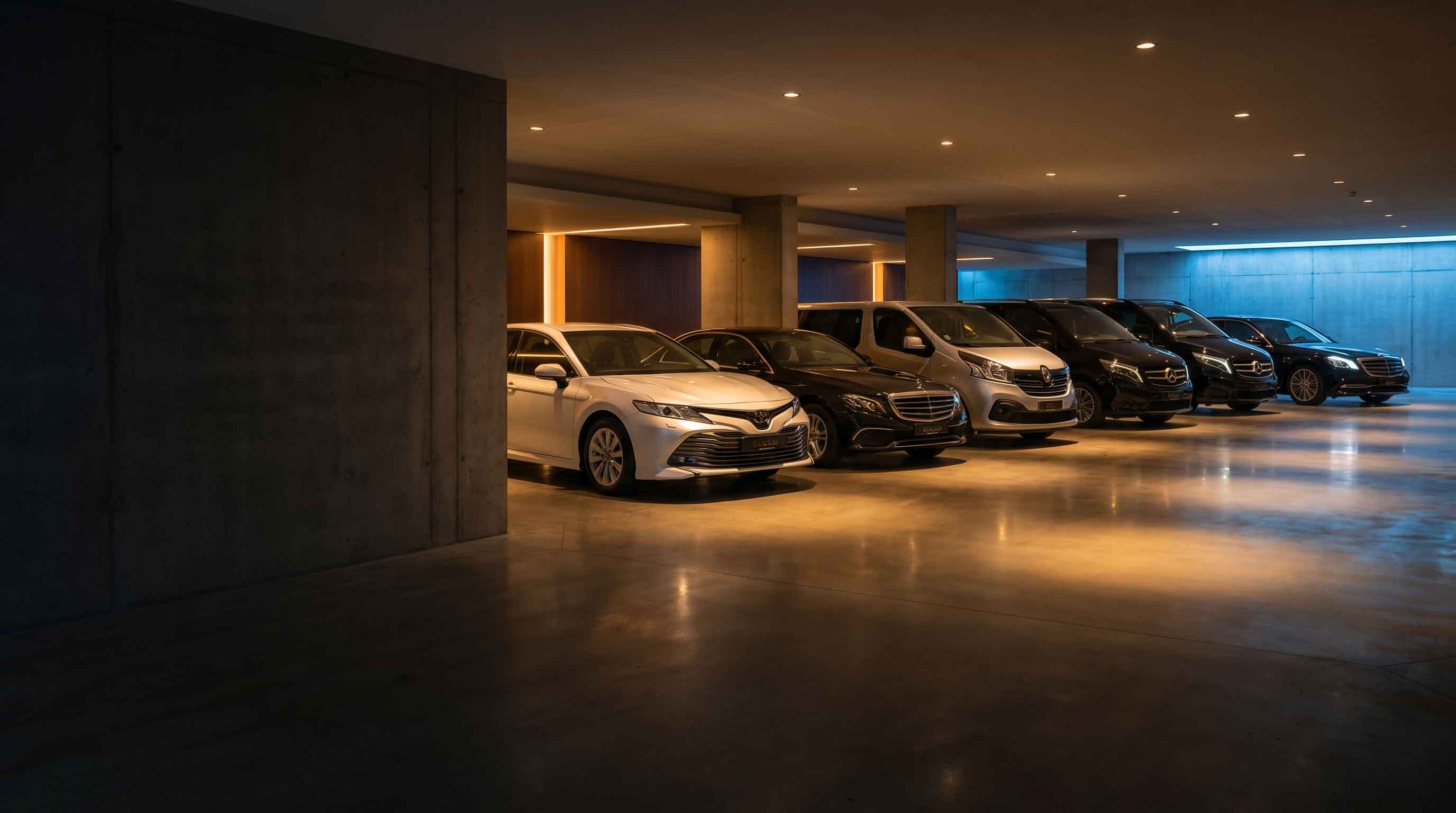
| Class | Seats | Large cases | Typical use |
|---|---|---|---|
| Business saloon (E-Class) | up to 3 | 2 to 3 | Airport runs, business, couples |
| First class saloon (S-Class) | up to 3 | 2 to 3 | Representation, long distance |
| Business van (V-Class) | up to 6 | 5 to 6 | Families, ski trips, groups |
| Transfer van (Vito) | up to 8 | 8 with roof box | Large groups, sports luggage |
Ski equipment changes the arithmetic sharply. A pair of skis plus a boot bag takes roughly the volume of one large suitcase. Six people with skis need a van with a roof box, not a fully loaded van. We would rather work that out in advance than at the airport kerb. More on those runs on our ski transfers page.
Child seats are mandatory in Austria up to 135 cm in height or 14 years of age, and that applies in a commercial hire car too. We carry infant carriers, child seats and boosters, but we need ages and weights at booking. See the child seat service for details.
Long-distance legs: what the map does not show
Austria looks compact on paper. In practice topography and the day of the week decide. Salzburg to Vienna on the A1 is about three hours if nothing intervenes. What intervenes is usually the stretch between Ybbs and St. Pölten on a Sunday afternoon when the weekend traffic returns, or summer roadworks near Amstetten.
Salzburg to Innsbruck is sensibly driven via the German A8 and the Inn valley motorway, around two hours. The purely Austrian route via Lofer and the Pass Thurn is prettier and considerably less reliable in winter. Salzburg to Zell am See normally takes about 80 minutes. On a Saturday in February between 09:00 and 12:00, when the ski resort changeover runs, it can stretch to two hours. We deliberately schedule such trips earlier.
The classic long-distance mistake is counting backwards from the departure. Someone flying at 06:15 from Munich while staying in Bad Gastein allows three hours and books pickup at 03:00. What is missing is the Tauern tunnel, which can be closed at night in phases, and the Katschberg diversion, which costs forty minutes in snow. For winter alpine transfers we plan a buffer of 45 to 60 minutes as standard.
Crossing borders: Munich, Ljubljana, Prague
There are no systematic border controls inside Schengen, but Germany has run stationary checks at Walserberg and near Freilassing for years. At peak times allow ten to thirty minutes. Carry your passport or national ID even though you rarely need it.
For us as an operator, cabotage rules apply on cross-border work: we may take you from Austria to Germany and back, but we may not accept a purely domestic German job, Munich to Nuremberg as a standalone trip, for instance. An operator who ignores that is not working cleanly. Similar rules apply towards Slovenia and Czechia, each with its own toll system, an electronic vignette in Slovenia and a digital one in Czechia. Both are part of our calculation.
The most frequent cross-border legs from Salzburg are Munich Airport at roughly 105 minutes, Munich city at roughly 90, and Berchtesgaden at around 45. Arrival procedures are covered on our airport transfers page.
What to check before you book
- Licence and insurance. A serious operator gives you the company name, register number and registered office without hesitating.
- What the price includes. Tolls, airport parking, waiting time, child seats. We include them. Not everyone does.
- Waiting time on delayed flights. Ask specifically how many minutes after actual landing are included and whether the flight is actively monitored.
- Meeting point. Arrivals hall with a name board, or short-stay parking? At Munich Airport the difference between Terminal 1 and Terminal 2 is substantial.
- Cancellation terms. Free until when, and what happens if the flight is cancelled.
- Winter equipment. Austria applies situational winter tyre rules from 1 November to 15 April. Ask whether chains are carried.
When a private transfer is the wrong answer
Honesty belongs here. From Salzburg Airport into the old town, trolleybus line 10 takes about twenty minutes for roughly three euros. If you travel alone with light luggage and no fixed deadline, you do not need us for that. Likewise the Salzburg to Vienna railway, hourly and just under two and a half hours, is often faster and calmer if you are going station to station anyway.
Inside Salzburg's old town the car is simply the slowest way to move. Mozartplatz to Mirabell Palace is a twelve-minute walk; by car in season it takes longer and the old town garage runs around four euros an hour. A private transfer earns its place where luggage, early hours, several passengers, children or a route with poor rail links come together. That is also where our private chauffeur service fits, for full days with multiple stops.
Once you know your route, your time window and how many bags you are carrying, we will price the whole thing firmly and in writing before you commit. Send us your route, flight number and luggage count and you will get a concrete, transparent quote with no surprises along the way.
Stefan Reiter — VPC Premium Transfer & Tours, Salzburg. Written first-hand: we drive these routes every day.
Frequently asked questions
What is the difference between a hire car with driver and a taxi in Austria?+
A taxi may be hailed on the street or boarded at a rank and charges by meter under the provincial tariff. A hire car with driver must be ordered in advance at the company's registered office, runs on an agreed fixed price and returns to base after the job. Austrian law regulates the two trades separately, though driver permits were merged in 2021.
Are tolls and parking included in a private transfer?+
With us, yes. Vignette, special tolls such as the Tauern motorway or Felbertauern, airport parking and waiting time are inside the agreed price. Check this explicitly with any operator, since some bill special tolls and parking afterwards. If you drive yourself: a ten-day vignette is around twelve euros and special toll sections roughly fifteen to twenty euros per passage.
How much luggage fits in a saloon or a van?+
An E-Class realistically takes two to three large cases plus hand luggage, not four. A V-Class business van carries five to six large cases with up to six passengers. Ski equipment counts roughly as one extra large case per person, so a group of six skiers normally needs a van with a roof box. State your bag count precisely when booking.
How long does Salzburg to Munich Airport take?+
Around 105 minutes on the A8 without disruption. Realistically add ten to thirty minutes for German border checks at Walserberg plus rush hour around the Munich North interchange. On December Friday afternoons and holiday return days we build in another 45 minutes of buffer, and more again for winter weather over alpine passes.
Do I need a child seat in a booked vehicle in Austria?+
Yes. Children under 135 cm in height or under 14 years need a suitable restraint, and that duty applies in a commercial hire car with driver too. We carry infant carriers, child seats and boosters, but we need the child's age, weight and height at the time of booking so the correct seat is already fitted in the vehicle.
When is the train or bus the better choice?+
From Salzburg Airport into the old town, trolleybus line 10 takes about twenty minutes for roughly three euros, and a solo traveller with light luggage does not need a transfer. Salzburg to Vienna by rail is often faster station to station at just under two and a half hours. A private transfer pays off with heavy luggage, early departures, children, groups or places with poor rail links.
Can an Austrian operator drive me within Germany?+
Only within cabotage rules. We may take you from Austria into Germany and back, but we may not accept a purely domestic German job such as Munich to Nuremberg as a standalone trip with no Austrian leg. Operators who ignore this are not working cleanly. Comparable rules apply to journeys into Slovenia, Italy and Czechia.
Your fixed price in 60 seconds — we handle the rest.
Private Mercedes chauffeur, flight tracking included, pay by cash or card.