travel-guide
Salzburg Airport Taxi vs. Fixed-Price Chauffeur: What Really Matters
A metered taxi from SZG and a pre-booked private chauffeur solve the same problem in very different ways. We drive both sides of Innsbrucker Bundesstraße every day, so here is an honest operator's-eye comparison — including the days when the rank outside Terminal 1 is the smarter choice.
Every winter Saturday, somewhere around 10:40 in the morning, the arrivals hall at Salzburg Airport changes character. Until then it is a quiet regional terminal with a handful of scheduled flights from Frankfurt, Vienna and Amsterdam. Then the charter wave lands — Stansted, Manchester, Copenhagen, Rotterdam, Bristol — and within ninety minutes a few thousand people with ski bags come through the same set of sliding doors. We are usually standing on the other side of them, name board in hand, watching the taxi rank fill up.
That contrast is really what this article is about. A metered taxi and a pre-booked fixed-price chauffeur are not the same product with different price tags. They are two different answers to the question "how do I get from the baggage hall to where I am sleeping tonight" — and each one wins under specific conditions. After years of doing this route in both directions, we would rather tell you honestly when the rank is the right call than pretend it never is.
How the meter actually works at SZG
An Austrian metered taxi charges you on a tariff set by the operator and displayed in the vehicle. The structure is consistent even when the numbers are not: a base fare that appears the moment the meter starts, then a running charge that switches between a per-kilometre rate while you are moving and a per-minute waiting rate when the vehicle drops below a threshold speed. On top of that sit surcharges — night tariff, Sunday and public holiday tariff, luggage items, sometimes an airport pickup supplement.
The important thing to understand is the switching behaviour. On a clear run into the city the meter is mostly counting kilometres, and the distance from the airport to the Altstadt is short. In traffic, the meter flips to time and keeps earning while you sit still. That is why the same journey can produce two noticeably different figures on two different afternoons.
And Salzburg gives the meter plenty of chances to switch. Innsbrucker Bundesstraße is the airport's artery into town, and it carries commuter traffic, the Europark shopping flow, and every coach heading for the city at the same time. If your route continues through the Neutor tunnel toward the left bank and the hotels around Mönchsberg, you inherit a bottleneck that has existed since the tunnel was cut through the rock in the 18th century. On an Advent weekend or a Festival evening in August, that tunnel approach can add fifteen or twenty minutes to a journey that is nominally eight minutes long. The meter does not know the difference between "we are nearly there" and "we have been nearly there for a quarter of an hour."
Add distance and the variance compounds. A run into the Altstadt has a modest ceiling on how wrong it can go. A run to Zell am See, Kitzbühel or Obertauern is a different order of exposure: mountain roads, winter conditions, one closed pass and a diversion, and the number on the display keeps climbing with the clock. This is the single biggest reason long-haul transfers are quoted as fixed prices across the industry — nobody, driver or passenger, wants to negotiate at the end of a two-hour drive.
The rank outside Terminal 1
Salzburg's layout is genuinely convenient. You come out of the baggage hall on the ground floor, and the taxi rank is directly outside the terminal exit — a walk of well under a minute, no shuttle, no multi-level car park to navigate. On a Tuesday in October it is close to perfect: you walk out, a car is waiting, you are moving before you have finished putting your coat on.
The winter Saturday is a different animal. The rank is supplied by a finite pool of drivers, and the charter wave does not arrive gradually — it arrives in blocks of 180 to 220 passengers at a time, several blocks stacked within the same hour. When four aircraft disgorge within forty minutes, the queue at the rank grows faster than vehicles can cycle back from the city. We have watched that line stretch along the terminal frontage while people in ski jackets stand with a trolley and two ski bags each, waiting in weather.
There is a second, subtler problem: vehicle roulette. Whatever arrives at the front of the rank when you reach it is what you get. If you are four adults with four large cases and two ski bags, the estate car at the front may simply not take you, and the etiquette of the rank means you wait for a van — which may be several cars back, or may not be there at all.
What a fixed price actually guarantees
People sometimes assume "fixed price" is just a marketing word for "we picked a number." It is more than that, and it is worth being precise about what changes when a transfer is agreed in advance.
- The figure is agreed before you fly. Traffic, tunnel queues, a diversion over the Pass Lueg, an unexpectedly slow crawl through Anif — none of it moves the number. The operator carries that risk instead of the passenger.
- The vehicle is assigned to your party. Not the next car in line — a vehicle chosen against your passenger count, your luggage count and your route. Nobody arrives at the kerb and discovers the boot is too small.
- The driver is assigned to your flight. They are dispatched against your arrival, not against a queue position, which means the whole schedule is built backwards from your landing time.
- Extras are priced in, not bolted on. Child seats, an extra stop, a ski-equipment allowance and waiting time are settled at booking, not improvised at the kerb.
- Tolls and vignettes are included. The Tauern tunnel toll, the Austrian motorway vignette and the German sections on a run to Munich Airport do not reappear as separate lines at the end of the journey.
The value here is not really financial. It is the removal of an unknown from a day that already contains several. You can read how we structure that on our airport transfers page.
Meet and greet versus finding the rank
The rank is a place you go to. A chauffeur is a person who is already there.
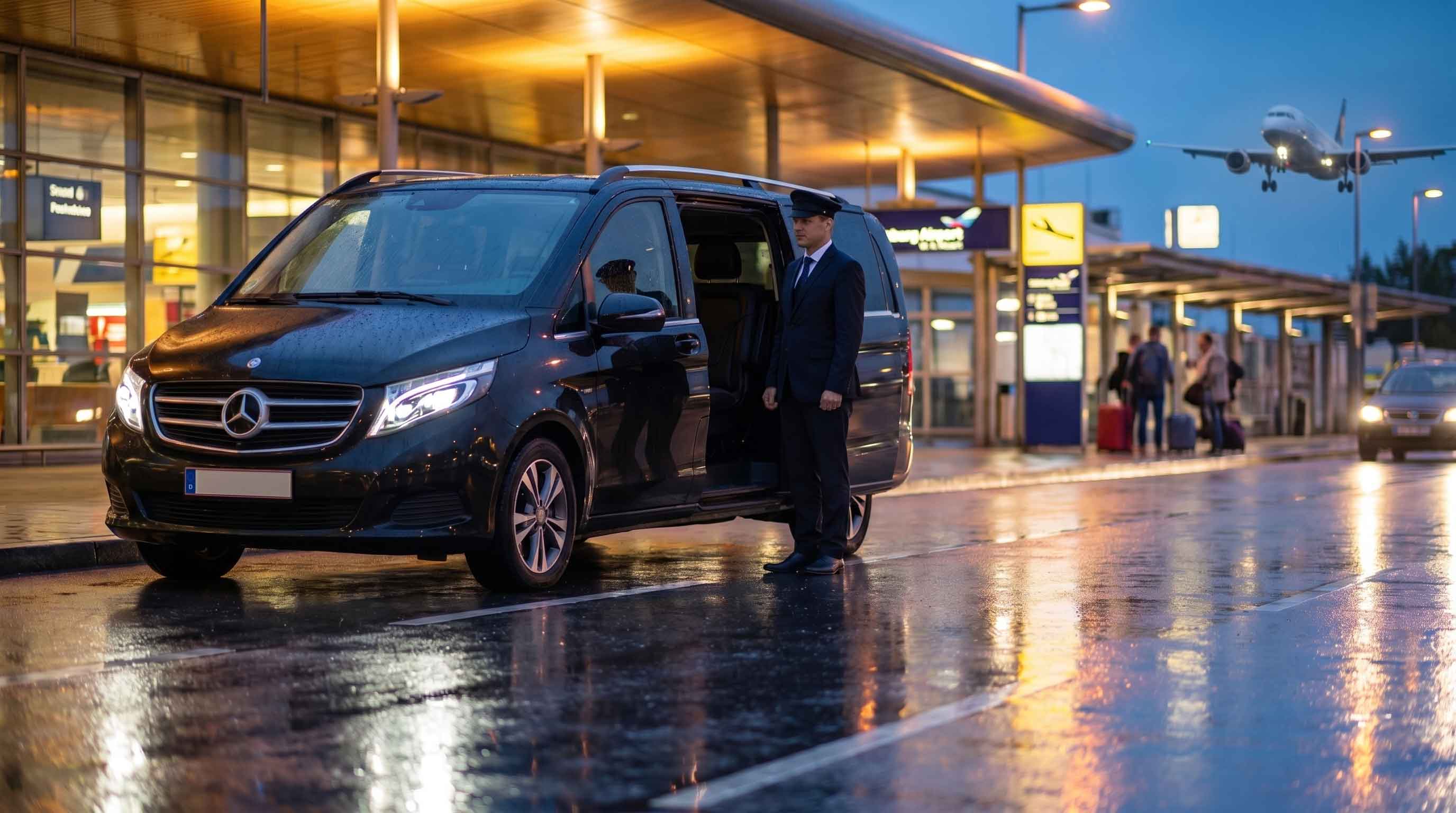
Our drivers park in the short-stay car park directly opposite the terminal and walk into arrivals before your aircraft is on stand. They wait at the baggage hall exit with a name board, take the trolley, and walk you across to the vehicle. For a solo business traveller with a cabin bag, that difference is pleasant but marginal. For a family arriving at 22:15 with a tired six-year-old, or for a group of six with skis, it removes the single most stressful ten minutes of the trip. Details are on our meet and greet page.
Flight tracking and delays
This is where pre-booking earns its keep most decisively, and it is invisible until something goes wrong.
We track your flight from the moment it is airborne. If you leave Gatwick ninety minutes late, nobody needs to be told: dispatch has already moved the pickup, and the driver leaves later. If you divert to Munich or Linz because of fog — which happens in Salzburg more often than the brochures admit, and which happens with almost boring regularity in November and January — we know before you have landed and we call you rather than waiting to be called.
Compare the alternatives. A metered taxi is not waiting for you, so a delay costs you a longer queue at a worse hour. A cheap prepaid transfer with no tracking may simply have gone home. Our approach is described under flight tracking.
Night flights and early departures
Salzburg is not a 24-hour airport, but its edges are busier than people expect. Delayed charters land close to midnight, and winter departures start checking in around 04:30. The rank thins out sharply in both windows. At 05:00 on a January morning, standing outside a hotel in Zell am See hoping a taxi materialises is not a plan — it is a bet on somebody else's roster. Pre-booked departures are simply scheduled, and the driver is at the door before you are.
Luggage, skis and boot geometry
Winter luggage is unforgiving. A pair of skis in a padded bag is roughly 170 to 190 cm and does not bend. Snowboard bags are shorter but bulkier. Boot bags eat the space that would otherwise take a suitcase, and helmets fill every remaining gap.
Four passengers with skis is a van job — an eight-seat V-Class configured with the rear row folded, or two vehicles. There is no clever packing that turns an E-Class boot into a ski carrier. When you pre-book, that arithmetic is done in the office with your actual numbers in front of us. At the rank, it is done on the kerb, in the cold, with a queue behind you. Our ski transfers page sets out what fits where, and the fleet page shows the classes in detail.
Child seats and Austrian law
Austria requires children under 14 years and shorter than 135 cm to travel in an approved restraint appropriate to their size and weight. There is a narrow exemption for taxis in some circumstances, but "legally permissible" and "what you want for your own child on a wet motorway" are not the same standard, and the practical reality is that street taxis rarely carry a suitable seat.
We carry infant carriers, forward-facing seats and booster cushions, fitted before we leave the depot — but only if we know the ages and heights in advance, which is why we ask at booking. See child seat service.
The arithmetic behind a fixed price
People often ask how a fixed-price operator can compete with a taxi that only waits five minutes at a rank. The answer is utilisation. A rank vehicle spends a substantial share of its working day waiting, and that idle time is priced into the tariff. A pre-booked chauffeur works to a calendar: every pickup is planned the day before, and the onward job in the region or the return leg to Salzburg is already on the sheet. That efficiency is what makes long routes predictable rather than punitive. What your specific route costs is shown in the calculator on the booking page — that calculator is the only binding source, because any example figure printed in a blog post would already be out of date by the time you read it.
Side by side
| Factor | Metered taxi at the rank | Pre-booked fixed-price chauffeur |
|---|---|---|
| Final figure | Depends on traffic, time of day, surcharges | Agreed before you fly |
| Availability | Instant off-peak; queues in charter waves | Reserved for your flight |
| Vehicle | Whatever is at the front of the line | Matched to passengers and luggage |
| Delay handling | Not tracked | Flight monitored, pickup adjusted |
| Meeting point | You walk to the rank | Name board at the baggage hall exit |
| Child seats | Rarely available | Fitted in advance to age and height |
| Skis and bulky luggage | Hit and miss | Capacity confirmed at booking |
| Night and dawn | Thin supply | Scheduled |
| Tolls and vignette | Itemised separately | Included in the agreed figure |
When the rank is honestly the better answer
We would rather you use us for the journeys where we add something real. Take the taxi when:
- You are one or two people with hand luggage. No vehicle-matching problem exists, so there is nothing to solve.
- You land midday, midweek, outside the ski season. The rank is quiet, the drive into town is short, and you will be moving in two minutes.
- Nothing depends on the arrival time. No dinner reservation, no train from the Hauptbahnhof, no connecting coach. If twenty minutes of slippage costs you nothing, buy the flexibility.
- Your plans are genuinely unformed. If you might go to the hotel, or might go straight to a restaurant, a meter handles improvisation better than a booking form.
And a third option deserves mention: bus line 2 runs from the terminal into the city and a single ticket costs roughly €2 to €4 depending on how you buy it. With one small bag, in daylight, it is a perfectly sensible choice. With skis and children, it is a story you tell later.
Where the balance tips
The line falls in a fairly consistent place. It tips toward pre-booking as soon as two or more of the following are true: you are three or more people; you have skis, golf bags or more than one large case per person; you are travelling with children; you land before 07:00 or after 21:00; you land on a winter Saturday; your destination is outside the city; or something later in the day depends on when you arrive.
One of those on its own is usually manageable. Two together and the rank starts costing you in time and stress what it might have saved elsewhere. For a business day with several appointments, look at corporate transfers; for a day out with multiple stops, at private chauffeur. If you would like us to look at your specific flight and party, get in touch — we will tell you straight if we think you would be fine walking out to the rank.
Last updated: August 2026. Written by the dispatch team at VPC Premium Transfer & Tours, Salzburg.
Stefan Reiter — VPC Premium Transfer & Tours, Salzburg. Written first-hand: we drive these routes every day.
Frequently asked questions
How long does the drive from Salzburg Airport to the Altstadt take?+
With a clear run it is roughly eight to twelve minutes along Innsbrucker Bundesstraße. At peak times, on Advent weekends and on Festival evenings in August, the queue at the Neutor tunnel can easily add fifteen to twenty minutes. We plan transfers with buffer time built in rather than trusting the optimistic figure a map app shows.
Do I really need to pre-book at Salzburg Airport, or is the rank enough?+
If you are one or two people with hand luggage, arriving midday midweek outside the ski season, the rank is fine. From three passengers upward, with skis, with children, arriving before 07:00 or after 21:00, or on a winter Saturday charter wave, pre-book. In those conditions the rank is usually the slower and more stressful option.
What happens if my flight is delayed or diverted?+
We track your flight from take-off. If it is delayed, dispatch moves the pickup automatically and you do not have to do anything. If you divert to Munich or Linz because of fog, which happens regularly in November and January, we call you and agree the alternative. With a rank taxi, a delay simply means a longer queue at a worse hour.
Will four people with ski equipment fit in one vehicle?+
Not in a saloon. A pair of skis in a bag is 170 to 190 cm and does not bend, and boot bags and helmets take the rest. Four passengers with skis is a van job, typically a V-Class with the rear row folded down. We settle that at booking using your actual luggage numbers, rather than working it out on the kerb in the cold.
Is there a cheap public transport alternative at Salzburg Airport?+
Yes. Bus line 2 runs from the terminal into the city, and a single ticket costs roughly €2 to €4 depending on where you buy it. With one small bag in daylight it is a perfectly sensible choice and we say so openly. With skis, children or several large cases it stops being practical very quickly.
Are tolls and the vignette included in a fixed price?+
Yes. The Tauern tunnel toll, the Austrian motorway vignette and the German sections on a run to Munich Airport are part of the agreed figure and do not reappear at the end. With a metered taxi such items are normally added to the bill separately, which is one more reason the final number is hard to predict before you arrive.
Do children need a child seat for transfers in Austria?+
Austrian law requires children under 14 and shorter than 135 cm to travel in an approved restraint suited to their size and weight. A narrow exemption exists for taxis in some situations, but street taxis rarely carry a suitable seat. We bring infant carriers, forward-facing seats or booster cushions already fitted, provided you tell us ages and heights when booking.
Your fixed price in 60 seconds — we handle the rest.
Private Mercedes chauffeur, flight tracking included, pay by cash or card.