travel-guide
Salzburg for First-Time Visitors: Everything You Need to Know
How small the old town really is, how many days you need, whether the Salzburg Card pays off, when the city becomes unbearable, and why arrival and departure days contain the most common planning errors. Written by a driver who runs these roads daily.
I have spent years driving the same roads between Salzburg Airport, the old town, the Salzkammergut lakes and the ski resorts in the Pinzgau valley. First-time guests say the same three things, almost word for word: "I thought the old town would be bigger." "Two nights was not enough." "Why is nothing moving on Sunday afternoon?" This article is an attempt to answer all of that honestly, without the brochure gloss.
What the old town actually is
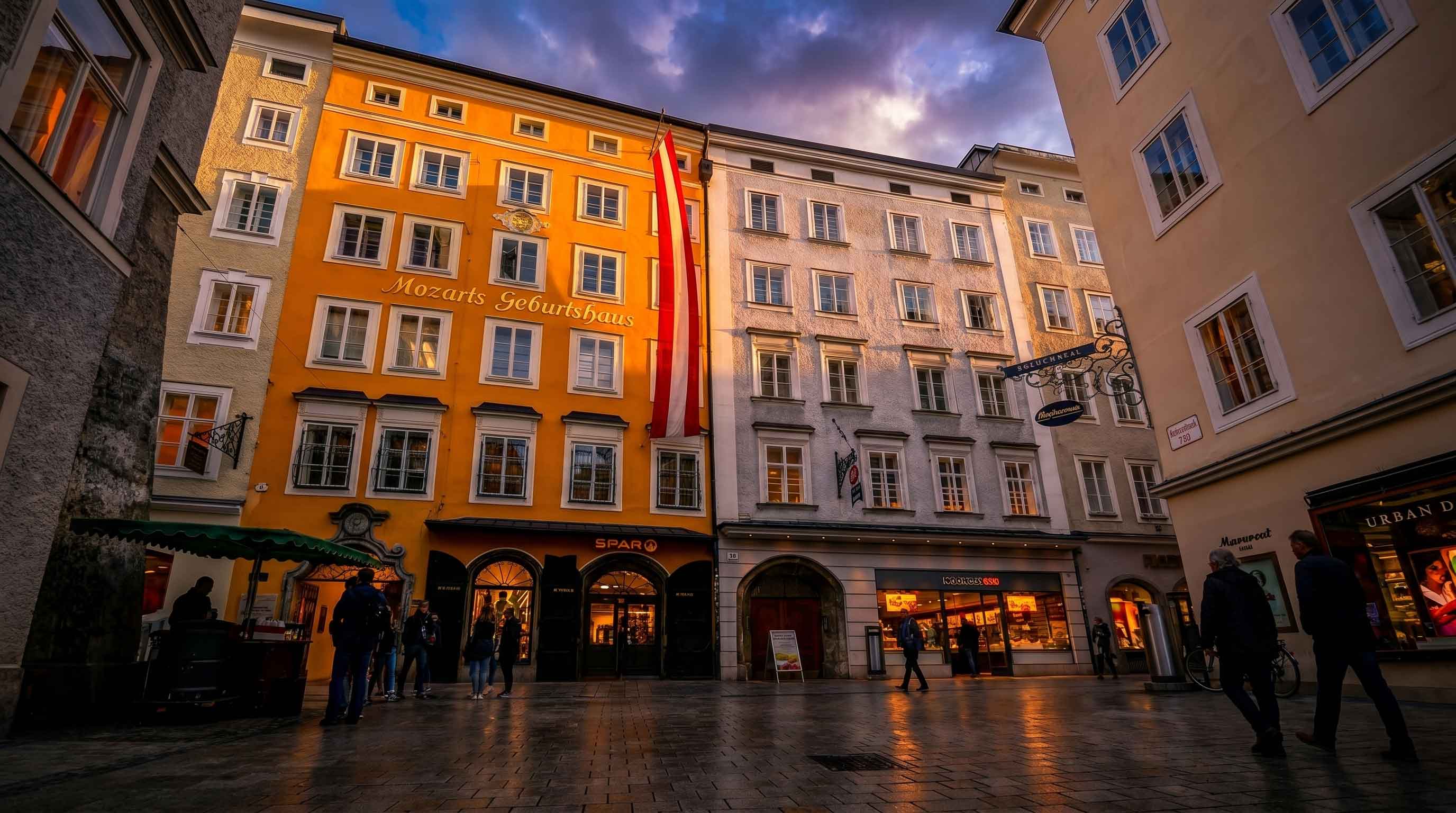
Salzburg's old town is small. Genuinely small. From Mirabellplatz across the Staatsbrücke, through Getreidegasse and out onto Domplatz is roughly a fifteen-minute stroll. The left bank (Getreidegasse, Universitätsplatz, Kapitelplatz, the fortress) and the right bank (Mirabell Gardens, Linzergasse, Kapuzinerberg) are two compact areas separated by the Salzach river. Visitors arriving from London, Rome or Istanbul consistently overestimate the scale, and then plan the wrong way around it.
The practical consequence: inside the old town you do not need a vehicle at all. The historic core is largely pedestrianised or residents-only, and access is tightly enforced. We drop guests at defined, permitted points — Rudolfskai, Kapitelplatz, Herbert-von-Karajan-Platz or Makartplatz — and from any of those it is a few minutes on foot to almost every old town hotel. Any chauffeur promising to stop directly outside your door in Getreidegasse does not know this city.
People also underestimate the gradients. Hohensalzburg fortress, the Mönchsberg and the Kapuzinerberg are real climbs. The funicular handles the steep part of the fortress, and the Mönchsberg lift does the same on the other side. If you are travelling with a pushchair, a walking aid, or simply tired knees, build both into the plan rather than treating them as a fallback.
How many days you actually need
The honest answer: two full days for the city alone. Three to four nights if you also want the surrounding region — the lakes, Wolfgangsee, Hallstatt. Anything less produces exactly the rush that strips Salzburg of the thing that makes it worth visiting.
A realistic frame looks like this. Day one: left bank, cathedral, Residenz, Getreidegasse, up to the fortress, evening views from the Kapuzinerberg. Day two: Mirabell Gardens early, Hellbrunn Palace with the trick fountains, an afternoon museum or a concert. Day three: out into the Salzkammergut. The classic loop runs Fuschlsee, St. Gilgen, St. Wolfgang and on to Hallstatt; we drive it as a private Hallstatt tour from Salzburg with stops that simply do not fit into a bus schedule.
If you only have one day, cut Hallstatt. It sounds harsh, but the round trip eats two and a half to three hours of pure driving depending on traffic, and you end up seeing neither Salzburg nor Hallstatt properly. Take Hellbrunn and the Untersberg instead, both within half an hour of the centre.
The Salzburg Card, done as arithmetic
The Salzburg Card is not a discount card. It is an intensity card. It only pays off if you cram a lot into a single day. It covers the fortress funicular, the cathedral, the Residenz gallery, Hellbrunn, both Mozart houses, the Untersberg cable car, the Salzach boat trip and public transport in the core zone.
Rule of thumb from experience: combine the fortress, Hellbrunn and two museums in one day and the 24-hour card comes out ahead. Wander gently, drink two coffees and go to a concert in the evening, and you have overpaid. Families should check the child rates; under-sixes are free at many sites anyway. And note that the card runs on the clock from first validation, not by calendar day. Activate at 2 pm and you need something substantial planned before 2 pm the next day.
One thing almost nobody works out in advance: if you are being driven privately anyway, the transport half of the card stops being an argument. What remains is the sum of the admission fees. Run that calculation — it takes five minutes and often saves an unnecessary purchase.
When the city is genuinely unbearable
Salzburg has clear peaks and they are remarkably predictable. The critical windows are July and August, the Festival weeks, the fortnight around Easter, and the four Advent weekends. Layered on top are the daily peaks: between 10:30 and 15:30, when coach groups and cruise-ship shuttles from Passau, Munich and Vienna all arrive at once.
| Period | Crowd level | What it means in practice |
|---|---|---|
| January to mid-March | low in the city, high in the resorts | quiet old town, gridlocked Tauern motorway on Saturdays |
| April to May | moderate | best balance of weather and breathing room |
| July to August | very high | Getreidegasse barely walkable at midday, heat trapped in the basin |
| September to October | moderate to high | calmer than summer, the lakes at their best |
| Advent | high at weekends | Friday to Sunday closures and queues on the ring road |
My personal recommendation after many seasons: the last two weeks of September and the first half of October. Coach density drops noticeably, the lakes still look alive, and you can actually stand still in Getreidegasse without being shouldered aside.
The arrival day most people get wrong
The most common planning error is an overloaded first day. You land at 12:20, you have a guided tour booked for 15:00 and a concert at 19:30. It usually works. When it does not, the whole day collapses.
Salzburg Airport sits four kilometres from the centre on the Innsbrucker Bundesstraße. Pure driving time is eight to twelve minutes. That sounds safe, and it usually is — but the Innsbrucker Bundesstraße junction with Neutorstraße, and the Neutor tunnel itself, are the classic pinch points, and on weekdays between 16:00 and 18:00 they seize up regularly. Coming from Munich, allow two to two and a half hours for the A8 and the Walserberg border crossing, and closer to three on summer Saturdays when holiday traffic and day-trippers overlap. Route-by-route detail lives on our airport transfers page.
What actually goes wrong: slow baggage delivery, missed connections in Frankfurt or Vienna, and winter diversions during snow clearing. That is why we track flight numbers and shift the pickup rather than sitting rigidly on the booked time. Travelling with small children? Flag it when you book — our child seat service costs nothing extra, but the seats have to be fitted before we leave the depot, not summoned at the terminal.
The departure day that goes wrong even more often
Departure day runs on different rules. Salzburg is a small airport, and that is exactly what makes people casual about it. In the winter season, especially Saturdays between 06:00 and 10:00, the British and Scandinavian ski charters land and depart in the same block. The check-in queue reaches out of the building. Allow two hours before departure on winter Saturdays; in summer 90 minutes is fine.
Flying home via Munich is a different calculation entirely: at least three hours between pickup in Salzburg and departure in Munich, three and a half on Fridays and Sundays. The stretch between the München Süd interchange and the airport feeder is where timetables go to die. Ski guests returning from Zell am See, Kitzbühel or Obertauern add the Tauern corridor on top; how we time that is covered under ski transfers.
When, honestly, you do not need us
Inside the old town you are faster on foot than any vehicle, always. From the main station to the centre, trolleybus line 3 or 5 does the job perfectly — a single ticket runs roughly 2 to 3 euros and the ride takes seven minutes. Hellbrunn is equally painless on line 25.
A private driver earns its place where the timetable constrains you: early flights, late concert finishes, luggage, children, several stops around the lakes, heavy rain, or a party of four where buying four singles plus a change no longer wins on either time or money. If you want a full day of flexibility, a private chauffeur beats five separately booked rides. And yes, there are taxi ranks at the station and on Residenzplatz; for a short spontaneous hop, a metered street taxi is a perfectly reasonable choice. For anything with consequences — flights, train departures — we would rather have it booked and fixed in advance.
The short version
Salzburg rewards travellers who plan less but plan more precisely. Two full days in the city, one day out to the lakes, avoid the midday window, and be generous with arrival and departure days. Send us your flight times, party size and the stops you have in mind, and we will tell you plainly which journeys are worth booking and which you can skip, then put together a quote that fits. Reach us via contact and we usually reply the same day.
Stefan Reiter — VPC Premium Transfer & Tours, Salzburg. Written first-hand: we drive these routes every day.
Frequently asked questions
How many days should you spend in Salzburg?+
Two full days is enough for the city itself. If you also want the Salzkammergut lakes, Wolfgangsee or Hallstatt, plan three to four nights. A single day covers the old town and the fortress, but leaves no room for an excursion. Trying to fit both into 24 hours means you see each of them only half properly.
Is the Salzburg Card worth it?+
Only if you sightsee intensively. Combine the fortress, Hellbrunn and two museums in one day and the 24-hour card pays off. A relaxed wandering itinerary means you overpay. Note that it runs on the clock from first validation, not by calendar day. If you are being driven privately, the transport benefit disappears and only the admission fees count.
When is the best time to visit Salzburg?+
The last two weeks of September and the first half of October. Coach traffic drops sharply, the weather is usually stable, and the lake district looks its best. July and August are hot and crowded, and so are the Advent weekends. April and May are a solid alternative if you can tolerate changeable weather.
How do I get from Salzburg Airport to the old town?+
The airport is only four kilometres from the centre, eight to twelve minutes of driving. Trolleybus line 2 runs straight into town and is fine if you travel light. With suitcases, children or an early departure, a pre-booked private transfer makes more sense, especially on weekdays between 16:00 and 18:00 when the Neutor tunnel backs up.
Can you drive into Salzburg's old town?+
Practically, no. The historic core is pedestrianised or residents-only and enforcement is strict. Vehicles stop at defined points such as Rudolfskai, Kapitelplatz or Makartplatz. If you are self-driving, use the Altstadt or Mönchsberg garages; daily rates typically run somewhere in the range of 20 to 30 euros depending on garage and season.
How much time do I need at the airport on departure day?+
Ninety minutes before departure is enough in summer. On winter Saturdays between 06:00 and 10:00, when the ski charters all leave in one block, allow two hours. If you are flying home via Munich, plan at least three hours between pickup in Salzburg and departure, and three and a half on Fridays and Sundays.
Is a day trip to Hallstatt from Salzburg realistic?+
Yes, but only as a dedicated day. The round trip takes roughly two and a half to three hours of driving depending on traffic. It works best when you fold in Fuschlsee, St. Gilgen and St. Wolfgang along the way. Squeezing Hallstatt into an already full city day means you see neither place properly.
Your fixed price in 60 seconds — we handle the rest.
Private Mercedes chauffeur, flight tracking included, pay by cash or card.