travel-guide
Salzburg in Summer: The Complete Travel and Transportation Guide
From mid-July to the end of August, Salzburg's traffic reorganises itself around the Festival. This guide covers the real time windows for the old town, the airport and the lakes, where coaches choke the B158, and when the trolleybus or a ten-minute walk simply beats being driven.
Salzburg in summer is not one city but three, sharing the same narrow basin. There is the city of early risers, where at 07:30 you can cross Residenzplatz hearing nothing but delivery vans and pigeons. There is the city between 10:00 and 16:00, when coach groups, day-trippers from Munich and river-cruise passengers from Passau are all funnelled through Getreidegasse at once. And from mid-July there is the Festival city, where evening gowns and Trachten move toward Hofstallgasse at 18:30 and traffic behaves nothing like it does in June.
We drive these roads year after year, several times a day through the season. What follows is not brochure copy. It is what we tell our own drivers before summer starts.
The Festival weeks and what they do to the city
The Salzburg Festival runs from the second half of July to the end of August. Three things change fundamentally during those weeks.
First, where guests sleep. Rooms in the old town or on the Mönchsberg go for peak rates in July and August, so many visitors stay in Anif, Grödig, Hallwang, Wals or out by the Wallersee and commute in. That creates two traffic peaks the city does not have in winter: inbound around 17:30, and outbound between 22:15 and 23:15.
Second, the discipline of the curtain. A performance in the Grosses Festspielhaus starts on time. If you are not inside, you wait for the interval. That is the hardest deadline in the Salzburg calendar, harder than a flight, because a missed flight has a later replacement and a missed first act does not. During these weeks we build in an extra 20 to 25 minutes of buffer for any inbound run, and we deliberately choose a drop-off point where stopping is actually permitted rather than one directly outside the door.
Third, the closures. Around Hofstallgasse, Max-Reinhardt-Platz, Universitätsplatz and Herbert-von-Karajan-Strasse the regime on performance days is tight. Access and stopping are restricted, at times permit-only. In practice, drop-offs work most reliably at the edge, toward Neutorstrasse, Sigmund-Haffner-Gasse or Anton-Neumayr-Platz, with the last three to five minutes on foot. On cobblestones and in evening shoes, that is a conversation to have beforehand, not afterwards.
The best hours of the day to move
Salzburg's summer traffic is remarkably predictable once you know who moves when. Coaches from Vienna, Munich and Italy arrive in a cluster between 09:30 and 11:00. Day-trippers who still want a lake leave the city between 13:30 and 15:00. Local commuter traffic on Alpenstrasse, Vogelweiderstrasse and at the Knoten Salzburg interchange seizes up on weekdays from 07:15 to 08:45 and again from 16:00 to 18:00.
| Time window | What is happening | Recommendation |
|---|---|---|
| 06:00 to 08:00 | Empty old town, clear motorway inbound | Best window for airport runs and photographs |
| 08:00 to 09:30 | Commuter and school traffic in the region | Workable, but add buffer |
| 09:30 to 12:00 | Coach wave, car parks filling | Avoid arriving in the old town |
| 12:00 to 14:00 | Peak heat, lake traffic on the B158 | Rest in the shade rather than travel |
| 14:00 to 16:00 | Day-trippers heading home | Good window to drive out to the lakes |
| 17:30 to 19:00 | Commuters plus Festival arrivals | The critical hour, maximum buffer |
| after 22:00 | Performances end, city empties | Fixed pickup points, no circling |
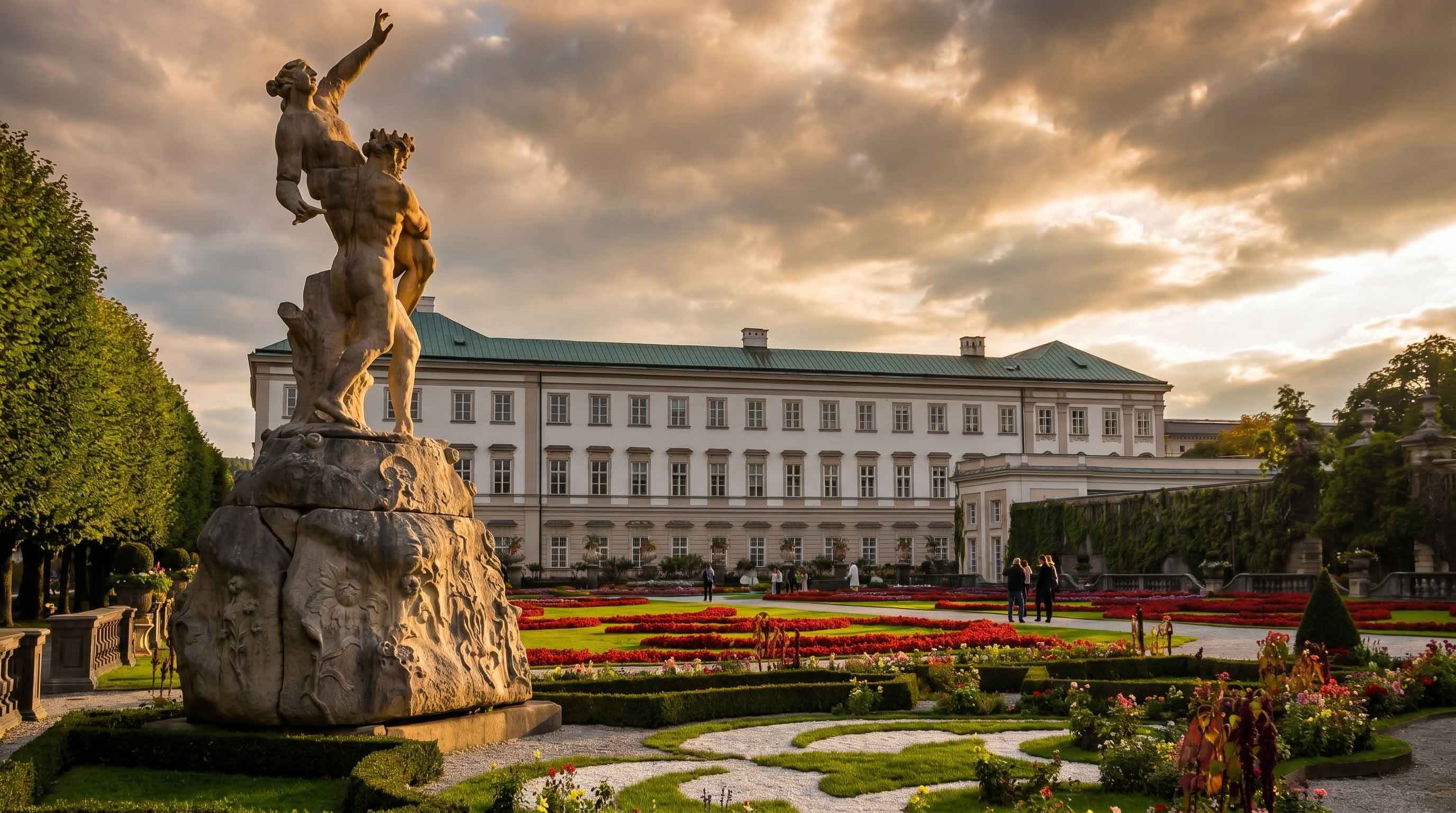
The most honest advice we can give: inside the old town ring, walking in summer is almost always faster. Mirabell Gardens to Domplatz is about twelve minutes on foot over the Staatsbrücke. The same trip by vehicle on an August Saturday can take twenty minutes plus garage time. We say this to guests openly, even when it means one fewer job for us.
Heat, and why it changes the plan
The Salzburg basin traps warmth. Thirty-two to thirty-four degrees is no longer unusual in July and August, and humidity off the mountains makes it heavy. The old town offers little shade: Residenzplatz, Kapitelplatz and Domplatz are open stone surfaces that behave like a hotplate after eleven. Anyone travelling with children, older relatives or straight off a night flight should push the midday hours indoors, into the churches, the Residenzgalerie, the DomQuartier, or the cool lanes of Steingasse on the right bank of the Salzach.
The Hohensalzburg fortress is also a heat question. The walk up the Festungsweg takes roughly twenty minutes and is steep. The funicular, return plus admission, costs somewhere around 14 to 18 euro per adult depending on the ticket, and on a hot day it is the sensible choice. We name third-party costs like this openly because they genuinely help with planning a day.
One practical note from the operating side: a vehicle standing in the sun for an hour is well over fifty degrees inside. We pre-cool before pickup. If you are travelling with small children, that matters, and so does a properly fitted seat. Sorting it in advance avoids a roadside debate: reserve child seats in advance.
Escaping to the lakes: rhythm, not route
The Salzkammergut starts twenty minutes east of the city. Fuschlsee, Wolfgangsee, Mondsee, Attersee, and further back Hallstatt. The route is trivial. The rhythm is everything.
The B158 through Hof bei Salzburg, Fuschl and the Scharfling is the classic connection, and in summer between 09:30 and 12:30 it is one continuous convoy of coaches and campervans. On the narrow stretches above the Wolfgangsee a single motorhome can build a queue of twenty vehicles. The alternative, the A1 Westautobahn to Mondsee and then south into the valley, is longer on the map but on many summer days genuinely faster and far calmer to drive.
Hallstatt is the special case. The village is tiny, car parks P1 and P2 are full by midday in good weather, and access is actively managed when it overloads. A day ticket at the car park runs roughly 10 to 15 euro. Arrive at 09:00 and you get an empty market square. Arrive at 12:00 and you see the same houses through five hundred phone cameras. That is why our Hallstatt tour from Salzburg starts deliberately early and routes back via St. Gilgen into the late afternoon light, long after the coaches have gone.
On the vignette: self-drivers need a valid motorway vignette in Austria. The 10-day version currently costs around 12 euro, the 2-month version about 30. With us it never comes up, since our vehicles carry valid vignettes and toll clearance as a matter of course, but anyone picking up a rental car near the border should know.
Airport, station and the ways into town
Salzburg W. A. Mozart Airport sits five kilometres west of the centre. That sounds harmless, and in winter it is. In summer the feeder traffic runs along Innsbrucker Bundesstrasse, and on August Saturday mornings, when charter waves collide with city traffic, twelve minutes becomes half an hour. If you have an early departure, leave before 06:45.
Many guests fly via Munich anyway. The run along the A8 and through the Walserberg border crossing takes about two hours when clear, but regularly two and a half to three hours on holiday weekends in July and August. Roadworks between Rosenheim and the Chiemsee are a permanent fixture. Everything about arrivals and departures is collected here: airport transfers to and from Salzburg.
Inside the city, the trolleybus is a serious competitor to any vehicle. Lines 1, 3 and 6 cover the main axes and a single ticket costs roughly 2.50 to 3.50 euro. For one hop from your hotel in the Neustadt to Mirabellplatz you do not need us. For luggage, groups, evening commitments, early flights, and anything involving children and a deadline, you very much do.
When a dedicated driver is the better answer
Three summer scenarios genuinely justify keeping a driver with you for the day or the evening. First, Festival days with several fixtures, where there is no slack between a matinee, lunch at the Fuschlsee and an evening performance. Second, lake circuits with four or five stops, where otherwise every stop means finding parking again. Third, wedding and corporate groups, where luggage and timetables have to move in sync. Details are here: private chauffeur in Salzburg.
And since it comes up often: we are not a metered street taxi. We work on an agreed fixed arrangement, with the same driver, a known vehicle and a schedule we walk through with you beforehand. In summer that is the real difference, when every minute stands between you and the curtain.
The short version
- Move before 09:30 and after 15:00. Avoid driving in between.
- On performance days add at least twenty minutes of buffer and fix the drop-off point in advance.
- Inside the old town ring, walking is usually faster and more pleasant in summer.
- Do Hallstatt and the Wolfgangsee early, and save the return leg for late afternoon.
- Spend the midday heat indoors, not on open squares.
If you are planning your summer days in Salzburg, send us your dates, your performance times and your party size. We will look at the sequence, tell you honestly which legs are worth driving and which are better on foot or by trolleybus, and come back to you with a no-obligation quote. Start here: request a quote.
Stefan Reiter — VPC Premium Transfer & Tours, Salzburg. Written first-hand: we drive these routes every day.
Frequently asked questions
What is the best time of day to get around Salzburg in summer?+
Before 09:30 and after 15:00. Between 09:30 and 12:00 the coach wave arrives, car parks fill and the old town is at its densest. On weekdays add local commuter peaks from 07:15 to 08:45 and 16:00 to 18:00. During the Festival weeks, 17:30 to 19:00 is the critical hour, because commuters and performance arrivals overlap.
How early should I leave for a Salzburg Festival performance?+
Allow at least 20 to 25 minutes more than a navigation app suggests. On performance days, access and stopping rules around Hofstallgasse and Max-Reinhardt-Platz are tight, so drop-offs usually happen at the edge with the last three to five minutes on foot. Arrive late and you wait for the interval. It is the hardest deadline in the city.
Is a car worth it inside Salzburg's old town?+
In summer, usually not. Mirabell Gardens to Domplatz is about twelve minutes on foot over the Staatsbrücke, while the same trip by vehicle on an August Saturday can take twenty minutes plus garage time. A vehicle earns its place for luggage, early flights, evening commitments, groups and trips out of the city, not for short hops inside the old town ring.
What time should I visit Hallstatt to avoid the crowds?+
Before 10:00 or after 16:00. Car parks P1 and P2 fill by midday in good weather, a day ticket runs roughly 10 to 15 euro, and access is managed when the village overloads. Arrive at 09:00 and the market square is nearly yours. The return leg via St. Gilgen is far calmer in the late afternoon.
How long does the drive from Munich Airport to Salzburg take in summer?+
Around two hours via the A8 and the Walserberg border crossing when traffic is clear. On holiday weekends in July and August, two and a half to three hours is realistic, mainly because of roadworks between Rosenheim and the Chiemsee. For a departing flight in summer we always build in an extra hour of buffer.
Do I need a vignette to drive to Salzburg?+
Yes, for Austrian motorways if you are driving yourself. The 10-day vignette currently costs around 12 euro and the 2-month version about 30, available at border service stations and digitally. With a booked chauffeur service it is a non-issue, since the vehicles already carry valid vignettes and toll clearance.
Is Salzburg's trolleybus a real alternative to a private driver?+
For single short hops without luggage, yes. Lines 1, 3 and 6 cover the main axes and a single ticket costs roughly 2.50 to 3.50 euro. Once suitcases, child seats, several people, early flights or fixed curtain times are involved, a dedicated vehicle saves real time, especially in the evening.
Your fixed price in 60 seconds — we handle the rest.
Private Mercedes chauffeur, flight tracking included, pay by cash or card.