travel-guide
Salzburg to Hallstatt: The Complete Day Trip Guide
Train and ferry, Postbus, coach tour or private transfer: honest travel times from Salzburg, when to leave, how much time you actually get in the village, what the Skywalk, salt mine and boat trip cost, and how to sidestep the coach crush between eleven and three.
Hallstatt sits barely 70 kilometres from Salzburg as the crow flies, but the road there is not a motorway. It is a chain of lake shores, tunnels and village high streets, and that is exactly what makes the day trip beautiful and, at the same time, easy to get wrong. We drive this route several times a week, in July with guests from the hotel district and in February with black ice on the Pötschenpass. This guide sets out what actually works and where visitors reliably lose hours.
The four ways to reach Hallstatt
There are four realistic options: train plus ferry, public bus via Bad Ischl, a guided coach tour, and a private transfer. None of them is universally better. It depends on how long you want in the village, how flexible you need to be, and whether you are travelling with children, luggage or older relatives.
| Option | Travel time each way | Realistic time in the village | Flexibility |
|---|---|---|---|
| Train + ferry via Attnang-Puchheim | 2 hr 30 to 2 hr 50 | 4 to 5 hours | Low, the connection is tight |
| Postbus via Bad Ischl | 2 hr 15 to 3 hr | 3 to 5 hours | Low, few departures |
| Guided coach tour | 1 hr 45 to 2 hr 15 | 1 hr 30 to 2 hours | None, fixed programme |
| Private transfer | 1 hr 20 to 1 hr 45 | 5 to 8 hours | Complete |
Train and ferry: romantic, but fragile
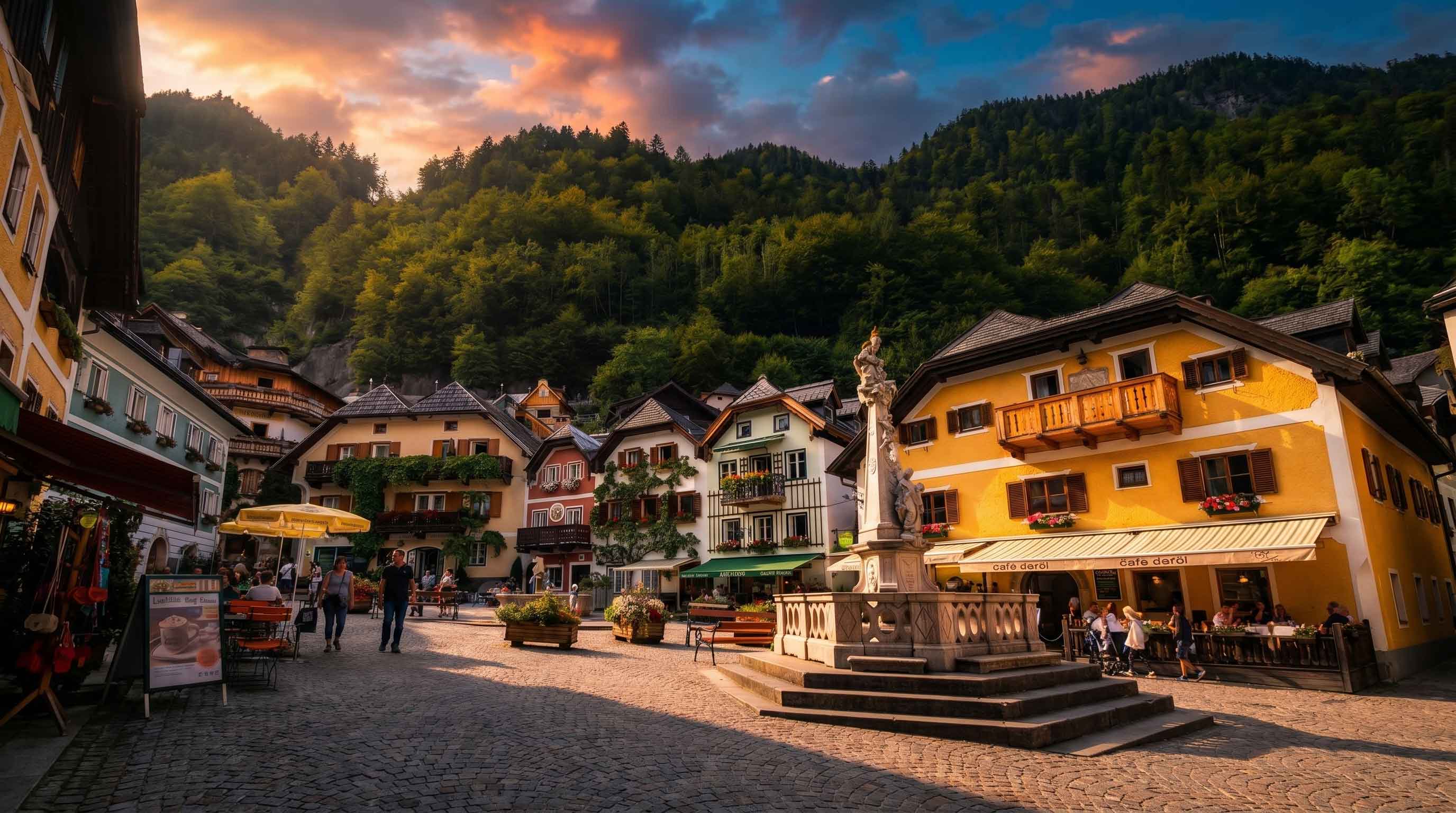
The classic route runs from Salzburg Hauptbahnhof to Attnang-Puchheim, then down the Salzkammergut line to Hallstatt station. That station is not in the village. It sits on the opposite shore, and a small ferry carries you across in roughly ten minutes, straight to the market square. The moment the village appears against the cliff face is, honestly, more beautiful than any approach by road.
The weak point is the change at Attnang-Puchheim. The window is short, and if the railjet from Vienna runs late you can lose an hour standing on that platform. The ferry is timed to the trains, but the last afternoon connections are thin, and if you miss one you are stranded on the wrong side of the lake. Expect roughly 20 to 30 euro per person each way for the rail leg and about 4 to 6 euro for the ferry. For two people this is clearly the cheapest way. From four people upwards the saving shrinks fast.
Bus via Bad Ischl: cheap, but it eats the day
Line 150 runs from Salzburg Hauptbahnhof through Mondsee and St. Gilgen to Bad Ischl, where you change to line 542 for Hallstatt Lahn. The stretch along the Wolfgangsee is genuinely lovely, but in summer the bus crawls between St. Gilgen and Strobl. Budget 2 hours 15 on a good day and up to three hours on an August Saturday. One real advantage: the bus stops at Hallstatt Lahn on the southern edge of the village, so you skip the ferry entirely.
The guided coach tour: shortest stop, least freedom
Large coaches usually leave the city between 8:30 and 9:30 and arrive in Hallstatt between 11:00 and 11:30, which is precisely the worst hour of the day. The stop is typically ninety minutes to two hours. That is enough for the market square, the standard photograph from Seestrasse and a coffee. It is not enough for the salt mine, the Skywalk or a boat trip. If the single photograph is your entire goal, fine. If you want to experience the place, it falls short.
Private transfer: why we leave at 7:30
Our drivers take the A1 to Thalgau, then the B158 through Hof and Fuschl to St. Gilgen, on via Strobl to the B145 into Bad Ischl, then through Bad Goisern onto the B166 along the lake. With a clear road that is 1 hour 20 to 1 hour 30. The alternative, staying on the A1 to Regau and dropping south past Gmunden, looks similar on paper but is often slower in the morning rush around Vöcklabruck.
What actually goes wrong: the Bad Ischl town crossing between 8:00 and 8:45 on weekdays, roadworks with temporary lights on the B158 in spring and autumn, and in winter the stretch between Bad Goisern and Hallstatt after fresh snow. So for a full-day trip in high season we start at 7:15 to 7:45. You are in the village shortly after nine, you get two quiet hours before the rush, and your midday looks completely different. The full itinerary is on our Hallstatt tour from Salzburg page.
Parking if you drive yourself
Hallstatt is largely closed to through traffic. You park at the numbered lots P1 to P3 along the approach road, with P2 inside the tunnel closest to the centre. Day rates run roughly 10 to 20 euro depending on season. On summer weekends P1 and P2 are full by about 10:30, and the queue that forms on the B166 can cost you half an hour. A hire car also needs the Austrian motorway vignette, around 12 to 14 euro for the ten-day sticker.
What is genuinely worth your time on site
The Skywalk and the salt mine
The funicular lifts you to the Rudolfsturm in a few minutes, and from there it is a five-minute walk to the viewing platform that hangs free above the rooftops. That view, not the market square, is the real event of the day. Combined funicular and mine tickets sit around 40 to 45 euro per adult depending on season. The mine tour itself runs about 70 minutes and the rock holds a steady eight degrees or so, which means a pullover belongs in your bag even in August.
The boat trip
Scheduled lake cruises from Hallstatt Markt take roughly 50 minutes and cost in the region of 15 euro. If all you want is the famous view of the village from the water, take the ordinary ferry across to the station and back instead. Half an hour, a fraction of the price, the same photograph.
The charnel house and the lanes
The small bone house beside St. Michael's chapel, with its painted skulls, is one of the most striking things in the Salzkammergut and most coach visitors walk straight past it. Entry is around two euro. Give it fifteen minutes.
The midday crush and how to sidestep it
Between 11:00 and 15:00 the entire coach flow from Salzburg, Vienna and Ceský Krumlov empties into the village at once. The market square is not thirty metres across, and in those hours several hundred people stand on it. Our advice: be there early, disappear up the funicular around eleven, eat lunch on the mountain, and come back down at about half past two. Alternatively drive out to Obertraun over lunch, walk part of the eastern shore path or visit the Koppenbrüller cave, and return at 16:00 when the coaches have gone. Between 16:30 and 18:30 in summer, Hallstatt is almost the village from the postcards again.
When train or bus is the better answer
We will say it plainly. If you are two people, have no fixed schedule and want the journey to be part of the experience, the train and ferry combination is hard to beat and we would tell you so on the phone. A private car earns its place when you are three or more, when small children are along, when you want to link several places in one day, when a flight has to be caught that evening, or in winter when timetables thin out. For families we fit appropriate seats through our child seat service, and anyone tying the day to an onward flight should plan it alongside our airport transfers.
Winter is not a bad idea
From November to March, Hallstatt on a weekday is close to empty, mist rises off the lake in the morning sun, and the photographs are better than anything you will get in July. The salt mine, however, normally closes from early November to late April, and the Skywalk depends on weather. The road through Bad Goisern is cleared and our vehicles run winter tyres throughout the season. If you want to combine the day with time in the mountains, our ski transfers cover the same corridor.
Tell us when you would like to start, how many of you are travelling, and whether the mine, a boat trip or a detour to St. Wolfgang should be part of it. We will build an itinerary with honest timings and send you a no-obligation quote for your day in the Salzkammergut.
Stefan Reiter — VPC Premium Transfer & Tours, Salzburg. Written first-hand: we drive these routes every day.
Frequently asked questions
How long does it take to get from Salzburg to Hallstatt?+
By car or private transfer it is 1 hour 20 to 1 hour 45 with a clear road, via Fuschl, Bad Ischl and Bad Goisern. Train plus ferry through Attnang-Puchheim takes 2 hours 30 to 2 hours 50, and the Postbus via Bad Ischl 2 hours 15 to three hours. In summer add 20 to 40 minutes on any of these options.
Can you do Hallstatt as a day trip from Salzburg?+
Yes, comfortably. With an early start at 7:15 to 7:45 you are in the village shortly after nine and have five to eight hours there. It also works by train, leaving roughly four to five hours on site. Only guided coach tours feel rushed, since the stop is often just ninety minutes to two hours.
When is Hallstatt least crowded?+
Before 10:00 and after 16:00. Between 11:00 and 15:00 the coach traffic from Salzburg, Vienna and the Czech Republic arrives together and the market square fills completely. Weekdays are quieter than weekends, and from November to March the village is close to empty on an ordinary weekday. Late summer afternoons are genuinely underrated.
Do you need to park outside Hallstatt and what does it cost?+
The centre is closed to through traffic. You park at lots P1 to P3 on the approach road, with P2 inside the tunnel nearest the village. Day rates run roughly 10 to 20 euro by season. On summer weekends the front lots fill by about 10:30 and a queue builds on the B166. A hire car also needs the Austrian motorway vignette.
Is the salt mine worth it, or is the Skywalk enough?+
The Skywalk alone is always worth it, the view is the highlight of the day. The mine tour runs about 70 minutes and is especially good with children. Combined tickets are around 40 to 45 euro per adult. Two things to know: the rock stays near eight degrees year-round, and the mine is normally closed from November until late April.
Do you have to take the ferry to reach Hallstatt?+
Only if you arrive by train. Hallstatt station sits on the opposite shore, and the ferry crossing takes about ten minutes at roughly 4 to 6 euro per trip. By bus, car or private transfer you reach the village directly on the B166 with no crossing needed. That said, arriving by boat is by far the most beautiful approach.
Can you combine Hallstatt with St. Wolfgang or the Wolfgangsee?+
Yes, and it is one of the main reasons people book a private car. The return leg already passes through Bad Ischl and Strobl, so a stop in St. Wolfgang or St. Gilgen adds only 45 to 90 minutes. It is technically possible on public transport in one day, but the connection times make it stressful in practice.
Your fixed price in 60 seconds — we handle the rest.
Private Mercedes chauffeur, flight tracking included, pay by cash or card.