travel-guide
Salzburg to Ljubljana: The Complete Travel Guide
About 290 kilometres, three toll systems and two national borders. What the drive from Salzburg to Ljubljana actually takes, where the Tauern queue forms, why no fast train exists on this axis, and how to arrive in Ljubljana's old town without ending up in a pedestrian zone.
Ljubljana is closer to Salzburg than most visitors assume. On the map it is roughly 290 kilometres, almost entirely motorway, and yet the connection sits in most travellers' heads as a full day's journey. That has less to do with distance than with what lies in between: the Tauern range, two summit tunnels with their own section toll, a national border inside the Karawanken tunnel, and a second toll system in Slovenia. Anyone who drives this route regularly knows the raw driving time is rarely the problem. The problem is the four or five places where it tips.
This is written from the driver's seat, after many runs in every season, with luggage, with children, with business travellers who have a 14:00 meeting in Ljubljana. It names roads, junctions, timings, and the points where our planning genuinely diverges from whatever the navigation system suggests.
The route: A10, A11 and the Karawanken
The standard route is unspectacular, which is exactly why it works. From Salzburg you join the A10 Tauern Autobahn heading south toward Villach. Past Golling and Werfen the road climbs into the Pongau valley, and then come the two bottlenecks: the Tauern tunnel near Flachau and Zederhaus, and shortly after it the Katschberg tunnel. Both fall under the section toll that is charged on top of the vignette.
Beyond Katschberg, Carinthia opens up. Via Spittal an der Drau and Villach you switch at the Villach interchange onto the A11 Karawanken Autobahn. The Karawanken tunnel runs just under eight kilometres and is the actual border. On the Slovenian side it continues as the A2 past Jesenice, past the Bled turn-off and Kranj, into Ljubljana. The final stretch from Kranj is the prettiest, with the Julian Alps standing in your left mirror.
Pure driving time with no stop and no queue: about three hours to three hours ten. Door to door, meaning pickup, luggage, one sensible break and the last mile inside Ljubljana, we plan three and a half to four hours and we say so honestly.
Where it actually goes wrong
The A10 is one of Austria's most reliable motorways and simultaneously one of its most brutally overloaded. The difference is the calendar, not the weather.
- Saturdays in winter, January to March. Ski changeover day fills the Salzburg to Radstadt section southbound between 08:00 and 12:00. On a Saturday morning, budget 45 to 90 minutes of buffer. We deliberately start earlier on those days, often 06:30.
- Summer weekends, July and August. Traffic heading for the Adriatic uses the exact same axis. Metered access at the Tauern tunnel produces queues that stretch for kilometres.
- Roadworks in the Tauern and Katschberg tunnels. Both bores get refurbished in phases, which means single-bore two-way running. That costs ten minutes on a normal weekday and an hour on a peak day.
- The Karawanken tunnel. You rarely wait because of the tunnel itself. You wait because of sporadic border checks on either side. They are not permanent, but they return, usually with no warning.
- Winter detours. The Wurzenpass and the Loibl pass are lovely and a poor idea in winter with luggage and a rental car on summer tyres. The Loibl's northern ramp has gradients that turn unpleasant when wet. We only divert there if the A11 is fully closed.
To be blunt: on a Tuesday in May at 09:00 this drive is relaxed and barely exceeds the map estimate. On 3 August at 10:00 it can take five hours. Same road, both times.
Tolls, vignettes and what self-drivers really pay
If you drive yourself you need three things. First the Austrian vignette, digital or sticker, roughly 12 to 13 euros for ten days. Second the section toll for the Tauern and Katschberg tunnels, around 15 euros combined per direction for a car. Third the Karawanken tunnel at roughly 8 euros per passage, plus the Slovenian e-vinjeta, available as a weekly vignette for about 16 euros. These figures are adjusted at each new year, but the order of magnitude stays stable.
A common and expensive mistake: the Slovenian vignette is purely electronic and tied to the number plate. There is no sticker any more, but there are very much cameras reading plates right after the tunnel. Forget it and the fine lands in the low hundreds. With a rental car, check whether cross-border travel into Slovenia is permitted at all. Many Salzburg airport contracts allow it but require written clearance first.
Why there is no fast train
The question comes up in nearly every second conversation: why is there no direct two-hour train? The answer is topography plus history. The rail axis between Salzburg and Ljubljana does not follow the motorway. It runs down the Tauernbahn to Villach, and there practically every traveller has to change. The continuation via Jesenice is a single-track mountain line with modest line speed.
In practice you are looking at four and a half to five and a half hours, few departures per day, and at least one change. If the Tauernbahn service arrives late into Villach, the connection is gone and the next one may be two hours out. For a solo traveller with light luggage and an appetite for scenery, the train is still a genuinely lovely option and I recommend it. For a family with four suitcases, a child seat and an afternoon appointment, it is not.
| Option | Door-to-door time | Changes | Best suited to |
|---|---|---|---|
| Private transfer | approx. 3.5 to 4 hrs | none | families, luggage, fixed appointments |
| Train via Villach | approx. 5 to 6.5 hrs | 1 to 2 | solo travellers, light luggage |
| Long-distance coach | approx. 5 to 6 hrs | usually 1 | tight budget, flexible schedule |
| Self-drive rental | approx. 3.5 to 4.5 hrs | none | those staying mobile afterwards |
Luggage, child seats and the break along the way
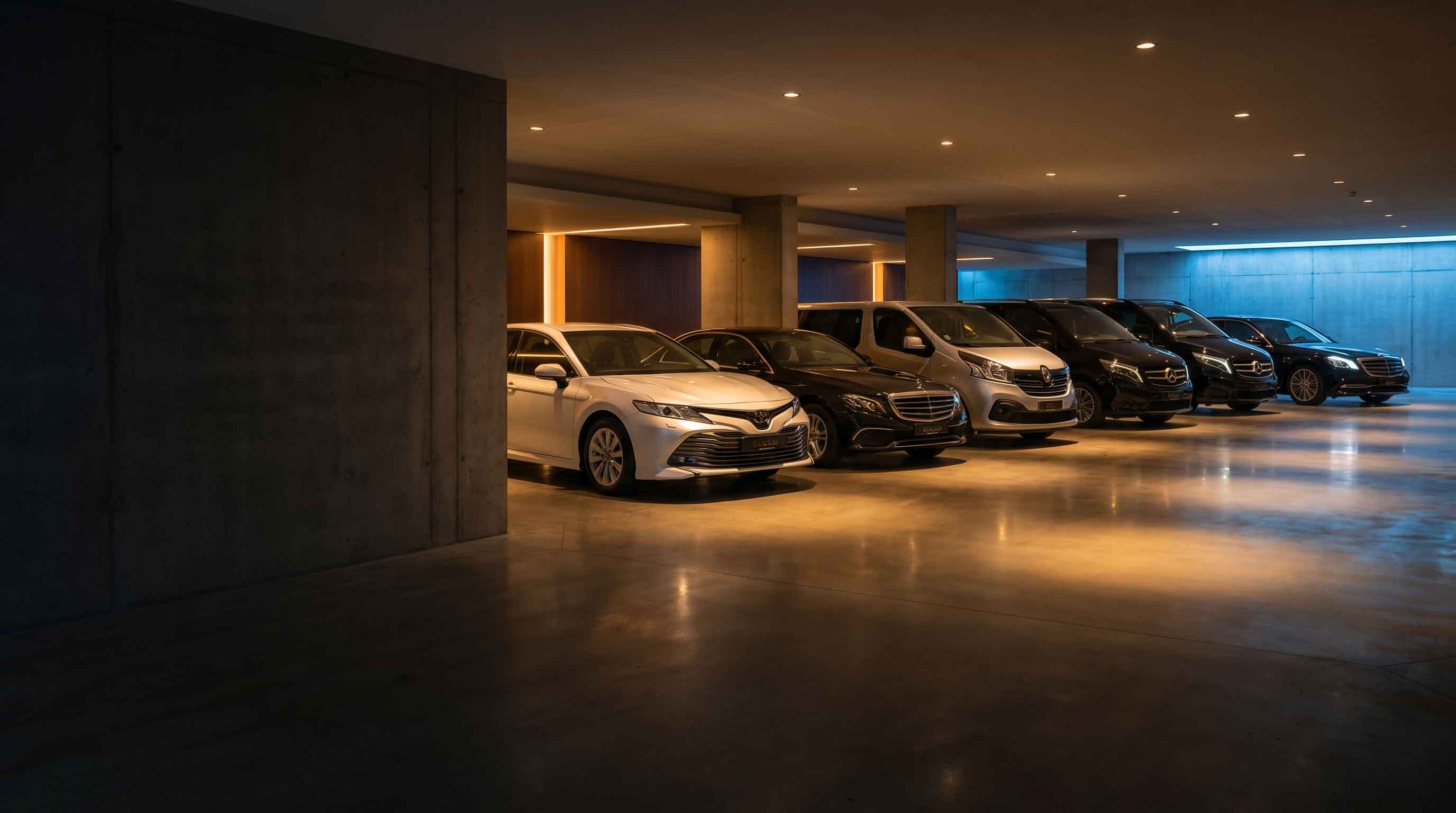
This is a luggage route. Many guests arrive with ski equipment from Zell am See or Obertauern and continue to Ljubljana; others travel with golf bags or cello cases. What matters is not seat count but boot volume. Four large suitcases plus hand luggage cannot honestly be fitted into a Mercedes E-Class; they can into a V-Class. That is why we ask for the number and type of bags on every booking, and it is not a formality.
Both Austria and Slovenia require child restraints up to 150 centimetres in height or twelve years of age. Suitable seats and boosters come through our child seat service, provided they are requested in advance.
For a break, the service area around Spittal and Lake Millstatt works well, as does a short detour to Lake Faak near Villach. Either costs twenty minutes and turns a transfer into a journey. With more time, add Bled: the detour off the A2 is under twenty minutes, and the island is at its best before the day coaches arrive.
Arriving in Ljubljana: the last mile
Ljubljana's old town is largely car-free, and rigorously so. Slovenska cesta is closed to through traffic and the embankments along the Ljubljanica are pedestrian zones. Follow your hotel address blindly into a satnav and you will meet a bollard.
Proven drop-off points are Kongresni trg for the western edge of the old town, Petkovškovo nabrežje for the north bank, and Gornji trg for the foot of the castle hill. From any of them it is a two to six minute walk. Self-drivers should aim for the Kongresni trg or NUK II underground garages, roughly 1.20 to 2.40 euros per hour with a daily cap. A hotel with its own garage inside the old core is the exception in Ljubljana, not the rule.
Half a day in the old town, without rushing
Ljubljana is small enough to grasp in an afternoon and dense enough to carry several days. For a first visit, this order works very well.
- Prešernov trg and the Triple Bridge. The central square with the pink Franciscan church and Jože Plečnik's three-armed bridge. Everything starts here.
- Central Market and the colonnade. Plečnik again, running along the river. Lively in the morning, quiet to closed on Sundays.
- Dragon Bridge. The city's emblem, four Art Nouveau dragons, five minutes downstream.
- Mestni trg, Stari trg, Gornji trg. The three linked old-town streets with the town hall and the Robba Fountain. This is where you eat and drink best.
- Ljubljana Castle. Twenty minutes uphill on foot, or the funicular from Krekov trg. A combined funicular and castle ticket runs about 13 to 16 euros; the funicular alone is well below that.
And here is a recommendation against our own interest: inside Ljubljana you do not need us. The city is flat, compact and faster on foot than in any vehicle. A car only makes sense again for the return leg, for excursions to Bled, Postojna or Piran, or when you have to move luggage from A to B.
When a private transfer genuinely pays off
Not always. If you travel alone with a backpack and your day is flexible, take the train via Villach and enjoy the window. If you are a couple planning several mobile days in Slovenia, rent a car and drive yourself; that is the economically clean answer.
A private chauffeur transfer earns its place where changing trains gets expensive: families with small children, business travellers with a fixed slot, onward flights from Salzburg or Munich, and any trip with serious luggage. Guests coming off the slopes often chain this route directly onto our ski transfers rather than reloading twice. For arrivals through the airports, the details sit under airport transfers.
If you are planning a run to Ljubljana, send us the date, time, number of passengers and pieces of luggage, plus any return leg or a stop at Bled. You will get a firm offer with vehicle class and driver, all tolls included, and you can decide in your own time. Get in touch and we reply the same day.
Stefan Reiter — VPC Premium Transfer & Tours, Salzburg. Written first-hand: we drive these routes every day.
Frequently asked questions
How long does the drive from Salzburg to Ljubljana take?+
Pure driving time via the A10 and the Karawanken tunnel is about three hours to three hours ten for roughly 290 kilometres. Door to door, including pickup, luggage and one break, we plan three and a half to four hours. On winter ski Saturdays and summer weekends in July and August, queues before the Tauern tunnel commonly add 45 to 90 minutes.
Is there a direct train from Salzburg to Ljubljana?+
Not a practical one. Nearly every connection runs down the Tauernbahn to Villach with a change there, then over the single-track mountain line via Jesenice. Realistically that means four and a half to five and a half hours with few departures per day. If the train into Villach runs late, the connection is gone. For solo travellers with light luggage the train is still enjoyable.
What tolls apply between Salzburg and Ljubljana?+
Three items: the Austrian vignette at roughly 12 to 13 euros for ten days, the section toll for the Tauern and Katschberg tunnels at around 15 euros combined per direction, and on the Slovenian side the Karawanken tunnel at about 8 euros plus the electronic e-vinjeta, roughly 16 euros for a week. These amounts are adjusted annually.
Do I need a Slovenian vignette and where do I get one?+
Yes, as soon as you use a Slovenian motorway or expressway, which starts at the Karawanken tunnel. The e-vinjeta is purely electronic and tied to your number plate; there is no sticker any more. Buy it online or at fuel stations shortly before the border. Plate-reading enforcement sits right after the tunnel and fines run into the low hundreds of euros.
Can you drive into Ljubljana's old town?+
Largely no. Slovenska cesta is closed to through traffic and the Ljubljanica embankments are pedestrian areas with bollards. Workable drop-off points are Kongresni trg, Petkovškovo nabrežje and Gornji trg, all within a two to six minute walk. Self-drivers are best served by the Kongresni trg or NUK II underground garages at roughly 1.20 to 2.40 euros per hour.
Is a stop at Bled worth it on the way?+
Yes, and at low cost. The turn-off from the Slovenian A2 adds under twenty minutes each way. A stop of one to one and a half hours covers the lakeshore path and a coffee. It is at its best early in the morning or in the late afternoon when the tour coaches are not parked along the shore. Please flag the stop when booking.
How much luggage fits in a vehicle for this route?+
As a rule of thumb, a Mercedes E-Class honestly takes two large suitcases plus two pieces of hand luggage. Four large cases, ski equipment or golf bags belong in a V-Class. Boot volume decides this, not seat count. Tell us the number and type of items, including prams or instruments, and we will assign the right vehicle class rather than guessing.
Your fixed price in 60 seconds — we handle the rest.
Private Mercedes chauffeur, flight tracking included, pay by cash or card.