travel-guide
Salzburg to Vienna: The Honest Guide to Train, Plane and Private Transfer
Railjet, plane or private transfer? We drive the A1 Westautobahn several times a week. Here are real door-to-door timings by weekday and season, the junctions where traffic actually stops, stopovers at Melk, the Wachau and Hallstatt, and the honest truth about luggage.
Salzburg to Vienna is the most argued-about journey in Austria, and most of what is written about it online comes from people who have done it twice. We drive it several times a week, in January snow, in the August holiday wave, and on Sunday evening when half of Upper Austria wants to get back to the city. This guide tells you honestly when the train is the better answer, why flying almost never makes sense, and when a private car genuinely earns its place.
The three options, compared without spin
Roughly 300 kilometres separate the Salzach from the Danube. On paper that is three hours of driving, two and a half hours by train, or a fifty-minute flight. In practice only one number matters: the time from your front door to your destination address, including waiting, changing, carrying bags and finding things.
| Criterion | Railjet | Flight | Private transfer |
|---|---|---|---|
| Pure travel time | approx. 2 hr 25 min station to station | approx. 50 min in the air | approx. 3 hr non-stop |
| Realistic door to door | 3 to 4 hr | 4 to 5 hr | 3 to 3.5 hr |
| Luggage | you carry it, racks are limited | check-in and reclaim | stays in the boot |
| Stopovers possible | only with a change of train | no | yes, freely planned |
| Weather exposure | very low | winter fog and wind | snow, but predictable |
| Best for | solo, couples, light bags | almost nobody | families, groups, deadlines, heavy luggage |
Railjet: when the train simply wins
We will say it plainly because it is true. If you are travelling alone or as a couple with hand luggage from Salzburg Hauptbahnhof to Wien Hauptbahnhof, with no hard deadline and no pram, the Railjet is unbeatable. It runs hourly through the day, takes around two hours twenty-five minutes, has power sockets, wifi and a dining car, and it does not sit in traffic. Sparschiene advance fares typically start somewhere around 20 to 30 euros per person; the flexible fare is considerably higher.
The train does have three weaknesses that nobody writes down. First, luggage: the open-plan coaches have only a handful of large-bag spaces, and anyone boarding with two big suitcases and a rucksack either blocks the aisle or wrestles a case overhead. Second, the last mile: from Wien Hauptbahnhof to a hotel in the first district means the U1 plus a walk, which with children and bags is comfortably thirty to forty-five minutes. Third, the first mile in Salzburg: if you are staying in Anif, Grödig, Wals or out by the Fuschlsee, you have already spent twenty to forty minutes just reaching the station.
Do the honest arithmetic. Four people with four suitcases changes the picture fast: four full-price tickets plus two last miles is no longer a bargain, and the comfort gap is enormous.
Flying: the option that almost always loses
Salzburg and Vienna are so close that a scheduled domestic flight barely works commercially, and the route has been thinned out heavily in recent years. Even if you find a rotation that fits, the maths look like this: an hour to Salzburg Airport, check-in and security, fifty minutes airborne, deplaning and the baggage belt at Schwechat, then the City Airport Train or the S7 into town. Four to five hours door to door is normal, and winter fog adds risk.
There is exactly one case where flying is rational: you are connecting onto a long-haul departure from Vienna Schwechat. Then the question is not Salzburg versus Vienna, it is connection security, and a direct ground transfer is often the calmer option because a missed feeder flight throws you into a completely different rebooking world. How we monitor flight times and build buffers is set out on our airport transfers page.
The A1 Westautobahn as it actually behaves
The A1 is a good motorway, but it has a character you need to know. From the Knoten Salzburg it runs east via Mondsee and Regau. The first pressure point is the Voralpenkreuz near Sattledt, where the A9 from Graz joins. The second is the Ybbs to Amstetten stretch, where contraflow roadworks can sit for months. The third and most important is the Vienna Woods: between Knoten Steinhäusl, the Wienerwald tunnel and the Auhof approach, weekday traffic collapses reliably between roughly 06:45 and 08:45.
Our working numbers, from the driver's seat:
- Tuesday to Thursday, departing 09:30: the golden window. Three hours ten to three hours twenty into central Vienna, no drama.
- Friday afternoon from 14:00 eastbound: workable, but the final thirty kilometres often cost twenty extra minutes.
- Sunday evening eastbound: the worst slot of the week. Between 16:00 and 20:00 we build in thirty to fifty minutes of buffer as standard.
- Saturdays in July and August: holiday changeover. Return traffic from the south pushes off the A10 and A9 onto the A1.
- January and February, Saturday morning: ski transfer traffic around Salzburg. Leaving early buys you half an hour. More on that under ski transfers.
If you are driving a hire car yourself, the digital vignette is compulsory: the ten-day version costs roughly 12 to 13 euros, the two-month version around 30 euros. Parking in Vienna is the real expense. A city-centre garage runs about 35 to 60 euros per day depending on location, on top of the city-wide short-stay parking zone. That is precisely why most guests switch to public transport on arrival anyway. A 24-hour Wiener Linien ticket is around 8 to 9 euros and is frankly the best way to move inside the Gürtel. Within the first district, walking beats every car, ours included.
Stopovers that turn the drive into the trip
This is the one advantage of a private car that cannot be argued away: the route itself becomes the itinerary. Three versions we run regularly.
Melk Abbey and the Wachau
Melk sits almost exactly halfway, and the exit puts you at the abbey gates within minutes. Ninety minutes covers the library, the Marble Hall and the terrace over the Danube. Then comes the finest detour in Austria: instead of rejoining the A1, follow the B33 along the south bank to Spitz, Weissenkirchen and Dürnstein, then via Krems and the S5 onto the A22 into Vienna. It adds roughly two to two and a half hours over the direct run and is worth every minute during apricot blossom in April and the October harvest. One warning: Dürnstein is hopelessly crowded on summer weekends, so we drop guests at one end of the village and collect them at the other.
Hallstatt
Hallstatt is not on the way; it lies well to the south. Via the Regau exit and the B145 Salzkammergut road it is about ninety minutes from Salzburg, after which you head back north towards Vienna. Budget generously, eight to ten hours in total. The village itself is effectively car-free, the P1 and P2 car parks cost roughly 10 to 15 euros a day and are full by ten in the morning in summer. Our advice: be there before nine or after four. The lake view is identical and the village is a different place. Day-trip details are on our Hallstatt tour from Salzburg page.
The short classic
If you only want a break: Mondsee, with the basilica from the famous wedding scene, is twenty minutes after departure, and St. Wolfgang another fifteen minutes off the line. Either adds about an hour overall and breaks the journey pleasantly.
Luggage, children and the truth about door to door
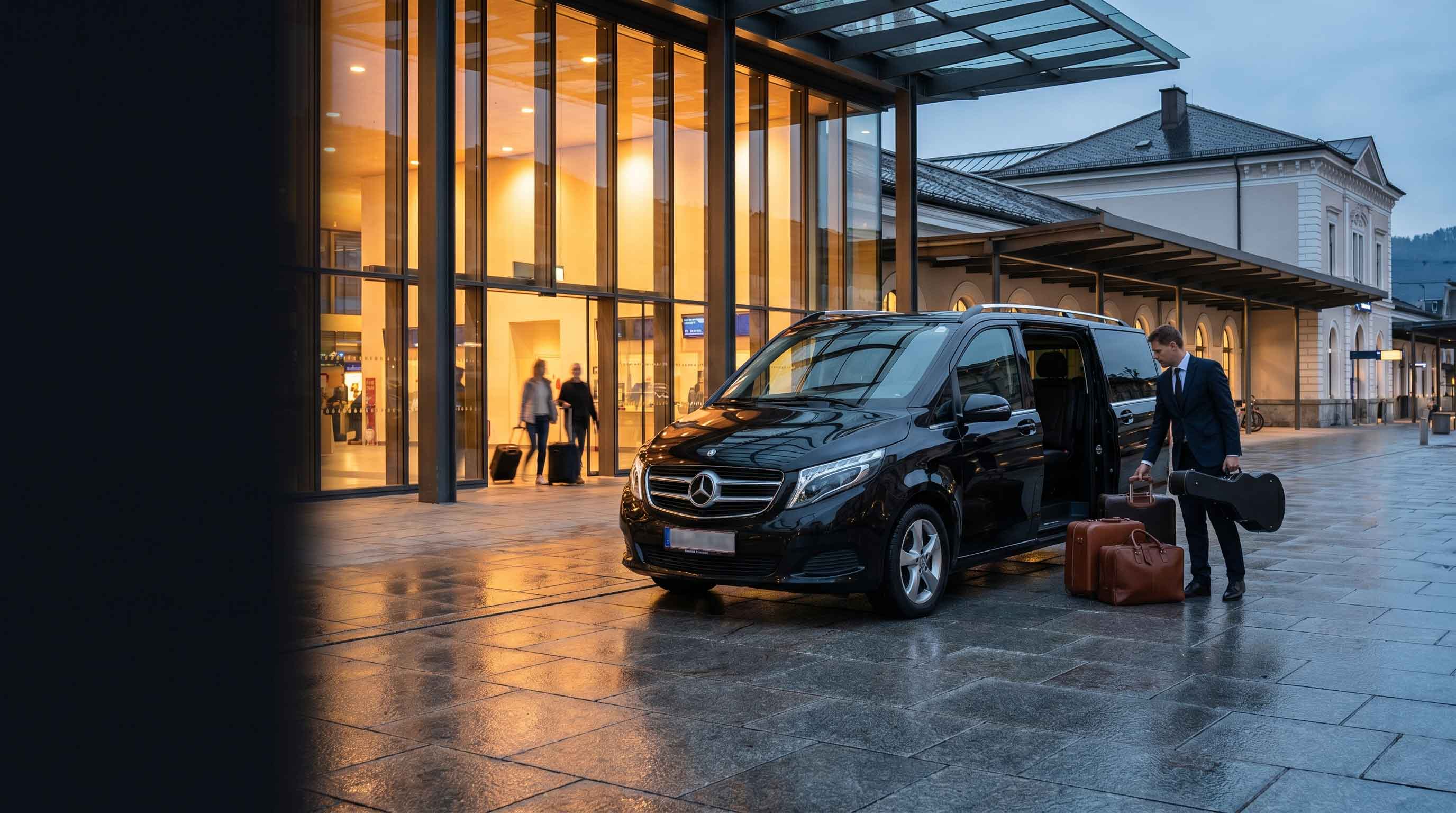
The most common reason guests end up with us is mundane: bags. An E-Class takes two large suitcases plus hand luggage comfortably; a V-Class swallows six or seven cases plus ski bags. A pram, two child seats and three suitcases on a Railjet is an athletic event; in a car they are simply loaded. We fit child seats in advance when they are mentioned at booking, see child seat service.
And the honest counter-argument: if there are two of you with roller cases going station to station, and your Vienna hotel is a short walk from the U1, take the Railjet. If you have an 08:30 meeting in central Vienna, take the train as well, because the Vienna Woods at rush hour is not where meetings are won. A private transfer earns its keep with families, groups of three or more, heavy luggage, onward flights, limited mobility, and whenever the journey itself is meant to be part of the holiday. Unlike a metered taxi flagged at the kerb, the fare is agreed in advance, the car is waiting at the agreed time, and the driver knows the alternative routes. How we run longer days with a dedicated driver is explained under private chauffeur.
How we plan a Salzburg to Vienna run
For meetings in Vienna we depart on weekdays either before 06:00 or after 09:30, never in between. For onward flights at Schwechat we allow at least four hours before departure, five for long-haul. In winter we add twenty minutes the moment snow is forecast for Upper Austria, because the Mondsee to Regau section turns sluggish immediately in wet snow. And we will tell you in advance if we think the train is the smarter choice for your particular situation. It costs us a job and saves you a bad day.
Send us the date, the time, the number of passengers, how much luggage you have, and whether you would like to stop at Melk, in the Wachau or at Hallstatt. You will get a firm quote with a fixed route and a named vehicle class, and no surprises on arrival. Reach us through the booking enquiry and we usually reply the same day.
Stefan Reiter — VPC Premium Transfer & Tours, Salzburg. Written first-hand: we drive these routes every day.
Frequently asked questions
How long does it take to drive from Salzburg to Vienna?+
Without stops and without traffic we plan around three hours for the roughly 300 kilometres on the A1 Westautobahn. Realistically, door to door is three to three and a half hours. On Sunday evenings, summer Saturdays and during the weekday morning peak in the Vienna Woods we add thirty to fifty minutes of buffer.
Is the Railjet faster than driving?+
Station to station, yes, at around two hours twenty-five minutes. Door to door usually not, because you add getting to Salzburg station, the U-Bahn change and the walk to your hotel. With light luggage and a central address the train wins; with a family, heavy bags or an address outside the centre the car wins.
Can you visit Melk and the Wachau on the way to Vienna?+
Yes. Melk sits almost exactly halfway, right on the A1, and ninety minutes is enough for the abbey. If you then follow the B33 through the Wachau to Krems before turning towards Vienna, you add roughly two to two and a half hours to the total journey. April and October are the most rewarding months for it.
Is a Hallstatt stopover on the way to Vienna worth it?+
Hallstatt is not on the route; it lies well south of it. It is about ninety minutes from Salzburg, after which you head back north. The full day runs eight to ten hours. If you do it, be there before nine in the morning or after four in the afternoon, otherwise the village is overwhelmed in summer and the car parks are full.
Do I need a vignette for the A1 between Salzburg and Vienna?+
Yes, a vignette is compulsory on all Austrian motorways, including for hire cars registered abroad. The digital ten-day vignette costs roughly 12 to 13 euros and the two-month version around 30 euros. On our vehicles this is already taken care of, so it is not something you need to arrange.
How much luggage fits in a transfer vehicle?+
An E-Class saloon comfortably takes two large suitcases plus hand luggage for two passengers. A V-Class van holds six or seven cases plus ski bags or a pram. Tell us the exact luggage when you enquire and we assign the right vehicle class in advance rather than improvising at the kerb.
When should I leave for a connecting flight from Vienna Schwechat?+
We plan at least four hours before departure, and five for long-haul. That covers the three-hour drive, the run out on the A4 to the airport, and a realistic buffer for the Vienna Woods and the city approach. In winter, or for Sunday evening departures, we add another twenty to thirty minutes on top.
Your fixed price in 60 seconds — we handle the rest.
Private Mercedes chauffeur, flight tracking included, pay by cash or card.