travel-guide
Salzkammergut from Salzburg: The Ultimate Day Trip Guide
Fuschlsee, Mondsee, Wolfgangsee, Attersee, Hallstättersee: which lake suits which traveller, how long the B158 and B145 really take, where July traffic jams up, and which one-day routes genuinely work without rushing.
We drive the Salzkammergut lakes for a living, sometimes daily in high summer, sometimes alone on the road for weeks in November. This guide is not brochure copy. It is what we tell guests in the car anyway: which lake suits which traveller, how long the drives actually take, what goes wrong, and when the train, the bus or your own two feet are simply the better answer.
The geography in five minutes
The Salzkammergut starts practically at Salzburg's eastern city limit. From the Salzburg Süd motorway junction or via the B158 you reach the first lake in a little over 20 minutes. The lakes are not strung along one line. They sit in two bands: one along the B158 (Fuschlsee, Wolfgangsee), one along the A1 motorway and the B151 (Mondsee, Attersee). Hallstättersee lies well to the southeast, beyond Bad Ischl, and is the only destination that fills a full day on its own.
Miss that and you plan the classic mistake: Mondsee, Wolfgangsee and Hallstatt before lunch. It does not work without turning the whole thing into a film playing past the window.
Driving times, honestly counted
Times below are measured from Salzburg's old town in normal traffic, no stops. In July and August add 15 to 30 minutes between Mondsee and St. Gilgen on fine days, and rather more on Sunday afternoons heading back toward the city.
| Destination | Route | One way | Suits |
|---|---|---|---|
| Fuschlsee | B158 | 25 to 30 min | short windows, a walk, coffee |
| Mondsee | A1 via Thalgau or Mondsee exit | 30 to 35 min | the wedding church, promenade, families |
| St. Gilgen (Wolfgangsee) | B158 | 35 to 40 min | lake boats, Zwölferhorn, village |
| St. Wolfgang | B158 then B154 | 50 to 60 min | White Horse Inn, Schafberg railway |
| Attersee (Unterach) | A1, B151 | 50 to 55 min | quiet, Klimt, swimming, sailing |
| Hallstatt | B158, B145, B166 | 75 to 90 min | a whole day, salt mine, photographs |
Which lake for which traveller
Fuschlsee: the underrated neighbour
The smallest of the five, walkable all the way around in roughly two hours, drinking-water clean, and with a shoreline far less built up than its neighbours. For guests with half a day, for older travellers, and for anyone who has just come off a long-haul flight and wants one deep breath, Fuschlsee is almost always the sensible answer. The castle on the north shore is private property; the view from the road is enough.
Mondsee: families, church, promenade
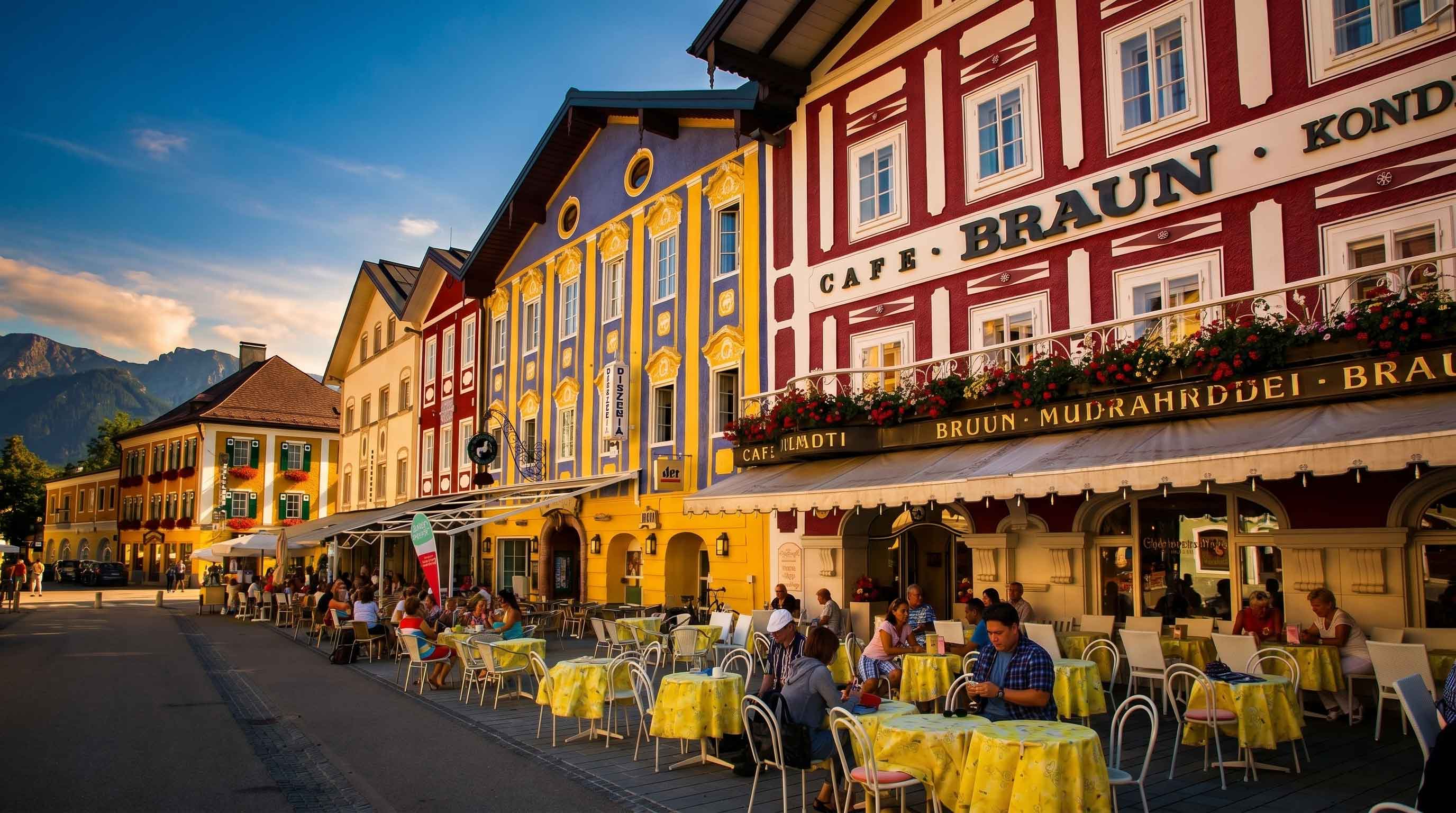
Mondsee is warm, shallow and sociable. The Basilica of St. Michael is the wedding church from The Sound of Music and is busy accordingly. The town has a handsome market street and enough cafés to fill two pleasant hours. Families with small children do better here than in Hallstatt, where the narrow lakeside path and the crowds make a pushchair hard work.
Wolfgangsee: the postcard
St. Gilgen on the western shore and St. Wolfgang on the northern shore are two very different places. St. Gilgen is quieter and quicker to reach; St. Wolfgang is the magnet, with the White Horse Inn and the Schafberg cog railway. Our advice for a one-day visit: drive to St. Gilgen, then take the lake steamer across. You skip the tight B154 and you see the lake from the angle it was meant to be seen from.
Attersee: the quiet giant
Upper Austria's largest lake, deep blue, windy, and for exactly that reason sailing country. Klimt painted here and the bus shelters along the west shore carry his paintings. Attersee is not a sightseeing lake, it is a staying lake. If you want to tick items off a list, go elsewhere. If you want to sit by water for three hours without crowds, this is it. The shore road from Unterach to Weissenbach is one of the finest in Austria and correspondingly slow in summer.
Hallstättersee: beautiful, tight, overrun
Hallstatt deserves its fame and is also the place where we counsel restraint most often. The village core has been closed to through traffic for years; every vehicle ends up in car parks P1 to P3, which fill from roughly ten in the morning on summer days. Day parking runs roughly 10 to 15 euros depending on the garage and season. A visit made between eleven and three mainly shows you other visitors. That is why we like a seven o'clock departure from Salzburg. We set out the full sequence on our Hallstatt tour from Salzburg page.
The roads themselves
The B158 out of Salzburg is the prettiest approach and the most fragile. Between Hof bei Salzburg and Fuschl it twists; the village of Fuschl is a 30 km/h zone; and the descent into St. Gilgen is unpleasant in the wet. Farm traffic and early-summer cyclists slow it further.
The A1 Westautobahn is the fast option toward Mondsee and Attersee. If you drive yourself you need a valid vignette; the ten-day sticker currently costs around 12 to 13 euros and is sold at every border filling station. Friday afternoons and Sunday evenings the A1 between Salzburg and Mondsee reliably backs up. That is the norm, not the exception.
The B145 Salzkammergutstrasse from Bad Ischl is the artery toward Hallstatt and Bad Aussee. It is well built but there is no alternative route. A closure after an accident really does cost 40 to 60 minutes. That is why we never plan a return leg tight against a flight; if your day ends at the airport, see airport transfers.
In winter the problem is not motorway snow but freezing fog in the basins around Mondsee and Bad Ischl. Winter tyres are legally required between November and March and are standard in our fleet. If your trip continues into the mountains, our routes are listed under ski transfers.
Three routes that genuinely work
Route A: the classic four hours
Salzburg, Fuschlsee for a photo stop on the north shore, St. Gilgen for an hour in the village and along the promenade, Mondsee for the basilica and coffee, back on the A1. Four to four and a half hours in total. This is the route for cruise passengers, business travellers with a free afternoon, and anyone with a concert in the evening.
Route B: the full day with Hallstatt
Leave at seven, run via the B158 and Bad Ischl straight to Hallstatt, two to three hours on the ground including the salt mine or the bone house, lunch in Obertraun or Gosau, then home with a stop in St. Wolfgang. Nine to ten hours. Only worth it if you genuinely want the early start.
Route C: the slow day at Attersee
Salzburg, a short stop in Mondsee, over the Kienberg pass to Unterach, the shore road to Steinbach, a long stay by the water, home on the A1. Six hours, little programme, a lot of lake. Our favourite for guests who have been here before.
When train, bus or walking beats a car
We earn nothing by selling you a drive you do not need. Three honest cases:
- Hallstatt only, no time pressure, two people: the train from Salzburg Hauptbahnhof changing at Attnang-Puchheim, then the little ferry across the lake, is one of the loveliest arrivals in Europe and costs roughly 30 to 40 euros per person return. Slower, but memorable.
- Fuschlsee or Mondsee only: Postbus lines 150 and 140 run frequently from the main station and Mirabellplatz. For a walk and back that is entirely sufficient.
- Inside St. Wolfgang and Hallstatt: walk. Both centres are designed to be car-free and every attempt to get closer ends at a barrier.
A car with a driver pays off when you combine several lakes, travel with children or luggage, form a group of three or more, or have a flight the same day. Unlike a metered street taxi, the vehicle waits while you stay longer and the price is agreed before you set off, not by the meter. Our private chauffeur service is exactly that: someone who knows the B158, who waits, and who has the boot open when it rains. Child seats are fitted in advance, see child seat service.
Practical things that save the day
- In July and August leave before nine or after three. Everyone drives in between.
- Book the Schafberg railway and the Hallstatt salt mine online in advance. Without a ticket you queue 60 minutes in August.
- Bring swimwear even if the forecast looks doubtful. Fuschlsee and Attersee are pleasantly warm in high summer.
- Carry coins for village car parks; many rural machines still refuse cards.
- A rain jacket, not an umbrella. The wind on Attersee destroys umbrellas.
If you are planning your Salzkammergut day, simply tell us which lakes interest you, how many people are travelling and when you need to be back. We will propose a realistic route and send you an individual quote with no obligation. You can reach us directly through contact.
Stefan Reiter — VPC Premium Transfer & Tours, Salzburg. Written first-hand: we drive these routes every day.
Frequently asked questions
Can you do Hallstatt, Wolfgangsee and Mondsee in one day?+
Technically yes, sensibly no. Hallstatt alone consumes about eight hours including travel and time on the ground. Adding two more lakes leaves you roughly 30 minutes per stop and the rest of the day in the car. Better: give Hallstatt its own early-start day and combine the other lakes on a relaxed half-day.
Which lake is best for swimming?+
Mondsee is the warmest in high summer with the shallowest entries, ideal for children. Fuschlsee is clearer and quieter but cooler. Attersee is deep, cold and windy, superb for strong swimmers and sailors. Wolfgangsee sits in between. Swimming in Hallstättersee is possible but shoreline access is limited.
Do I need a vignette for a Salzkammergut day trip?+
Only if you drive yourself and use the A1 motorway, for example toward Mondsee or Attersee. The ten-day vignette currently costs around 12 to 13 euros, available digitally or as a sticker. The B158 via Fuschl and St. Gilgen needs no vignette but is slower. With a chauffeur the question does not arise.
How do I get from Salzburg to Hallstatt without a car?+
Take the train from Salzburg Hauptbahnhof, change at Attnang-Puchheim, continue to Hallstatt station on the eastern shore, then cross on the small ferry. Pure travel time is about two and a half hours each way, roughly 30 to 40 euros per person return. Arriving by boat gives you the best possible first view of the village.
When is the best season for the lakes?+
Late May through late June and the second half of September are ideal: warm water, long days, far less traffic than July and August. October gives misty mornings and clear afternoons, very photogenic. November to March is quiet and atmospheric, but many boat services and mountain railways pause for the season.
How long is the drive from Salzburg airport to the lakes?+
From the airport it is roughly 30 minutes to Mondsee via the A1, about 35 minutes to Fuschlsee and 45 minutes to St. Gilgen. Allow around 90 minutes for Hallstatt. Many guests set off straight after landing, leave luggage in the vehicle and check into their hotel only in the evening.
Are the roads driveable in winter with a normal car?+
Yes. The B158, B145 and A1 are cleared reliably. Austria requires winter tyres in wintry conditions between 1 November and 15 April. Freezing fog in the basins around Mondsee and Bad Ischl is more dangerous than snow. As a rule, add 15 to 20 minutes to every winter journey.
Your fixed price in 60 seconds — we handle the rest.
Private Mercedes chauffeur, flight tracking included, pay by cash or card.