travel-guide
St. Wolfgang, St. Gilgen and Wolfgangsee: The Complete Travel Guide
Two villages on the same lake, two very different days out: St. Gilgen is close, calm and quick to reach, St. Wolfgang is busier and sits behind a narrow shore road. Plus the Schafberg railway, the Zwölferhorn cable car, the lake ferry, bus 150, and the truth about the evening return.
Wolfgangsee sits about 30 kilometres east of Salzburg, and it is the lake our guests most often confuse with Hallstatt. It has a smaller reputation but is far more practical: get in at nine in Salzburg's old town and you are standing at the water in St. Gilgen by half past. We drive this route several times a week, in July as much as in a wet November, and this is our attempt to write down everything worth knowing beforehand.
Getting there from Salzburg: A1, Fuschlsee, B158
The standard route runs on the A1 Westautobahn towards Vienna to the Thalgau exit, then onto the B158 Wolfgangseestraße. From Thalgau you pass Fuschlsee through Hof bei Salzburg and Fuschl am See, then the road drops in switchbacks into St. Gilgen. Pure driving time from central Salzburg: roughly 35 to 45 minutes to St. Gilgen, roughly 50 to 60 minutes to St. Wolfgang.
What actually goes wrong: from Hof bei Salzburg the B158 becomes one long queue the moment a truck or a motorhome leads it. Overtaking opportunities are almost nonexistent. On Sundays and public holidays between 10am and noon, and on August changeover weekends, add 15 to 25 minutes. Using the A1 requires the Austrian vignette; the day vignette currently runs about 9 to 10 euros and the 10-day version about 12 to 13 euros. For a single outing the toll-free option via Koppl and the B158 from Hof is a genuine alternative, though it costs a good ten minutes.
In winter the critical stretch is between Fuschl and St. Gilgen. It lies in shade, freezes early, and is reliably cleared, but before seven in the morning it is regularly slick. If you need a January connection to the airport at 6:30am, plan generously; how we handle that is on our airport transfers page.
St. Gilgen or St. Wolfgang: the honest comparison
Both villages sit on the same lake, but the day feels entirely different. St. Gilgen is the place people live: quieter, with a pretty small centre around Mozartplatz, the birthplace of Mozart's mother, and a lakefront promenade you can walk in twenty minutes. St. Wolfgang is the postcard: the Weißes Rössl, the pilgrimage church with the Pacher altarpiece, narrow lanes packed with coach day visitors between 11am and 3pm in July and August.
| Criterion | St. Gilgen | St. Wolfgang |
|---|---|---|
| Drive time from Salzburg | approx. 35 to 45 min | approx. 50 to 60 min |
| Character | calm, residential, fewer groups | iconic, crowded midday |
| Mountain ride | Zwölferhorn cable car, year-round | Schafberg cog railway, approx. May to Oct |
| Public transport | bus 150 direct | bus 150 plus change, or ferry |
| Parking | several lots at the village edge | garage at entrance, often full midday |
| Best for | half day, families, quiet | full day with Schafberg |
Our recommendation after many runs: with only half a day, go to St. Gilgen. If you want the Schafberg, treat St. Wolfgang as a full-day destination. Doing both in one morning is possible, but it becomes sightseeing at walking speed with one eye on the clock.
Bus 150 and when it is genuinely the better answer
Bus 150 runs from Salzburg Hauptbahnhof via Mirabellplatz and Salzburg Süd to Bad Ischl, stopping at Fuschl and St. Gilgen along the way. It runs roughly every half hour during the day and is one of the most beautiful scheduled bus routes in Austria. A single to St. Gilgen costs around 9 to 11 euros, a return double that, and regional day tickets sit roughly in the 18 to 25 euro band depending on zones.
We will say it plainly: for two people with no luggage, a flexible schedule and decent weather, bus 150 to St. Gilgen is hard to beat, and we recommend it regularly. It becomes a problem when you are four or more, when there are pushchairs, ski gear or suitcases, when you have a flight the same day, or when you want St. Wolfgang. The 150 does not go there directly; you change in Strobl onto bus 546, and in summer the 9 to 10am departures from Salzburg are often full enough that standing as far as Fuschl is normal.
The ferry, the Schafberg railway and the Zwölferhorn
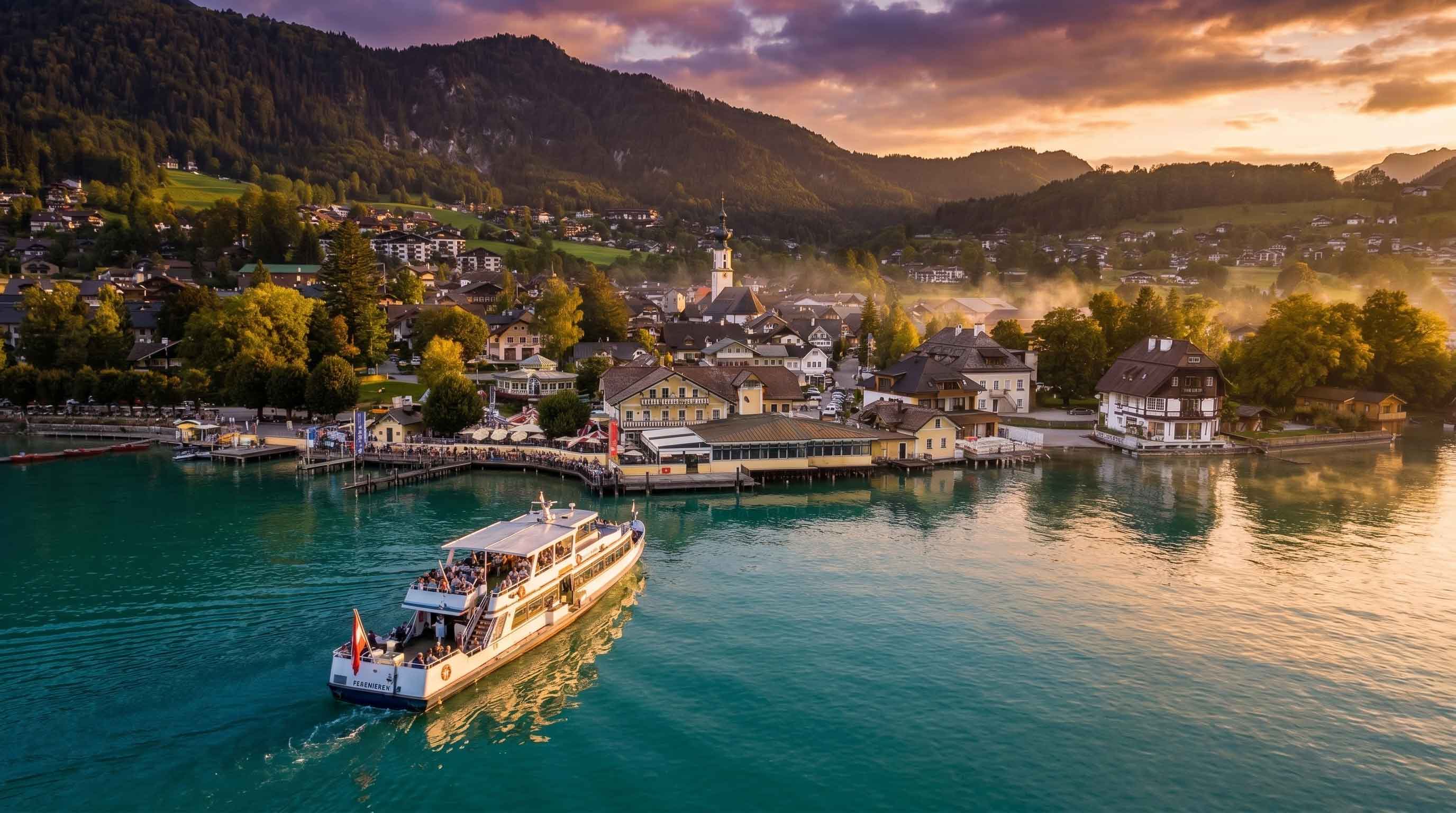
The Wolfgangsee shipping service runs roughly from late April to late October between St. Gilgen, Fürberg, Ried-Falkenstein, St. Wolfgang and Strobl. St. Gilgen to St. Wolfgang takes around 50 minutes and costs about 12 to 15 euros per adult one way. It is the finest connection the lake offers, and the only arrival that shows St. Wolfgang the way it was meant to be seen: head-on, from the water.
Our favourite combination, and the one we drive most often: we bring you to St. Gilgen, you take the ferry to St. Wolfgang, ride the Schafberg railway up, come back down, and we collect you in St. Wolfgang. No return sailing, no anxious watching for the last departure.
The Schafbergbahn is a cog railway from St. Wolfgang to 1,783 metres, operating roughly May to October, about 35 minutes each way, with a return ticket around 45 to 55 euros per adult. This matters: reserve your timed slot online in advance. On fine July days the morning departures from 10am sell out routinely, and arriving without a reservation can mean queueing for two hours. Allow at least an hour at the top or you will be rushing between the view and the descent.
The Zwölferhorn cable car in St. Gilgen is the calmer sibling: a modern gondola since 2020, about 12 minutes up, running year-round with maintenance breaks, return ticket roughly 30 to 35 euros. There is an easy loop walk at the top, plus tobogganing and skiing in winter. With small children or a tight schedule, the Zwölferhorn is the sensible choice. For everything on seats, see our child seat service.
Parking, village access and what really happens at midday
St. Wolfgang's centre is largely traffic-calmed. Self-drivers usually end up in the underground garage at the village entrance or the lots in front of it; expect roughly 2 to 3 euros per hour and about 12 to 18 euros for a day. Between 11am and 2pm in high summer the garage is regularly full, and the approach along the narrow shore road from Strobl backs up to before the village boundary. That is why we set down at the designated stopping bay and drive back out rather than circling inside. It saves you twenty minutes and us our composure.
St. Gilgen is more relaxed, but the lakefront car park fills from ten on swimming days. Paid, roughly the same rates. One detail that surprises many: between St. Gilgen and Fürberg the shore road is narrow enough in places that two coaches cannot pass. If you are stuck there in high summer, no clever routing helps, only patience.
The evening return, honestly calculated
This is where most day trips fall apart. The last boat from St. Wolfgang to St. Gilgen usually leaves in the early evening in peak season, and in shoulder season sometimes as early as late afternoon; from November to April it does not sail at all. The last bus 546 from Strobl and its connections onto the 150 back to Salzburg thin out after about 6pm, and thinner still on Sundays. If you are enjoying sunset on the Schafbergalm at 7:30pm, you effectively have no public transport home from St. Wolfgang.
Metered street taxis are essentially not waiting in St. Wolfgang in the evening, and ordering one out from Salzburg means both the approach time and the approach cost. That is exactly why a pre-arranged pickup at a fixed time is the calmest option: you finish your meal without watching the clock. We drive the same pattern in winter, often alongside our ski transfers into the surrounding resorts.
When to come
May and June are our favourite months: the boats and the Schafberg are running, the meadows are up, and the coach groups arrive later in the year. July and August are lovely but loud; if you must, come early, meaning in St. Wolfgang before 9:30am. September is the most reliable choice for clear mountain views. Shipping ends in late October, November leaves the lake silent with most businesses closed. Advent is worth it again: the market in St. Wolfgang on the waterfront is one of the few that earns its reputation, and arriving by boat from Strobl is an experience in itself.
If you want both the lake and the Salzkammergut classics, Wolfgangsee combines well with a continuation; how the timings work is described on our Hallstatt tour from Salzburg.
Tell us how many of you there are, which day you have in mind, and whether the Schafberg or the Zwölferhorn belongs in the plan. We will work the timings through realistically, tell you frankly if bus 150 is the better answer that day, and send you a no-obligation quote. Get in touch and we usually reply the same day.
Stefan Reiter — VPC Premium Transfer & Tours, Salzburg. Written first-hand: we drive these routes every day.
Frequently asked questions
How long does it take to get from Salzburg to St. Wolfgang?+
Via the A1 to Thalgau and onward on the B158 the pure driving time is 50 to 60 minutes. On Sundays between 10am and noon and throughout August, add 15 to 25 minutes, because the B158 turns into a single queue past Hof bei Salzburg with almost no overtaking. St. Gilgen is only about 35 to 45 minutes.
Does bus 150 go directly to St. Wolfgang?+
No. The 150 runs Salzburg, Fuschl, St. Gilgen, Strobl and on to Bad Ischl. For St. Wolfgang you change in Strobl onto bus 546. To St. Gilgen, however, the 150 is direct, roughly every half hour, and at about 9 to 11 euros one way it is an excellent option for two people travelling without luggage.
Do I need to book the Schafberg railway in advance?+
Yes, absolutely in high season. The cog railway operates roughly May to October, takes about 35 minutes, and costs around 45 to 55 euros return per adult. On fine July days the morning departures from 10am sell out routinely. Without a timed reservation you risk waiting two hours in the village before you board.
St. Gilgen or St. Wolfgang, which is more worthwhile?+
For half a day, St. Gilgen: closer, quieter, with the year-round Zwölferhorn cable car. For a full day, St. Wolfgang, because the Schafberg railway starts there and the centre delivers the famous views. If you want both, go to St. Gilgen, take the ferry across, and be collected again in St. Wolfgang.
How do I get back to Salzburg from Wolfgangsee in the evening?+
This is the weak point. The boats usually stop in the early evening and do not sail at all from November to April. Bus 546 from Strobl and its connections onto the 150 thin out after about 6pm, and further on Sundays. Metered street taxis are rarely waiting in St. Wolfgang at night, so a pre-arranged pickup at a fixed time is the most reliable answer.
What is parking like in St. Wolfgang?+
The centre is largely traffic-calmed. There is an underground garage at the village entrance plus lots in front, at roughly 2 to 3 euros per hour or 12 to 18 euros for the day. Between 11am and 2pm in high summer everything is full and the narrow shore road from Strobl backs up. Being dropped off skips that loop entirely.
Do I need a vignette to drive there?+
Only if you use the A1 Westautobahn as far as Thalgau. The day vignette costs around 9 to 10 euros and the 10-day version about 12 to 13 euros. A toll-free route exists via Koppl and the B158 from Hof bei Salzburg, though it costs a good ten minutes more. For a single outing the toll-free option can genuinely pay off.
Your fixed price in 60 seconds — we handle the rest.
Private Mercedes chauffeur, flight tracking included, pay by cash or card.