travel-guide
Travelling to Salzburg With Large Luggage: What You Need to Know
How many large cases genuinely fit in each vehicle class, what happens with golf bags, instruments, prams and wheelchairs, and why cobblestones and lift-free old-town buildings are the real challenge in Salzburg.
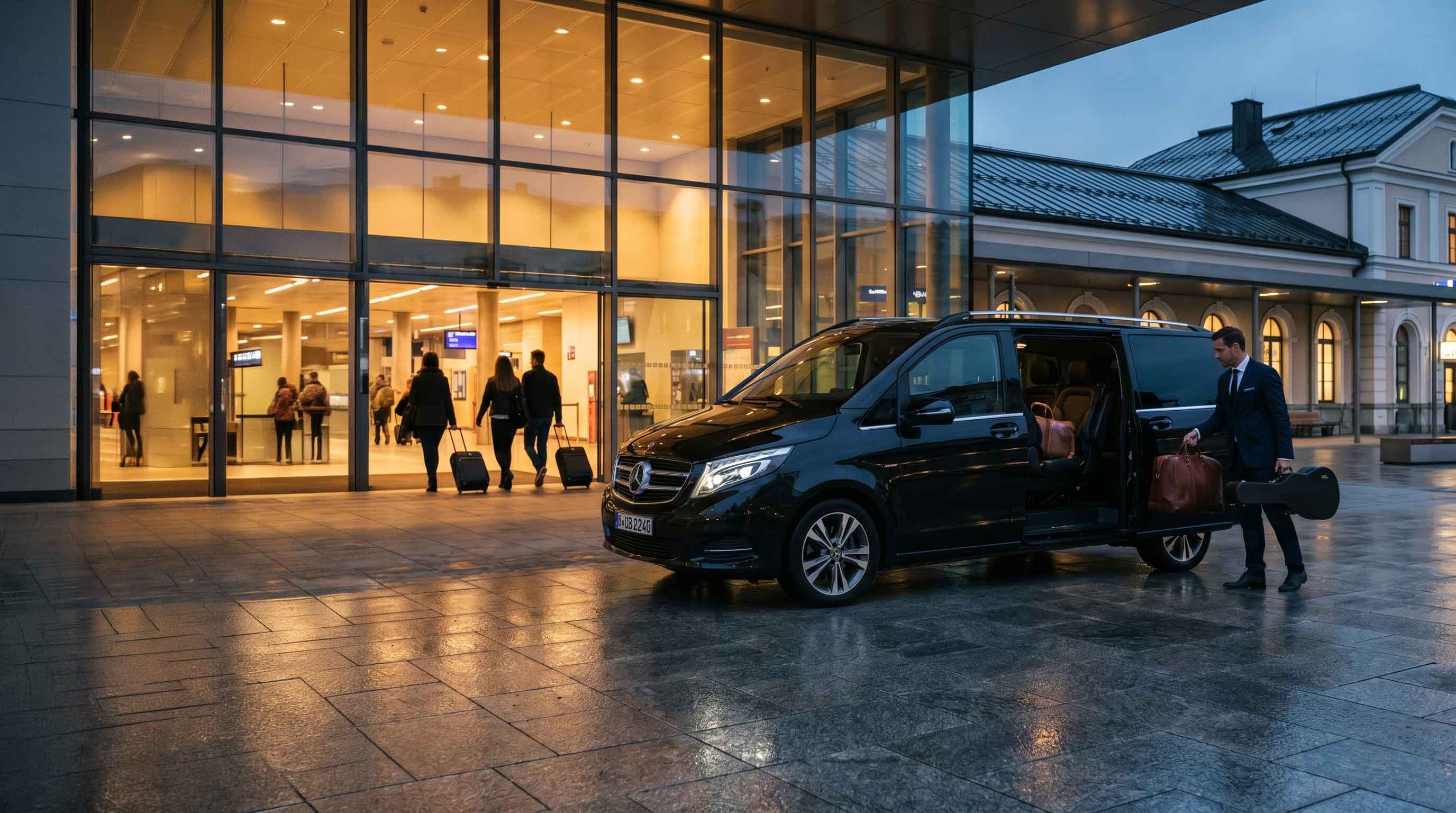
Most travellers plan their arrival in Salzburg around the number of people. In practice, luggage almost always decides whether an arrival is calm or ends in an awkward conversation at the kerb. Four adults fit in nearly any vehicle. Four adults with four large cases, two cabin bags, a pram and a cello case fit in very few. We drive these routes daily, from the airport into the old town, across from Munich, up into the ski resorts, and this guide collects what we have learned.
What "large" actually means
Manufacturer boot-capacity figures tell you very little about how many suitcases genuinely fit. Shape and height matter more than litres. We work with three practical categories:
- Cabin bag, up to roughly 55 x 40 x 23 cm, usually hard-shell and easy to stack.
- Medium case, around 65 to 70 cm tall, the typical week-long suitcase.
- Large case, from about 75 cm tall, often 28 or 30 inch, and frequently overpacked so it bulges. That bulge is what costs space.
A soft, tightly stuffed 30-inch case behaves in a load area like a piece of furniture. Two of them side by side block a boot that would otherwise take three hard-shell cases. If you are unsure, measure the height of your biggest item at home and tell us the number. That is far more useful than "normal luggage".
Capacity by vehicle class
The table below shows realistic figures, meaning what can be loaded safely and without blocking the driver's view. Full details on each model are on the fleet page.
| Vehicle class | Realistic passengers | Large cases | Additional cabin bags | Oversized items |
|---|---|---|---|---|
| Saloon (E-Class) | 1 to 3 | 2 | 2 | no |
| Business van (V-Class) | 1 to 6 | 5 to 6 | 4 | limited, by arrangement |
| Van with all 7 seats in use | 7 | 3 to 4 | 3 | no |
| Large-capacity vehicle (Vito, 8 seats) | 1 to 8 | 4 to 5 when full | 4 | yes, with fewer passengers |
The third row is the important one. A seven-seater with every seat occupied has almost no load space left, because the rear bench sits exactly where the cases would go. If seven of you travel with seven large cases, you need either two vehicles or a genuine large-capacity vehicle with a reduced seating layout. That is not a sales pitch, it is geometry.
Oversized items: golf bags, instruments, prams, wheelchairs, bike boxes
Bulky single items are almost never a problem when they are declared in advance, and almost always a problem when they are not. What we carry regularly:
- Golf bags are around 130 cm long and can only be loaded lengthways. Two bags plus four cases work in a van; three bags do not.
- Instruments come up unusually often in Salzburg, thanks to the Festival and the Mozarteum. A cello in a hard case travels on its own seat with us, not in the load area. Double basses and harps always need a conversation first, since interior height and loading lip decide the answer.
- Prams are the most underestimated space consumer of all. A modern twin buggy fills a saloon boot completely. Tell us the model or its folded dimensions and we plan correctly.
- Wheelchairs: folding manual chairs are straightforward. Powered chairs often weigh over 100 kg and cannot be lifted, so they need a ramp-equipped vehicle. Ask early, availability in Salzburg is limited.
- Bike boxes, at roughly 130 x 80 x 30 cm, are the bulkiest items we handle. One fits a van; two only with three passengers or fewer.
- Ski bags are rarely an issue as long as passenger numbers are moderate. Airline sports-equipment fees are the bigger cost, typically 40 to 90 euro each way.
The real obstacle: cobblestones, steps and the pedestrian zone
The drive is usually the easy part. The last two hundred metres are where things get difficult. Large parts of Salzburg's old town are pedestrian zones or restricted to permit holders, and the surface in Getreidegasse, Judengasse and around Residenzplatz is historic paving. Suitcase wheels survive it, but they sound like a road drill and jam easily. Between the old town and the Mönchsberg you also meet steps and gradients.
In practice this means we bring you as close to the address as the rules allow, often right to the door, sometimes to the nearest permitted stopping point. If your hotel sits deep in a pedestrian zone we clarify that in advance and help carry. When booking accommodation, always ask two questions: is there a lift, and how far is the nearest vehicle access.
Hotels and apartments without lifts
Many of the most beautiful old-town buildings are listed monuments and therefore have no lift. A third-floor room up a narrow spiral staircase is charming, but with two 30-inch cases it is genuinely hard work. With holiday apartments there is the added issue that nobody may be on site to help. If you travel heavy, choose a property with a lift, or stay in Nonntal, Riedenburg or the edge of the Neustadt where access is simpler.
Train, bus or door to door
We do not recommend a private vehicle for everything. With light luggage the train is often the better choice, and we say so. The overview below covers typical arrivals.
| Route | Private transfer | Public transport | Changes with luggage |
|---|---|---|---|
| Salzburg Airport to old town | approx. 15 min | bus approx. 20 to 25 min | 1, plus a walk |
| Munich Airport to old town | approx. 1 h 45 min | rail approx. 2.5 to 3 h | 2 to 3 |
| Vienna Airport to Salzburg | approx. 3 h | rail approx. 3 h | 1 to 2 |
| Salzburg to Zell am See | approx. 1 h 15 min | rail approx. 1.5 h | 1 |
Honestly: Vienna to Salzburg for two people with light bags is excellent by rail, fast, relaxed and inexpensive. From three large cases upward, or with children, the maths flips, because you move every item yourself on the platform, in the carriage and at the destination station. Munich is similar, with the added change between suburban rail and the long-distance train, plus stairs. For the short leg from the terminal, we describe the process in detail on the Salzburg Airport transfer page.
Luggage storage in Salzburg
The classic situation: check-out at ten, flight at eight in the evening. The main station has lockers in several sizes, usually around 3 to 6 euro per day. In high season, especially during the Festival and on Advent weekends, the large lockers are often taken by mid-morning. Several shops in the centre and near the station also offer storage, typically 5 to 8 euro per item per day. And almost every hotel will hold your bags after check-out free of charge, which is the simplest and most reliable option.
Practical tips from daily driving
- When booking, give the number of bags split into large and small, not just the passenger count.
- Declare every oversized item separately, including approximate dimensions.
- Hard-shell cases use load space far better than soft, overstuffed holdalls.
- Pack three medium cases rather than two enormous ones; they load more flexibly and carry more easily.
- Check lift and vehicle access before confirming your hotel. That removes most surprises.
- Keep medication, documents and chargers in one small bag within reach.
- Child seats take space too. Tell us the children's ages and weights so we bring the right ones.
- If you would otherwise be carrying a lot between terminal and city, a second vehicle is usually more comfortable than one overloaded one.
Conclusion
Luggage is not a side issue in Salzburg. It is the factor that shapes your first travel day. The combination of a historic old town, narrow lanes, pedestrian zones and lift-free buildings rewards a little planning. Tell us in advance how many pieces you are bringing and which of them are bulky, and we will send the right vehicle and get you as close to the door as the rules permit. Simply include your luggage list with your enquiry, and we will plan the rest.
Stefan Reiter — VPC Premium Transfer & Tours, Salzburg. Written first-hand: we drive these routes every day.
Frequently asked questions
How many large suitcases fit in a van?+
A business van carrying up to six passengers realistically takes five to six large cases plus about four cabin bags. If the seventh seat row is in use, capacity drops to three or four large cases, because the rear bench occupies exactly the load space.
Can I bring golf bags or a bike box?+
Yes, if declared in advance. Two golf bags plus four cases work in a van. One bike box of roughly 130 x 80 x 30 cm fits a van; two only with three passengers or fewer. Please state quantity and approximate dimensions with your enquiry.
How do I transport a cello or double bass in Salzburg?+
A cello in a hard case travels on its own seat with us rather than in the load area. Double basses and harps need clarification in advance, since interior height and loading lip decide feasibility. Please mention the instrument when booking.
Can you get through Salzburg's old town with suitcases?+
It is possible but unpleasant. Large parts of the old town are pedestrian zones with historic cobblestones, plus steps towards the Mönchsberg. We drive as close to the address as permitted and help carry the final stretch.
Where can I store luggage in Salzburg?+
The main station has lockers in several sizes, usually around 3 to 6 euro per day, though the large ones fill up early in high season. Some city-centre shops offer storage at roughly 5 to 8 euro per item. Simplest of all is your hotel, which will normally hold bags free after check-out.
Train or private transfer when travelling with heavy luggage?+
With light luggage the train is often the better choice, for example Vienna to Salzburg in about three hours. From three large cases upward, or with children or oversized items, a door-to-door transfer pays off, because changes, stairs and platform walks otherwise become the main effort.
Your fixed price in 60 seconds — we handle the rest.
Private Mercedes chauffeur, flight tracking included, pay by cash or card.