travel-guide
Wedding Transportation in Salzburg: The Complete Guide
Church, Schloss or lakeside: couples marrying in Salzburg almost always underestimate drive times. How shuttle waves actually work, which vehicle suits a hooped skirt, why the B158 needs 75 minutes in August, and how to plan the run back to town after midnight.
I have driven wedding parties around Salzburg city and province for years, and I will start with the uncomfortable part: transport is the element of the day that most often goes wrong, and it is also the element almost nobody plans seriously. Flowers, menu and music get months of attention. The question of how sixty guests get from the cathedral to Schloss Leopoldskron at 16:30 while festival crowds fill the old town usually surfaces about two weeks out. This guide is not a brochure. It is what I would tell a couple over a kitchen table.
The three Salzburg wedding geographies
Almost every wedding here falls into one of three categories, and each has its own logic.
City. Civil ceremony in the Marmorsaal at Schloss Mirabell, church at the Dom, Stiftskirche St. Peter, the Kollegienkirche or the Franziskanerkirche. Sounds simple. It is not. The old town on both banks of the Salzach is largely pedestrian or residents-only. Vehicles reach Kapitelplatz, Kajetanerplatz or Herbert-von-Karajan-Platz, and after that everyone walks. Anyone who imagines pulling up outside the cathedral has never seen Domplatz on a Saturday in July.
Schloss and estate. Leopoldskron, Hellbrunn with its Orangerie, Mönchstein on the Mönchsberg, Kavalierhaus Klessheim, Schloss Urstein, Gut Aiderbichl. These mean gravel drives, narrow gateways and very limited turning space. A 50-seat coach simply does not get up to Mönchstein; the climb via Mönchsbergstraße is no place for a large vehicle.
Lake. Fuschlsee, Wolfgangsee with St. Gilgen and Strobl, Mondsee with the Basilika St. Michael, Wallersee, Mattsee, Hintersee. Unbeatable scenery, and logistically the hardest case, because everything depends on one single road.
What actually happens on the roads
The B158 from Salzburg via Hof and Fuschl to St. Gilgen is the main artery for lake weddings and, in summer, the most reliable source of delay in the whole province. Single lane, almost no overtaking, and from May onward it clogs on fine Saturdays between 10:00 and 14:00 with day-trippers, motorcycle groups and campervans. What takes 35 minutes on a Tuesday in March takes 60 to 75 minutes on the third Saturday in August. If your ceremony is at 14:00 in St. Gilgen and you leave the city at 13:10, you are gambling.
Mondsee is reached via the A1 Westautobahn, which is far more stable, though the Thalgau exit backs up in the opposite direction on Sunday afternoons. Heading south to Golling, Werfen or Hallein I use either the A10 or the B159 through the Salzach valley depending on the hour. From roughly 14:00 on Fridays the A10 regularly congeals near the Salzburg junction and towards the Tauern, and the B159 is often faster despite its lower speed limit.
In the city itself the classics are the Staatsbrücke during events, the Neutor tunnel in heavy rain, and Rainerstraße around the main station. Then there are dates you simply have to know. The festival season from late July to the end of August rewrites old-town traffic entirely, the Rupertikirtag in late September closes parts of the centre, and in Advent Residenzplatz and Mirabellplatz become Christmas market territory with the closures that follow. A December wedding is beautiful and logistically demanding.
Guest shuttles: the honest arithmetic
The most common planning error is assuming guests will sort themselves out. They will not. They rent cars, fail to find parking, arrive late for the ceremony, and then drink in the evening and are stuck with a vehicle. Austria's limit is 0.5 per mille, and 0.1 for newly licensed drivers. A shuttle is not a luxury; it is the condition under which your guests can actually enjoy the night.
A hub-and-spoke structure works: two or three collection points in the city, typically the main station, a hotel cluster around Mirabellplatz or Rainerstraße, and one point in the old town. From there, run waves to the venue. Sixty guests do not need a coach if three vans shuttle; with a 20-minute run that is two clean waves. What matters is that someone on the ground holds the list, otherwise you sit waiting for an aunt who has gone to the toilet.
Honesty also means naming the cases where driving is the worse answer. If ceremony and reception are both in the old town, say St. Peter followed by a restaurant on the Mönchsberg, walk it or take the Mönchsberg lift. A ten-minute walk beats any convoy. For individual guests travelling from Vienna or Munich, the train to Salzburg Hauptbahnhof plus a single transfer to the venue is cheaper and calmer than a rental car sitting in a garage for three days. A day pass on the trolleybus network is a low single-digit euro amount, a day ticket in the Mönchsberg or Altstadt garage runs roughly 20 to 26 euro, and the Austrian 10-day motorway vignette costs about 12 to 14 euro. Put those figures in your invitation pack.
The bridal car: what really matters
Romantic notions and hooped skirts get along badly with low coupés. A classic vintage car photographs beautifully and brings three practical problems: no air conditioning, no reliability guarantee, and usually a narrow door aperture. I have seen an August bride emerge after twelve minutes in unconditioned sunlight looking as if she had come from a sauna.
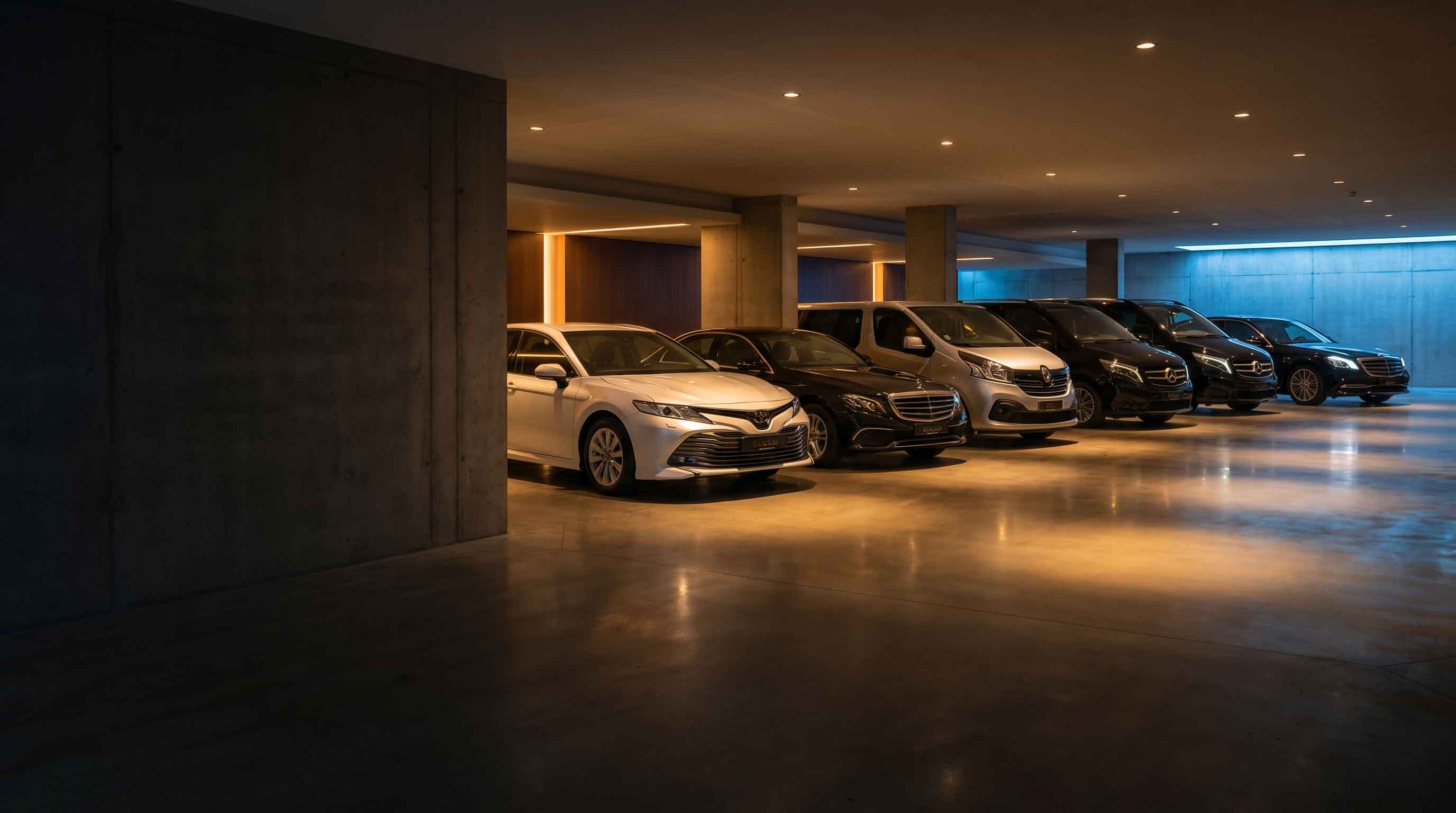
For a dress with volume, a long-wheelbase luxury saloon is one good answer and a van with a sliding door is the other. The sliding door is the underrated hero: you step in upright, the fabric is never dragged along a door edge, and the skirt has room. The practical technique, by the way, is to sit down first and then swing both legs in together. Put one leg in first and you buckle the hoop.
More things learned the hard way: no tape or suction mounts on paintwork that has gone soft in the heat, no confetti or petals inside because they lodge in leather seams, and always two large umbrellas in the boot. If children are in the party, settle the seating question in advance; we prepare that through our child seat service so that nobody improvises on the morning.
Timing buffers that hold
My rule of thumb: satnav time plus 30 percent, plus fixed dwell time for photos and boarding. For a group of ten in suits, dresses and with children, I budget five to eight minutes per stop purely for getting in and out. It sounds generous and is regularly not enough.
| Leg | Tuesday, March | Saturday, August | What goes wrong |
|---|---|---|---|
| Old town to Schloss Leopoldskron | 12 min | 20 min | Tight drive, little turning space |
| City to Schloss Hellbrunn | 15 min | 25 min | Trick fountain visitor traffic |
| City to St. Gilgen (B158) | 35 min | 60 to 75 min | Day-trip traffic, no overtaking |
| City to Mondsee (A1) | 35 min | 45 min | Thalgau exit, return traffic |
| City to Zell am See | 75 min | 100 min | A10 Friday afternoon, tunnel works |
And one rule I repeat constantly: put the buffer at the front, not the back. Standing outside the church fifteen minutes early is pleasant. Being fifteen minutes late at the Mirabell registry office means the next couple is already waiting.
Weather, winter and the things that break
Salzburg gets well over 1,200 millimetres of rain a year, and the local fine drizzle known as Schnürlregen tends to arrive exactly when photos on the Makartsteg were planned. In July and August, hot days build thunderstorms over the Untersberg from late afternoon that flood everything within twenty minutes. Plan B has to exist beforehand, not be invented on the back seat: a covered photo location, one extra stop, and a vehicle that gets close enough that there are not thirty metres of rain between door and portal.
Winter is a different animal. Between Hof and Fuschl the shaded sections ice up in the morning, and in January a mountain leg can add half an hour. We run appropriate tyres there year-round, and for mountain venues the same winter discipline applies as on our ski transfers. For guests arriving the day before, a properly planned airport transfer from Salzburg or Munich is the best way to keep arrival stress off the wedding day itself.
The run home after midnight
This is where good planning separates from bad. City public transport finishes around 23:00 on ordinary evenings, and night lines run only at weekends. Around Fuschlsee and Wolfgangsee it is effectively over by about 20:00. Finding a metered street taxi out there spontaneously at night is not realistic, and on an August Saturday it is fantasy.
What works: two or three pre-agreed return waves, typically 23:30, 01:00 and a final run whenever the party truly ends. Older guests and families with children take the first wave, which is fine because the room gets louder anyway. The driver waits on site, which matters, because dispatching from the city would double every waiting time. For the couple themselves we like to plan a separate, independent car, often as part of a private chauffeur service, so that your departure is not chained to the shuttle schedule.
If your guests are staying a few days anyway, a next-day excursion pays off, for example a Hallstatt tour from Salzburg, since hungover guests should not be driving themselves in the first place.
Put the schedule on one sheet of paper
In the end one document decides everything: time, pickup point with exact address, number of people, destination, and one contact phone number per vehicle. Not the bride, not the groom. A bridesmaid or the planner. We like to receive that plan four to six weeks ahead, drive the critical points if needed, and report back where the access does not work the way the map suggests.
If you are planning your wedding day in or around Salzburg, send us your running order, the venues and the guest count. We will look at the access, the timings and the seasonal traffic, and put together an individual proposal shaped around your day. The simplest route is our contact form.
Stefan Reiter — VPC Premium Transfer & Tours, Salzburg. Written first-hand: we drive these routes every day.
Frequently asked questions
How much timing buffer do I need between ceremony and reception in Salzburg?+
Take the satnav time and add 30 percent, then five to eight minutes per stop purely for a group in formal dress boarding and alighting. In the old town add walking time, since vehicles only reach Kapitelplatz or Herbert-von-Karajan-Platz. Put the buffer at the front: arriving early at the church is pleasant, arriving late at the Mirabell registry office is not, because the next couple is already waiting.
Can a full-size coach reach Salzburg's Schloss venues?+
Not everywhere. Schloss Mönchstein on the Mönchsberg is unsuitable for large vehicles because of the hill approach, and several Schloss driveways have narrow gateways, gravel and almost no turning space. For 40 to 70 guests, several vans running in shuttle waves are usually more practical and faster than one coach, because they get closer to the door and can work in waves.
How do guests get back to Salzburg from Fuschlsee or Wolfgangsee after midnight?+
Only with pre-booked vehicles. Regional public transport stops around 20:00 and city services around 23:00, with night lines at weekends only. Finding a metered street taxi spontaneously at the lakes after dark is not realistic. What works is two or three fixed return waves, for example 23:30 and 01:00 plus a final run, with the driver waiting on site rather than dispatching from town.
Which vehicle suits a wedding dress with a hooped skirt?+
A long-wheelbase luxury saloon or a van with a sliding door. The sliding door is the most practical answer, because you step in upright and the fabric is never dragged along a door edge. Sit down first, then swing both legs in together. Vintage cars look wonderful but usually have narrow apertures and no air conditioning, which turns unpleasant fast on a hot Salzburg afternoon.
Is a wedding during the Salzburg Festival a traffic problem?+
You need more time. From late July to the end of August the old town is markedly busier, access points and standing spaces are scarcer, and the B158 towards Fuschl and St. Gilgen takes 60 to 75 minutes on Saturdays instead of 35. Nothing is impossible, but pickup times should be more generous and any photo stops in the centre agreed in advance with the driver.
Should visiting guests rent a car?+
Usually not. Guests coming only for the wedding are calmer and better off taking the train to Salzburg Hauptbahnhof plus a single transfer. Old town parking is expensive, a day ticket in the Mönchsberg or Altstadt garage is roughly 20 to 26 euro, and the 10-day motorway vignette about 12 to 14 euro. Add the drink-driving limit of 0.5 per mille, and a rental car mostly sits in a garage.
When should I book wedding transport?+
For dates between May and October, and during Advent, book as early as you can, ideally six to nine months ahead, because summer Saturdays fill quickly. The detailed running order, with times, exact addresses, passenger numbers and one contact person per vehicle, should reach us four to six weeks before the day so we can check the tricky access points in advance.
Your fixed price in 60 seconds — we handle the rest.
Private Mercedes chauffeur, flight tracking included, pay by cash or card.