travel-guide
Skiing Near Salzburg Without a Rental Car: An Honest Field Guide
In most Salzburger Land resorts a hire car spends the week buried under snow. Our driver team explains how ski buses, lift-linked villages and short walks cover everything, and when a car genuinely earns its place.
We drive the routes between Salzburg Airport and the ski resorts of Salzburger Land year after year, often several times a day between December and April. One pattern repeats every season: a large share of guests who booked a hire car for their first trip cancel it for the second. Not out of principle, but because the car sat untouched in the hotel car park all week under twenty centimetres of fresh snow, while still costing money every single day.
This is not a blanket argument against cars. There are situations where a vehicle in resort genuinely helps, and we name them honestly further down. But for the typical ski week in Flachau, Zell am See, Obertauern, Saalbach or Bad Gastein the conclusion is clear: once you have arrived, you do not need your own vehicle.
Why a hire car underperforms in a ski week
An alpine winter rental is a different product from a summer Mediterranean rental. Three factors change the maths.
First, winter equipment. Austria applies situational winter tyre rules between 1 November and 15 April. Reputable rental desks at Salzburg Airport equip their fleet accordingly, but usually add a winter surcharge, commonly in the range of roughly 5 to 15 euros per day. Snow chains are charged separately, as is a ski rack where one is available at all.
Second, parking. If you stay in a village centre such as Zell am See or Bad Hofgastein, an underground garage or managed hotel space typically runs around 10 to 20 euros per night. Free valley-station car parks have become the exception in the larger areas and are full by nine in the morning on peak days.
Third, driving stress. Reaching a base station on a Saturday in February means convoy traffic, snow ploughs, closed pass roads and, at worst, a drive home in the dark on a freshly refrozen hairpin. After six hours on the slopes that is not a trivial task. And anyone who wants a glass of wine in the evening is out as a driver anyway.
The leg that actually matters: airport to valley
The real reason most guests book a car is the first leg. Salzburg is superbly placed as an arrival airport, but the resorts sit 50 to 100 kilometres away, and changing between train and bus with ski bags, helmet bags and children is nobody's idea of a holiday start.
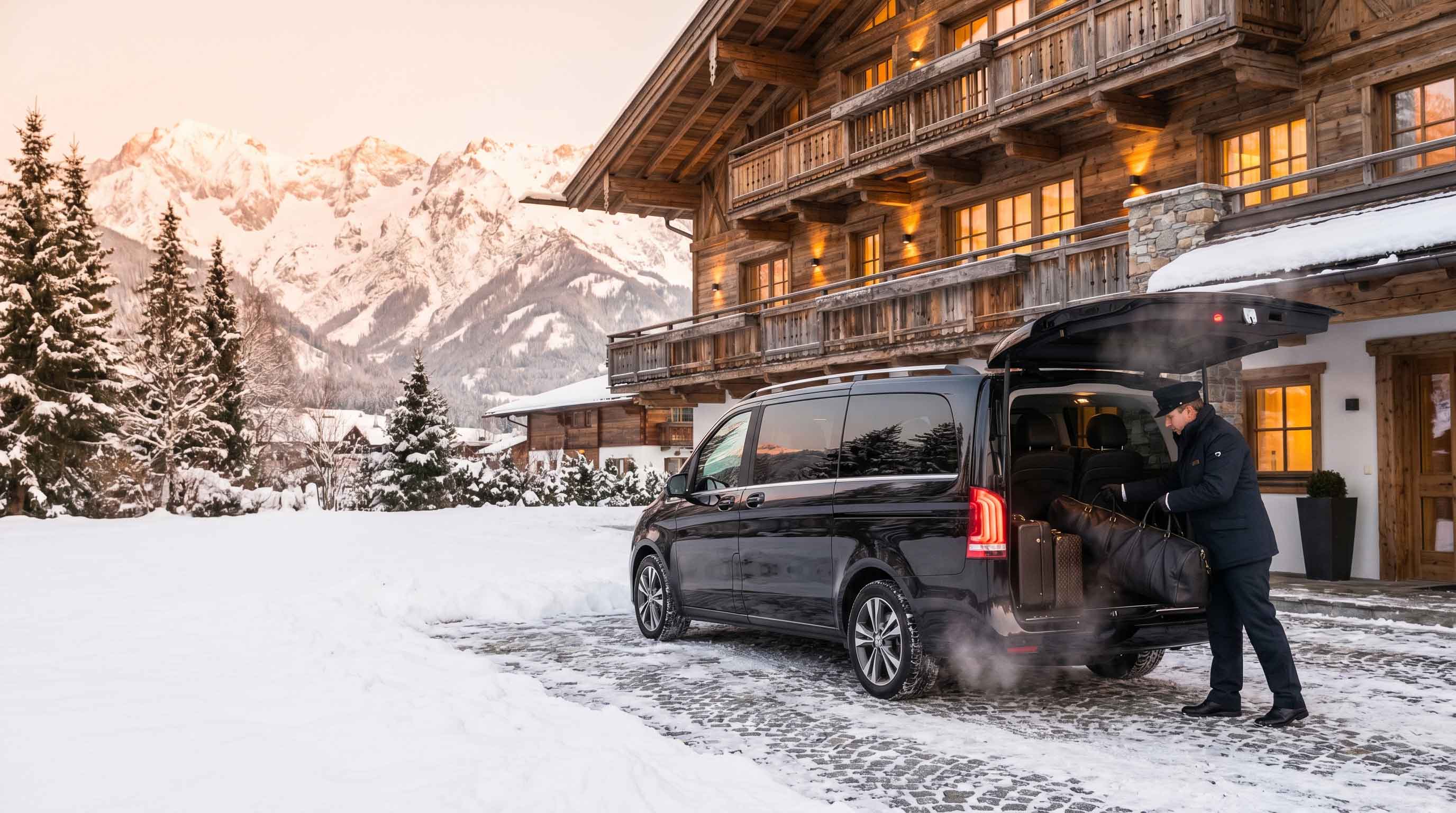
That single journey can be solved cleanly without tying yourself to a vehicle for seven days. A private transfer takes you and all your luggage directly to the door of your accommodation, in a vehicle with genuine volume for ski bags and with drivers who cross these passes in snowfall daily. Route-by-route detail is collected in our overview of ski transfers from Salzburg.
| Resort | Distance from Salzburg Airport | Winter driving time | Car needed in resort? |
|---|---|---|---|
| Flachau / Wagrain | approx. 75 km | approx. 60 to 75 minutes | No, dense ski bus network |
| Zell am See / Kaprun | approx. 90 km | approx. 80 to 95 minutes | No, bus and local railway |
| Obertauern | approx. 95 km | approx. 90 to 105 minutes | No, village sits inside the ski area |
| Saalbach Hinterglemm | approx. 95 km | approx. 85 to 100 minutes | No, valley bus every few minutes |
| Bad Gastein / Bad Hofgastein | approx. 100 km | approx. 90 to 110 minutes | No, bus plus S-Bahn in the valley |
These times come from live winter operations, not from navigation estimates on dry tarmac. On changeover Saturdays between eleven and three we always plan a buffer on top.
Getting around in resort: what genuinely works, area by area
Flachau, Wagrain and Salzburger Sportwelt
The Sportwelt is the strongest single argument against a hire car. The villages are linked by lifts and pistes, which means you change valley on skis rather than on the road. On top of that, a free ski bus runs at short intervals between village districts, base stations and hotels. Stay in Flachau and you can reach Wagrain, Alpendorf and Zauchensee without driving a metre. Arrival detail is on our Flachau transfer page.
Zell am See and Kaprun
This valley is more comfortable than most, because alongside the ski bus you also have the Pinzgau local railway and regular Postbus services. The guest card normally covers the bus between Zell am See, Kaprun and the Kitzsteinhorn. If you stay in Zell am See itself, the City Xpress and the town centre are usually a walk away. More on our Zell am See transfer page.
Obertauern
Obertauern is the case where even the ski bus becomes close to redundant. The village sits at 1,740 metres inside the ski area, with lifts starting effectively at hotel doorsteps. A car here is mainly an object you dig out every morning.
Saalbach Hinterglemm and Bad Gastein
Both are long, narrow valleys served by high-frequency bus routes, in Saalbach at times every five to ten minutes well into the evening. The Gastein valley adds the S-Bahn linking Dorfgastein, Bad Hofgastein and Bad Gastein, which in heavy snowfall is more reliable than any road.
Evenings out: where the car loses decisively
Floodlit tobogganing, dinner in a mountain hut, a concert in the next village. This is precisely where a hire car stops being freedom and becomes a constraint. Austria's drink-drive limit is 0.5, and enforcement in winter sports towns is consistent. Whoever drives, does not drink.
The alternatives are good. Night buses run until around 23:00 or later in most large resorts, many hotels operate their own shuttle to huts and restaurants, and for a trip into the city of Salzburg or an evening at one of the thermal spas you can book a vehicle with a driver for that occasion only. You pay for the journey you actually make instead of seven days of standing still.
When a car genuinely does help
In fairness, there are cases where we recommend a rental ourselves.
- Multiple valleys in one week. If you hold a Ski Alpin Card and plan to rotate between Schmittenhöhe, Kitzsteinhorn, Saalbach and Gastein, a vehicle beats any timetable for flexibility.
- Self-catering with a big shop. A chalet or apartment for eight means a weekly supermarket run in the valley town. Doable by bus, but tedious.
- Remote accommodation. Isolated farmhouses and mountain lodges off the bus route are hard to serve without a car or a dedicated hotel shuttle.
- Ski touring and freeriding. If you choose trailheads by the day depending on wind and snow, your own mobility is worth the cost.
For everything else, meaning the classic week in one resort with a ski bus and lift access, the hire car is an expensive parking-space placeholder.
Practical tips from our drivers
- Check before booking whether your accommodation's guest card includes the ski bus and regional transport. In most Salzburg resorts it does.
- Build a real buffer into your return transfer. In winter we suggest at least 30 to 45 minutes on top of pure driving time.
- Bring proper ski bags rather than loose skis. It protects your gear and the vehicle interior, and loading goes faster.
- Airlines typically charge roughly 40 to 70 euros each way for ski equipment. For a single week, compare that against renting locally, which is often cheaper and better matched to current snow conditions.
- If your flight is delayed, a private transfer with flight monitoring waits. A rental desk closes for the night.
- Do not plan around the very last ski bus. In winter, the second-to-last departure is the smarter choice.
Conclusion
For the large majority of ski weeks in Salzburger Land, the hire car is a reflex rather than a need. What you actually need is a reliable solution for two journeys: airport to accommodation and back, with luggage, in snow, on time. Everything in between is handled by the ski bus, the lift and a short walk.
If you are still choosing a resort, our overview of the ski resorts near Salzburg is the place to start. If the resort is already fixed, we are happy to plan the transfer with you, including flight monitoring, child seats and proper space for equipment. Send us your flight details and destination address and we will come back with a concrete proposal.
Stefan Reiter — VPC Premium Transfer & Tours, Salzburg. Written first-hand: we drive these routes every day.
Frequently asked questions
Do I really need a car for a ski holiday in Salzburger Land?+
In most resorts, no. Flachau, Wagrain, Obertauern, Saalbach, Zell am See and the Gastein valley all have ski buses that are free or covered by the guest card, plus lift-linked villages and short walks. A car mainly pays off if you plan to rotate between several valleys or have booked very remote accommodation.
How do I get from Salzburg Airport to the ski resorts?+
Most resorts lie 75 to 100 kilometres away, with winter driving times of roughly 60 to 110 minutes. Public transport works via Salzburg main station with a change in Bischofshofen, St. Johann or Zell am See, but it is laborious with ski luggage and children. A private transfer takes you and all your bags straight to the door.
Are ski buses free in the Salzburg ski areas?+
In most regions yes, either free outright or covered by your accommodation's guest card. In Zell am See, Kaprun and the Gastein valley regional buses and the railway are often included too. Ask when booking which card your property issues, as coverage varies from resort to resort.
What extra costs does a hire car bring in winter?+
Expect a winter tyre surcharge of roughly 5 to 15 euros per day, in-resort parking of around 10 to 20 euros per night, and possible extras for snow chains and a ski rack. Add fuel, plus the time spent digging out and de-icing on snowy mornings.
How do I get to huts or the next village in the evening without a car?+
In larger resorts night buses usually run until around 23:00 or later, and many hotels operate their own shuttles to restaurants and toboggan huts. For trips into Salzburg city or to a thermal spa you can book a vehicle with a driver for that evening only. With Austria's 0.5 drink-drive limit, that is the more relaxed option anyway.
Is it better to bring my own skis or rent locally?+
Airlines typically charge around 40 to 70 euros each way for ski equipment. For a single week, renting in resort is often cheaper and better matched to current snow conditions. If you ski on your own fitted setup, bring it and use a sturdy ski bag.
Your fixed price in 60 seconds — we handle the rest.
Private Mercedes chauffeur, flight tracking included, pay by cash or card.