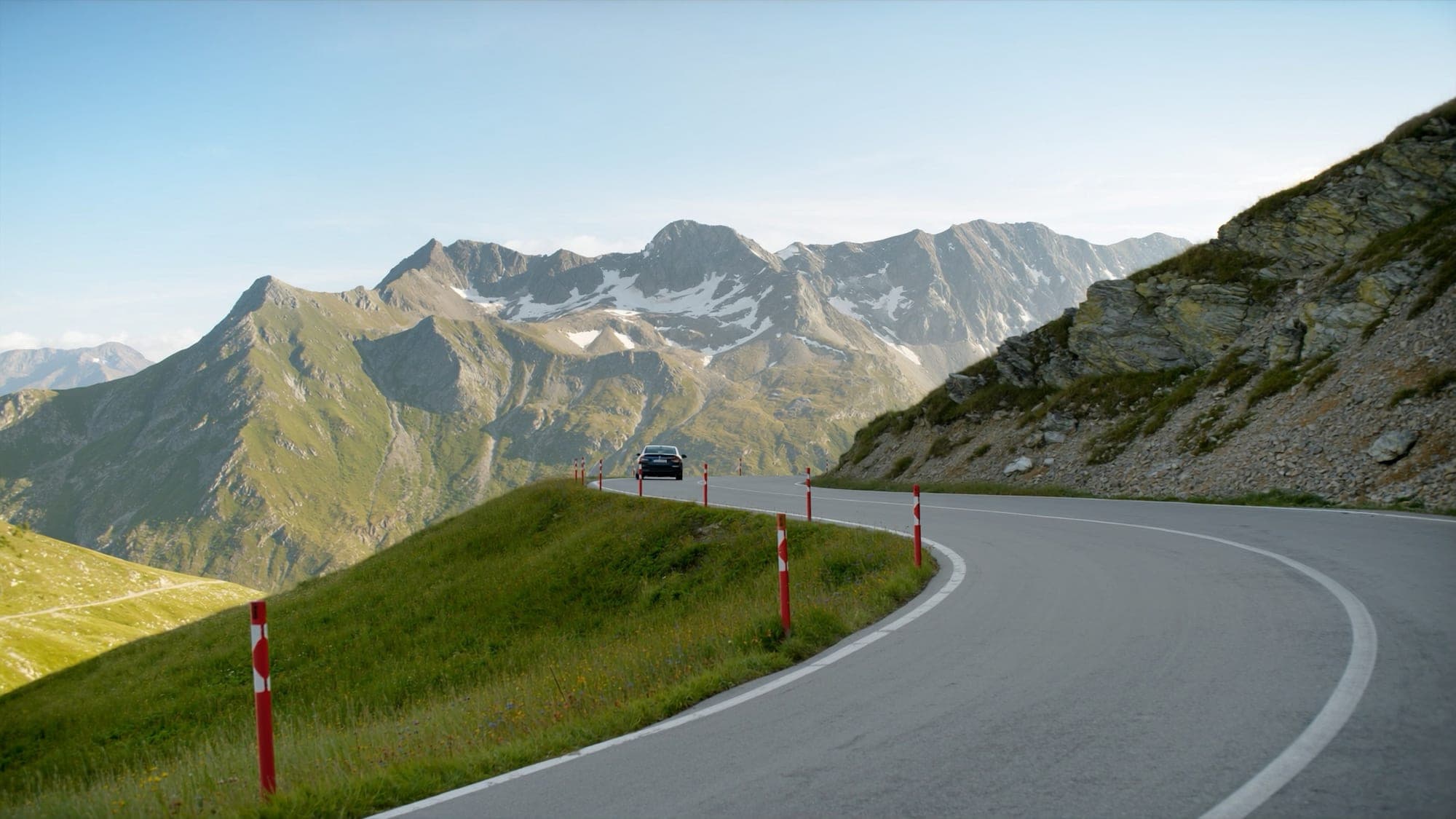
Salzburg to Zürich: the Alpine crossing over the Arlberg
Around 590 kilometres, three countries, one pass. Your chauffeur drives you up the Inn valley, under or over the Arlberg and down the Rhine valley to your door in Zürich. If the Arlberg is closed, we know the way via Munich and Lindau just as well.
- Over the Arlberg
- Plan B via Germany
- 5.5 to 6.5 hours
- Flat rate, no meter
Arlberg or Germany: two ways to Zürich
| Via the Arlberg (A12, S16, A14) | Via Germany (A8, A96, Lindau) | |
|---|---|---|
| Routing | Salzburg, the German corner near Rosenheim, Kufstein, Innsbruck, Landeck, Arlberg tunnel, Bludenz, Feldkirch, Liechtenstein or St. Margrethen, Zürich | Salzburg, A8 to Munich, A99 and A96 via Memmingen to Lindau, Pfänder tunnel at Bregenz, St. Margrethen, St. Gallen, Zürich |
| Distance | around 590 km | around 600 km |
| Pure driving time | 5 h 30 to 6 h 30, depending on weekday and weather | similar on paper, in practice usually 30 to 60 minutes longer because of the Munich ring |
| Scenery | Inn valley, Lechtal and Verwall Alps, Klostertal, Rhine valley: high mountains the whole way | Chiemsee, the Alpine foothills, Allgäu, Lake Constance at the end: gentler and more open |
| Borders | A short German stretch at the German corner, then Austria, Liechtenstein or straight into Switzerland | Austria, Germany, briefly Austria at Bregenz, Switzerland |
| Tolls | Austrian vignette, a separate section toll for the Arlberg tunnel, Swiss vignette | German motorways toll-free for cars, a short stretch on the Austrian vignette, Swiss vignette |
| Winter risk | Snowfall on the S16, chains on the pass road, Saturday queues from ski changeover | Far less altitude, but fog in the Allgäu and congestion around Munich |
| When we choose it | Our default whenever the tunnel and its approaches are open | During a tunnel closure, heavy snow on the Arlberg, or if you want to see Munich, Lindau or Lake Constance |
The route is set the evening before, not at the on-ramp
On most of our routes the choice of road is a formality. To Zürich it is the most important decision of the whole trip. The Arlberg is the bottleneck between Tyrol and Vorarlberg: the road tunnel is about 14 kilometres long, has a single bore with two-way traffic, and the only nearby alternative is the pass road over St. Christoph at 1,793 metres. When the tunnel closes for renovation, as it has for long stretches in recent years, or when fresh snow makes the pass road impassable, there is no sensible detour left on Austrian soil.
So the dispatcher checks the ASFINAG traffic reports, the avalanche danger level for the Arlberg area and the forecast for Landeck and the Klostertal on the evening before every Zürich run. On the morning of departure your chauffeur checks again. Both routes are identical as far as the Inntal junction near Rosenheim anyway, and that is where the final call is made: right towards Kufstein and the Arlberg, or straight on along the A8 to Munich.
None of this changes your flat rate or your pick-up time. We plan so that either variant fits the agreed time window. If we reroute, we tell you as you get in, with the reason and a new estimated arrival. And if you have a preference, perhaps because you want to see Lake Constance or drop someone in Lech on the way, we follow it as far as the road allows.
From the Salzach to the Limmat
 01
01Salzburg
Departure, kilometre 0
We collect you wherever you are: at your hotel in the old town, at a private address in Anif or Elsbethen, at the main railway station. For Zürich we recommend leaving between 7 and 9 am. That puts the Arlberg in the late morning, gets you into Zürich ahead of the evening rush at the Brüttisellen interchange, and leaves time for a proper lunch stop in Vorarlberg.
The first section is unremarkable but important: the A1 to the Walserberg border, then the A8 through Bavaria to the Inntal junction. These roughly 80 kilometres through Germany, known as the German corner, are the fastest way into Tyrol. There are intermittent police checks at the border near Kiefersfelden and Kufstein, so every passenger should keep an ID or passport to hand.
If you would rather avoid Germany altogether, we can stay inside Austria via Lofer and St. Johann in Tirol. It adds about half an hour but runs through the Saalach valley and past the Wilder Kaiser. Tell us when you book and that becomes the route.
 02
02Innsbruck and the Inn valley
approx. 1 h 45 from Salzburg
From Kufstein, its fortress towering over the Inn, the A12 Inn valley motorway begins. The valley narrows, the Nordkette range moves closer, and near Hall in Tirol you see Innsbruck for the first time. Roughly a third of the route now lies behind you. A first break can be a coffee in Innsbruck's old town, ten minutes from the motorway exit, or simply the service area if you prefer to save time.
The Inn valley is where the driving time is won or lost. On weekdays it usually runs calmly, lorries keep to the right lane and traffic flows. On winter Saturdays, however, the A12 is the main artery of the ski changeover: anyone heading west between 9 am and 2 pm meets the arrivals bound for the Zillertal, the Ötztal and the Arlberg. On those days our chauffeurs deliberately build in an extra hour.
Beyond Innsbruck the valley turns rural again. Telfs, Imst and finally Landeck, where the Inn swings south and the road starts to climb towards the Arlberg. If you want to know this first stage in more depth, our page on the Salzburg to Innsbruck route covers both variants in detail.
 03
03The Arlberg: St. Anton, tunnel or pass road
approx. 3 h from Salzburg
From Landeck the road becomes the S16 Arlberg expressway. It runs through the Stanzertal, past Pettneu and St. Jakob, until the tunnel portal appears just before St. Anton. Inside the tunnel overtaking is prohibited, the speed is limited, and with oncoming traffic in a single bore you drive with focus and no hurry. After about ten minutes you come back into daylight at Langen in the Klostertal, and you are in Vorarlberg.
In summer and in good weather, if you wish, we do not go through the mountain but over it. The B197 pass road branches off at St. Anton and climbs to St. Christoph, where the hospice has sheltered travellers for centuries. At the top are open alpine meadows, and to the north you look towards Stuben and the Flexen pass leading to Zürs and Lech. The detour costs about 20 minutes and is the finest moment of the whole drive.
In winter the Arlberg is a world-class ski destination, and you feel that on the road. St. Anton is packed on Saturdays, the pass road may require chains, and at high avalanche danger it is closed at short notice. If you want to stop in St. Anton, Zürs or Lech on the way, or drop luggage and fellow travellers there, we are happy to plan it in. For dedicated ski transfers from Salzburg, our ski transfers page is also worth a look.
 04
04Feldkirch
approx. 3 h 45 from Salzburg
From the Klostertal the A14 Rhine valley motorway runs past Bludenz down into the Walgau. You feel the descent, the mountains step back, and after roughly half an hour you reach Feldkirch, the medieval little town beneath the Schattenburg castle. For us Feldkirch is the natural lunch stop: the old town with its arcades is compact, the car parks are close, and after almost four hours in the car a walk does you good.
This is also where the second routing decision is made. Either across the Tisis and Schaanwald border into Liechtenstein and on to the Swiss A13, or further along the A14 towards Bregenz and into Switzerland at St. Margrethen. The Liechtenstein variant is more scenic and often quieter; the St. Margrethen variant has the faster motorway link to St. Gallen and Zürich.
An honest note: if all you want is to arrive quickly, we do not recommend stopping in Feldkirch but a short break at a service area instead. A leisurely lunch easily adds an hour to the journey. We go by what you want, and we tell you beforehand what it costs in time.
 05
05Liechtenstein or St. Gallen
approx. 4 h 15 from Salzburg
Crossing Liechtenstein from Schaanwald to the Rhine bridge takes only about 20 minutes. There is no border control in the usual sense between the principality and Switzerland, as the two countries form a customs union. Checks, if any, happen when you enter from Austria. In Vaduz the castle sits high above the little town on the hillside, and if you like you can have a coffee here or collect a souvenir stamp in your passport, a small ritual many of our guests enjoy.
Via Buchs or Sevelen you join the Swiss A13, which follows the Rhine north and meets the A1 at St. Margrethen. If you take the direct St. Margrethen route instead, you pass the motorway border crossing, where Swiss customs occasionally wave vehicles aside. Keep the duty-free allowances in mind, especially for meat, alcohol and larger purchases, since Switzerland is not part of the EU.
St. Gallen itself sits right on the A1 and is worth it if you have time: the abbey district with its baroque cathedral and famous abbey library is a UNESCO World Heritage site. For most guests, though, St. Gallen stays a name on the road sign, because from here Zürich is only a little over an hour away.
 06
06Zürich
Arrival after 5 h 30 to 6 h 30 driving
The final stage runs along the A1 via Wil and Winterthur into Zürich. The bottleneck is the Brüttisellen interchange, and from about 4 pm on weekdays it reliably grinds to a halt. That is why we time the departure from Salzburg for an early-afternoon arrival, or divert via Zürich Nord and the Milchbuck when the traffic data justifies it.
We take you straight to your destination: a hotel at the end of the Bahnhofstrasse, an office on Paradeplatz, an apartment on the Zürichberg or the lakeside towards Küsnacht and Kilchberg. Your chauffeur carries the luggage to reception and waits in case you need something else from the car. The city itself is organised into 30 km/h zones and one-way streets, but our drivers know them.
A note on scope: this page covers the drive into the city of Zürich and its region. If you are flying on from Zürich, all the airport details are on our separate page for Zürich Airport to Salzburg. And for the way back there is the reverse route, Zürich to Salzburg, which we often drive for business travellers.
The Arlberg between Tyrol and Vorarlberg
Tunnel portal near St. Anton, pass road over St. Christoph, exit at Langen in the Klostertal: this is where it is decided whether the drive to Zürich runs through Austria or via Germany.
Arlberg road tunnel and B197 pass road
Open pass, Lake Constance and a Liechtenstein detour
Between June and early October this route shows its most generous side. The pass road over St. Christoph is open, the meadows at the top are green, and instead of the tunnel we are happy to take the road over the mountain. Leave early and you see the Arlberg in clear morning light, before the motorcyclists who fill the passes of Vorarlberg and Tyrol on fine weekends.
Summer is also the season for the Lake Constance variant. Instead of heading from Feldkirch straight towards Switzerland, we follow the A14 to Bregenz, stop at the lakeside promenade or cross the short distance to Lindau with its harbour and the Bavarian lion at the entrance. From there we continue via St. Margrethen and St. Gallen to Zürich. Allow about an extra hour, depending on how long you stay.
A stop in Vaduz is just as popular, ideally around lunchtime. The principality is small enough that a coffee and a short stroll through the little town fit into three quarters of an hour, and the onward drive on the Swiss A13 along the Rhine is usually free of queues in summer.
To be honest, summer has its pitfalls too. On holiday weekends, especially at the start of the Bavarian and Baden-Württemberg summer holidays, traffic backs up around the German corner and at the Pfänder tunnel near Bregenz. Roadworks on the A12 and A14 tend to be scheduled for the summer months. On those days we leave earlier, or move your departure to a weekday if you are flexible.
What changes between November and April
In winter the panoramic route becomes a job for experienced drivers. These are the points we run through before every winter drive to Zürich.
Winter tyres and snow chains
In Austria the situational winter equipment rule applies from 1 November to 15 April. Our vehicles run on winter tyres throughout that period, with snow chains in the boot. Chains may be mandatory on the Arlberg pass road and on the Flexen pass to Lech and Zürs. The S16 expressway is cleared, but in heavy snowfall traffic still crawls behind the snowplough.
St. Anton, Lech and Zürs
The Arlberg is one of the great ski areas of the Alps, and many guests combine the drive to Zürich with a stay there. We drop you in St. Anton on the way, or drive via Stuben and the Flexen pass to Zürs and Lech when the road is open. At high avalanche danger the Flexen road is closed, and Lech and Zürs can then be cut off for a while.
Closures and the German fallback
If the Arlberg tunnel is closed or its approaches are blocked by accidents or snowfall, we drive via Munich, Memmingen and Lindau. That route is much lower and usually more reliable in winter, though we expect fog in the Allgäu and queues on the Munich ring. The call is made the evening before and confirmed in the morning.
Swiss motorway vignette
Every vehicle needs a vignette for Swiss motorways; the annual vignette costs around 40 Swiss francs and is now also available electronically. Our vehicles carry it, as well as the Austrian vignette. We pay the Arlberg tunnel toll on the way. You do not have to deal with any of it.
Saturdays in ski season
Saturday is changeover day in the ski resorts of Tyrol and Vorarlberg. Between Kufstein and St. Anton the journey can then take an hour or more longer. If you are flexible, travel on a Friday or Sunday. If not, we set off very early to reach the Arlberg ahead of the wave.
When the train is the better choice
The ÖBB Arlberg railway links Salzburg and Zürich directly in about five and a half hours. In heavy snowfall the train is often more reliable than any car. If you travel alone, with light luggage and no stop along the way, we honestly recommend the train. With family, ski equipment or a stop on the Arlberg, a chauffeur remains the more comfortable option.
What really goes wrong on this route
VPC Chauffeur-Team
Chauffeurs who regularly drive over the Arlberg to Zürich
The biggest delay on this route is rarely the Arlberg itself. It is the transitions before and after: the border checks near Kiefersfelden, which cost a quarter of an hour on some days, and at the other end the Brüttisellen interchange outside Zürich in the late afternoon. Leave Salzburg at 7 am and you usually avoid both.
Little happens in the tunnel itself, but when it does, it matters. An accident or breakdown in the single bore means an immediate closure, and traffic is diverted over the pass road. In summer that is a pleasant detour. In winter, with the pass closed or chains required, it can mean turning back to Landeck and going via Germany. We then call you or your assistant and tell you plainly how late it will be.
Our advice after many runs: plan a full travel day for Zürich, not half of one. Pure driving time is just over six hours, but with a lunch stop, a coffee in Innsbruck and the view from the pass, you are usually on the road for seven to eight hours. It is the kind of journey you do not regret when you give it the time.
Book Salzburg to Zürich at a flat rate
Our booking calculator shows your flat rate instantly, with vignettes and tunnel toll accounted for. For stops in St. Anton, Lech, Vaduz or at Lake Constance, simply send us an enquiry.
Questions about the drive from Salzburg to Zürich
Can't find your answer? Message us on WhatsApp – we typically reply within minutes.
WhatsAppHow long does the drive from Salzburg to Zürich take by car?+
Pure driving time for the roughly 590 kilometres is between 5 hours 30 and 6 hours 30 minutes. On winter Saturdays or with queues at the Brüttisellen interchange outside Zürich it can take longer. Including breaks, allow seven to eight hours.
Do you drive from Salzburg to Zürich via the Arlberg or via Germany?+
Our standard route runs via Innsbruck, the Arlberg tunnel and Feldkirch. We use the route via Munich and Lindau when the Arlberg is closed, in heavy snowfall, or if you want to see Lake Constance. We decide the evening before based on current traffic and weather.
What happens if the Arlberg tunnel is closed?+
During a closure we either take the pass road over St. Christoph, if it is open and safe, or the German fallback via Munich, Memmingen and Lindau. Your flat rate stays the same, and we let you know the expected arrival time in advance.
Do I need a Swiss vignette for the trip?+
No, not as a passenger. Our vehicles carry the Swiss motorway vignette and the Austrian vignette, and pay the Arlberg tunnel toll on the way. These costs are accounted for in the flat-rate calculation.
Which documents do I need for the borders into Germany, Liechtenstein and Switzerland?+
All countries on the route are in the Schengen area, but there are spot checks at the German border near Kufstein and at the Swiss border. Every passenger needs a valid passport or national ID card. As Switzerland is not in the EU, duty-free allowances for goods apply.
Can we stop in Innsbruck, St. Anton, Vaduz or at Lake Constance on the way?+
Yes. Short breaks are always possible. Longer stops such as lunch in Feldkirch, a detour to Lech or a halt at the Bregenz lakeside we are happy to plan in. Ideally send us an enquiry so we can factor in the time.
Is the train from Salzburg to Zürich an alternative?+
Yes, and for solo travellers with little luggage often a good one. The direct connection over the Arlberg railway takes about five and a half hours. A chauffeur is worth it above all for families and groups, with ski equipment, for stops along the way and for door-to-door travel.
Is the drive over the Arlberg safe in winter?+
With the right equipment and experience, yes. Our vehicles run on winter tyres and carry snow chains, and our chauffeurs know the route. At high avalanche danger or with the road closed we do not take chances but divert via Germany.
Which vehicle suits the long drive to Zürich?+
For one to three people we recommend the Mercedes E-Class; for families, groups and ski luggage the Mercedes V-Class with generous legroom and a large boot. All vehicles have Wi-Fi, water on board and child seats on request.
Related journeys and services
Zürich to Salzburg
The reverse direction as a calm long run for business travellers, with a workspace in the back.
→Salzburg to Innsbruck
The first stage of this route in detail: via the German corner or inside Austria.
→Zürich Airport to Salzburg
Terminal pick-up with name board and flight monitoring.
→Ski transfers from Salzburg
With ski luggage to the great winter resorts of the Alps.
→Mercedes V-Class
Plenty of room for families, groups and winter luggage on long routes.
→